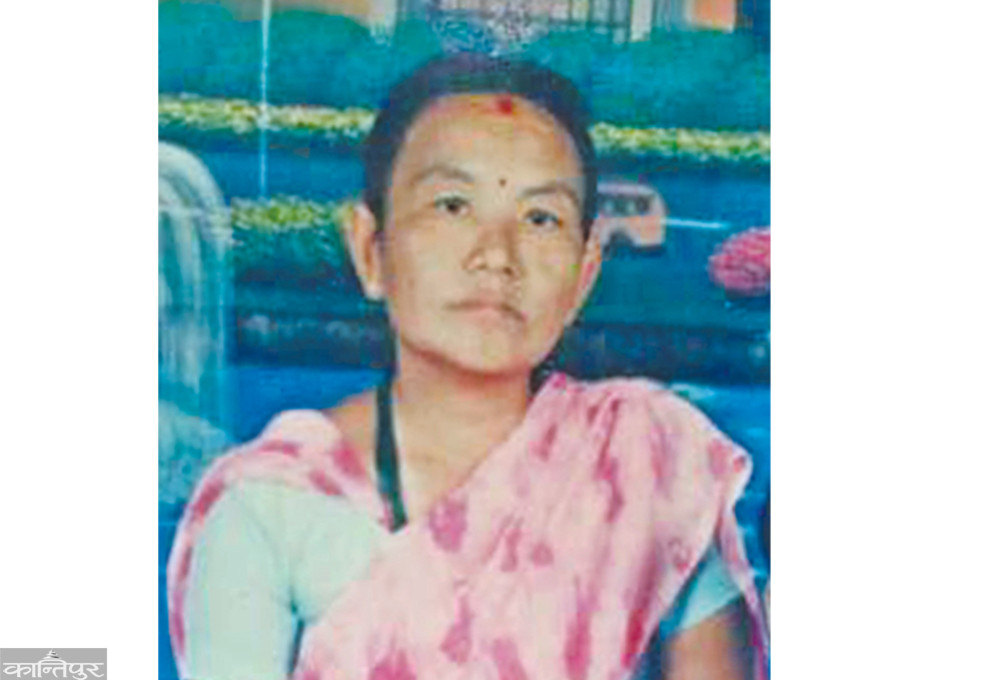
Rupandehi Saraswati, who came to Saudi Arabia as a domestic worker, was accused of murdering her employer, but after her stance that she was framed, the Supreme Court ordered to resume the judicial process of the case.
We use Google Cloud Translation Services. Google requires we provide the following disclaimer relating to use of this service:
This service may contain translations powered by Google. Google disclaims all warranties related to the translations, expressed or implied, including any warranties of accuracy, reliability, and any implied warranties of merchantability, fitness for a particular purpose, and noninfringement.
The judicial process of the case of Saraswati Gurung Ghimire of Rupandehi, who was sentenced to death by all three levels of courts in Saudi Arabia, has resumed. After the Supreme Court there ordered to hear the case of murder connected to Ghimire from zero point, the lower court of Saudi started hearing again. The lower court fixed January 26 as the third hearing date.
Ghimire, who came to Saudi capital Riyadh as a domestic worker (housemaid), was sentenced to death by the lower, high and supreme courts on the charge of murdering her employer Abdul Rahman Abdul Aziz Alaj Lan. Lan was murdered in his own residence on 23 August 2070. However, Ghimire has been maintaining the stand that she did not kill but was framed.
'The relationship between the owner and the owner was broken. On the day of the murder, a Saudi citizen wearing a mask entered the house. He locked me in the toilet. After two hours, they opened the toilet and stabbed my hand with a sharp knife. They kept that knife in my hand and locked it in the toilet again," she told the court and the Nepali Embassy, "I was trapped. I am innocent.' Ghimire has been telling that she is the victim of a dispute between the owner and the owner.
Damruballabh Paudel, the deputy head of the Nepali Embassy in Riyadh, said that the trial has started again after a petition was filed in the Supreme Court. We have also informed the Saudi Ministry of Foreign Affairs in writing about this. We met the Saudi Human Rights Commission and the governor and drew their attention," said Paudel, "Ghimire's lawyer also took the initiative. After the initiative of both parties, the Supreme Court has ordered a judicial hearing from scratch.'
The Nepali Embassy did not get the information even three years after the lower court sentenced Saraswati to death. The lower court had pronounced the death sentence on 24 November 2071. Then the High Court also upheld the same decision. On the other hand, even the family did not contact the embassy to search for Saraswati. The reason for this was that son Sunil and daughter Savitri, who were in Butwal, found the dead body of their mother Saraswati who came from Saudi Arabia in 2069 from Tribhuvan International Airport.
'In 7 months after arriving in Saudi Arabia, the body of the mother's name came. Along with the body was a handwritten passport with a photograph of the mother. The body was unrecognizable. The eyes were very dark. Cheeks were also wrinkled. Only the teeth were visible,'' son Sunil told Kantipur, 'we thought it was his mother's body. Cremation took place at Pashupati. We came to the village and did Kazkiriya.'
After 6 years, Sunil met his mother in Malaj prison in Saudi. I went to work in Saudi Arabia. The embassy says the woman with the same name as your mother is in jail. Is your mother or not? I got information that I had to go to see him,' he said, 'mother is in jail.'
The family is hoping that mother Saraswati, who has been imprisoned for 10 years, will be released. We lost our mother. What happened from where, found in jail. That too after receiving the death sentence,' said Sunil, 'he keeps calling from jail every now and then.' It has not yet been found out whose body was found in his mother's name.
The Supreme Court also upheld the verdict of death penalty pronounced by the lower and higher courts. The embassy staff and the lawyer on behalf of Saraswati appealed to the court saying that justice was not served by the Supreme Court's decision. The Supreme Court accepted that request and sent it to the appeals court to review the decision," said Paudel, the deputy head of the embassy. "Last May, the appeal formed a bench of five judges to hear the case."
On the day of the appeal bench, only four judges were present and debated the pros and cons of the case. On that day, the then ambassador Navraj Subedi, deputy chief Paudel and the staff of the embassy also participated in the courtroom. Subedi himself also argued the case in the Court of Appeal.
'whose murder is said to be. That person was much taller, fatter and stronger than Saraswati. It is not believable that Saraswati, who has a tall stature, killed a tall and strong person by stabbing him in the chest," Subedi said before the appeal, "Saraswati has been framed. She is innocent. The language interpreter during the initial court statement is not an expert in Nepali language. So the statement remained flawed.'
The opinion of that bench of appeals was divided. Two stood for the death penalty. Two stood in opposition. The judge, who was absent on the day of the trial, stood in favor of the death penalty while writing the verdict. Saraswati was found guilty by the 'review' of the appeal which was heard on the order of the Supreme Court. Again Saraswati, her lawyer and the embassy appeared against this decision. They again applied to the Supreme Court saying that it was unfair.
The Supreme Court ordered the lower court to start the judicial process from scratch. Son Sunil said that this order increased the hope of justice for Saraswati.
'Now mother is happy. Chances of acquittal have increased. Now there is a hope that he will come to Nepal soon," said Sunil. An influential Saudi law firm has also been appointed on Saraswati's side. Women sentenced in Riyadh's Malaj prison have collected donations to bring justice to Saraswati. "The lawyer has not asked us for a service fee," said Poudel.