Two-thirds is mandatory for the amendment of the constitution, and the government should not be with other parties even to make laws
We use Google Cloud Translation Services. Google requires we provide the following disclaimer relating to use of this service:
This service may contain translations powered by Google. Google disclaims all warranties related to the translations, expressed or implied, including any warranties of accuracy, reliability, and any implied warranties of merchantability, fitness for a particular purpose, and noninfringement.
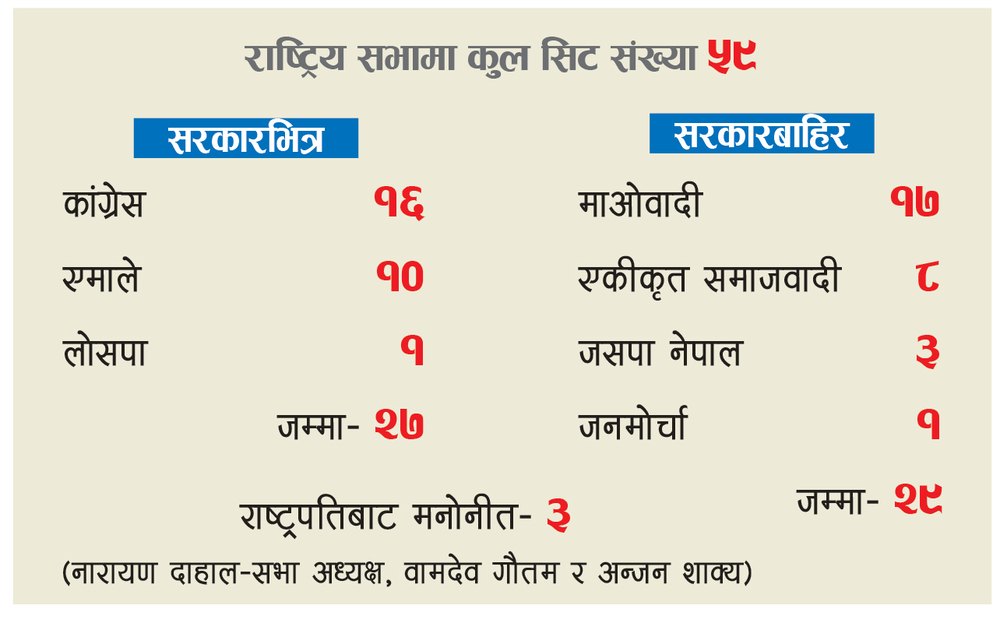
The KP Sharma Oli-led government, which has the support of two-thirds of MPs in the House of Representatives, is finding it difficult to get a simple majority in the upper house, the National Assembly. In the 59-member National Assembly, which requires 30 MPs for a majority and 40 MPs for a two-thirds vote, both Congress and UML have only 26 MPs.
Since there is no general majority in the upper house, there is also a problem for the Oli government to introduce laws of its own accord or to pass the ordinances that have been introduced now. For a majority, the ruling party must support the MPs nominated by the President or the opposition party. Another two-thirds majority is required for constitutional amendment. The National Assembly must understand this arithmetic, Oli has expressed that the amendment of the constitution will only happen in 2087.
The largest party in the National Assembly is the Maoists. It has 17 MPs. There are 16 from Congress and 10 from UML. There are 8 members of United Samajwadi Party, 3 members of Jaspa Nepal, 1 member of LOSPA and 1 member of Jan Morcha. The number of members nominated by the President is 3. Among the 3 nominees, Narayan Dahal is the Speaker. Another nominee, Vamdev Gautam, is close to the United Socialist Party, while Anjan Shakya is from the UML. Therefore, even if the Congress-UML alliance gets one more vote from the nominee, it has to get three more people for the majority.
There is only one MP in the National Assembly from LOSPA, another party participating in the government. Jaspa Nepal has supported the government. But because of the government's preparation to increase the 'threshold' towards proportionality in the House of Representatives and the State Assembly, dissatisfaction has started to be seen in JSP Nepal and LOSPA. The Madhesh-centric parties have already started the practice of front banding to prevent the 'threshold' from increasing.
Gopi Bahadur Sarki Achami, chief whip of the opposition party Maoist in the Upper House, says, "Congress and UML are not in a position to go through the National Assembly with the strength of the majority."
Congress and UML, the two biggest parties in the parliament, made the amendment of the constitution a major agenda when they formed an alliance last June 17. On the strength of the same agenda, they have agreed to cooperate until the 2084 elections, according to which UML president KP Sharma Oli will lead the government for two years and then Congress president Sher Bahadur Deuba until the general elections in November 2084. But after Oli expressed that the amendment of the constitution will not happen immediately, the justification of the alliance has been questioned.
Oli said in the UML central committee meeting held on December 21-23 that the constitution amendment will be done only in 2087. While the two parties have said that this alliance will only last until the 2084 general elections. Congress leaders from Shekhar Koirala, Arjun Narsingh KC to NP Saud have already given a public response that Oli's statement has ended the rationale of the alliance.
On the other hand, even after six months of forming the government, the issue of constitutional amendment has not been brought up in the procedural debate. It does not seem that there is a serious discussion between the coalition parties for amending the constitution.
UML's chief whip in the National Assembly, Bhagwati Nyupane, says that Prime Minister Oli may have expressed that it would be difficult to amend the constitution immediately by looking at the accounts within the parliament. She mentioned that without the support of the opposition party in the upper house, the required two-thirds of the constitutional amendment cannot be reached.
"Prime Minister Oli said in a joking manner about the Constitution Amendment 2087 in the party meeting," she said, "However, neither he nor the party has any intention of pushing the issue of the Constitution Amendment." Before the election of 2084, the necessary amendments are made to the constitution.'
should be approved by the majority of the provincial assembly if it is a matter of provincial boundaries and rights. The Constitution can be amended only if it is passed by a majority of at least two-thirds of the total number of members immediately existing in both the House of Representatives and the National Assembly on matters that do not require the consent of the Provincial Assembly. On July 6, Prime Minister Oli received a two-thirds vote of confidence in the House of Representatives. If it can be maintained, the government can pass the constitution amendment agenda from the House of Representatives.
The 6-year tenure of 19 members of the National Assembly is ending on February 20, 2082. UML has the highest number of 8 people whose terms will expire next year. Apart from this, the term of office of 7 members of Maoist, 1/1 member of United Socialist Party, LOSPA and JSP will expire. The term of Vamdev Gautam, nominated by the President, will also be completed next year.
19 new members will enter the National Assembly from February 21, 2082 by election in 18 seats and one nominated by the President. At that time, the arithmetic of the National Assembly was different from now. But even then, Congress-UML will not reach two-thirds.
UML has a challenge to retain its 8 seats and win more seats. UML's chief whip Bhagwati Neupane says that if the Congress and UML go to the polls with an alliance, the ruling party can win all the 18 seats to be elected next year and the government will recommend one seat to be nominated by the President. "If all 19 seats are won by Congress and UML, we will be in a comfortable position," she said. However, even then, reaching two-thirds ie 40 seats is not possible without the support of Upendra Yadav-led Jaspa Nepal.
If the Maoists and the Unified Socialists in the opposition win one seat, it will be difficult for the government to reach two-thirds even with the support of Jaspa Nepal. As Maoist chairman Pushpa Kamal Dahal is reviving the opposition Samajwadi Front, there is also a possibility that Yadav will join it again. If 20 members change from the 2084 election, the Congress and UML can make up two-thirds of the National Assembly. But until then, the alliance of Congress and UML is not certain to continue.
Krishna Bahadur Rokaya, chief whip of the Congress in the National Assembly, says that it is best to seek the agreement of all parties as much as possible on the amendment of the constitution. The two big parties have formed an alliance by making constitutional amendment the main agenda. It is a question about the legitimacy of the coalition government to say that the Prime Minister will amend the constitution in 2087,' he said He says.
Congress National Assembly member Anand Prasad Dhungana says that since there is talk of amendment based on the constitutional provision that the constitution can be reviewed in 10 years, it should be done with everyone's support. "Majority is not a matter of minority, the review of the constitution obtained by 95 percent of votes should be the same," he said, "for this, within the party, inter-party and then the parties as a whole will sit and find a consensus."
Narayankaji Shrestha, leader of the opposition Maoist party in the National Assembly, comments that the Congress and UML have talked about amending the constitution to show the legitimacy of the alliance. "Why did the two big parties campaign to amend the constitution instead of forming a government? The reason for that is over," he said, "They may have talked about 2087 even though the amendment they thought was not possible."

