The women of the land movement are still without land rights, most of their cases are on the streets, but they are not desperate, they have not lost courage, they say, ”One day, how can we not get justice?”
We use Google Cloud Translation Services. Google requires we provide the following disclaimer relating to use of this service:
This service may contain translations powered by Google. Google disclaims all warranties related to the translations, expressed or implied, including any warranties of accuracy, reliability, and any implied warranties of merchantability, fitness for a particular purpose, and noninfringement.
If you look at the lifestyle and style of women active in the Birta movement, it can be seen that their dreams were born on the banks of Betravati and died there. They are living outside the capital, they are always deprived of basic human rights. After many years, the women of the land movement are still without land rights.
Not without some achievements, but most of his cases are on the road. They are not desperate, they are not discouraged. They say, 'One day, how was justice not found?'
The conclusion of the conversation of Rasuwa-Nuwakot Birta land-dependent women who participated in the land movement was that not having land in one's name means being empty in one's life. That woman had a terrible complaint - about the incumbent, the leader who kept on giving assurances and never looked back after winning the election. It seemed that they have an everlasting commitment to the land movement.
If you look at the past of the women's movement, you will come across many 'portraits' of protestors and warriors. Ever since the battle of Nalapani, women were on the front lines of the battle along with men. Recorded in the history of the movement are Yogamaya, Divya Koirala, Nona Koirala, Rammaya Pode, Revantakumari Acharya, Mangaladevi Singh, Sahana Pradhans, who were in street struggle against autocratic regime. Women also had an important role in the public movement of 062/63.
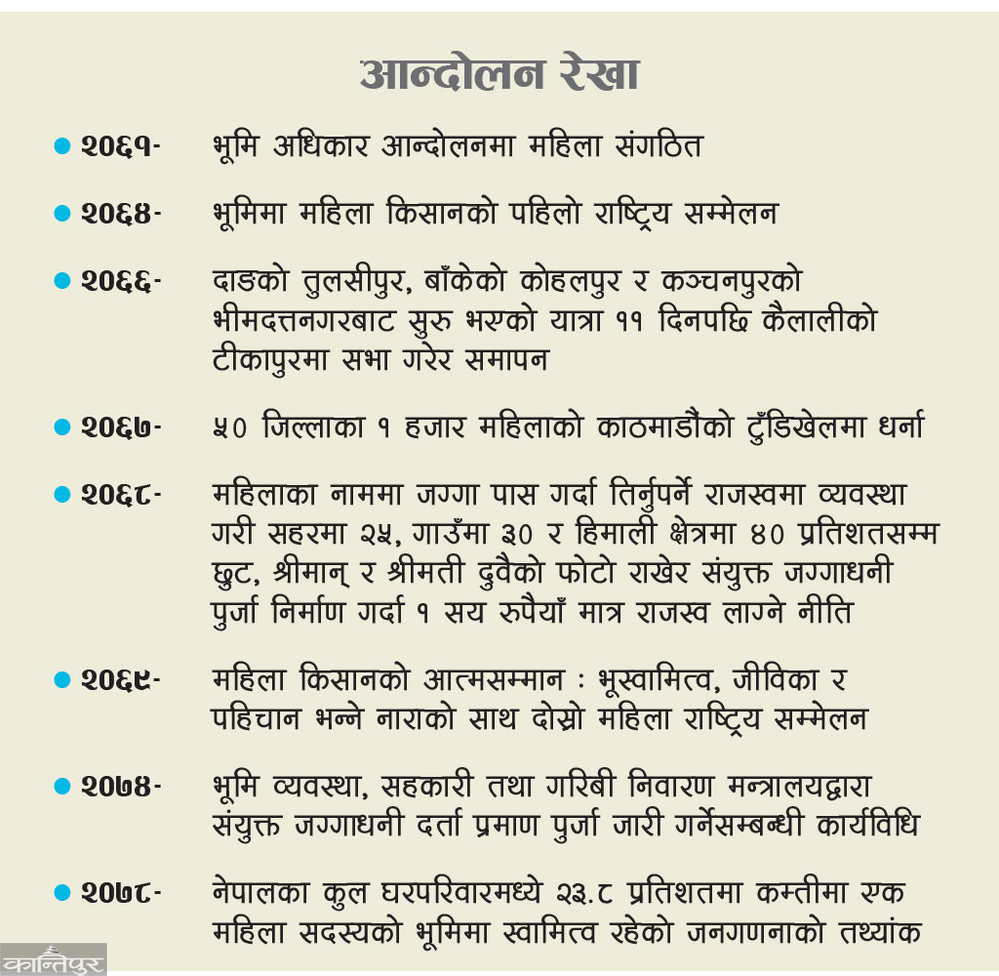
In Nepal, especially after 2007, there were various land-related movements. Some movements succeeded, some did not. And, the movement is still ongoing in various forms. Some are tired of the movement, some are still hopeful. Those who are tired say that no matter how much they jump and shout, the power that turns a deaf ear does not hear anything. The optimists say - after saying it many times, the government will not listen to us one day!
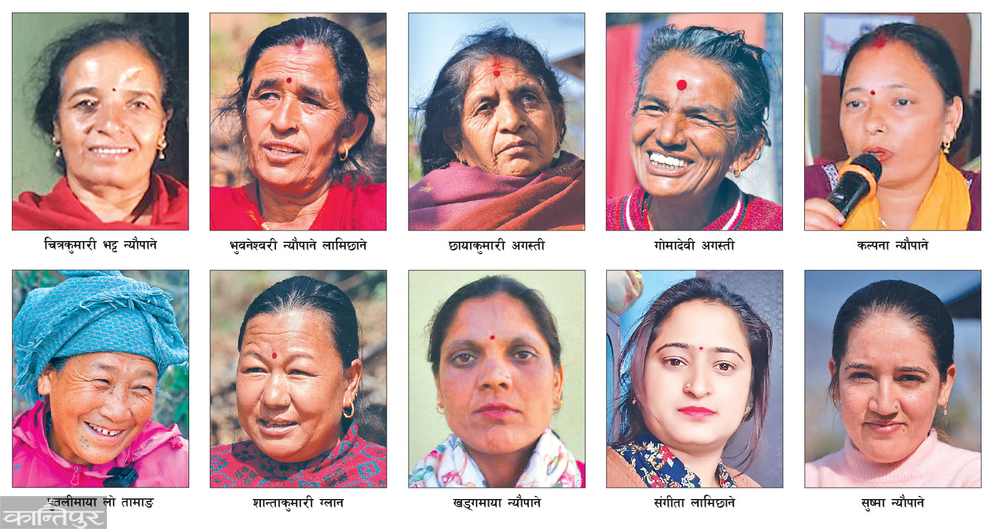
Women are at the front line of the socio-political movement in Nepal from time to time, or let's say they have a leading role. Like Rasuwa and Nuwakot, women were at the forefront of the Birta movement. He had little success. Those women who stuck to the street-struggle have created a high history of the movement. In fact, they are agitating for the right to be human.
According to anthropologist Suresh Dhakal, the rights movement is also a class movement, so the participation of all victims, men and women, is important. "Whether it is Birta Kisan's movement or any land rights movement, it is a continuous process and it expects continuity," says Dhakal. If the fact that all types of land rights are also basic human rights cannot be established, the movement will be disrupted by politics.'
After the change of 2007, Nepalese came out of the big prison of autocratic military regime. However, the farmers of Rasuwa and Nuwakot have been imprisoned in Birta jail for decades.
...
The farmers of Rasuwa have been protesting for years to get rid of the ghost of Birta, which has been legally abolished but is haunting the farmers. Homin certainly didn't have it easy in the struggle. For women confined to Chulochou and farming, leaving behind their children and belongings, and embarking on the movement was like traveling to Bhir.
It was a challenging task for women who did not get the right even to their father's and husband's property, going out on the streets and shouting slogans, sitting on open platforms and dharna at government offices day and night, demanding the red portion of the land. After hearing the words of these protesting women found in Rasuwa-Nuwakot, it seems that their life graph is full of struggle, where the warm sun of happiness has never shone.
Kalika-2, Chitrakumari Bhatt, a victim of Garaghar, is a warrior of Neupane land movement. He could not read, his childhood was spent cutting grass, shepherding goats and fairs. Married to Dhruva Prasad Neupane at the age of 17. His father-in-law still remembers the scene of his father-in-law tightening the rope, breaking the stones, making the field by breaking the soil and lifting the silt in the landslide. Later, she came to know that the soil with the sweat of the father-in-law's father-in-law was in the name of the king's relative, Birtarwala.
3 sons were born to Chitrakumari. Both the husband's kidneys failed. They rushed to hospitals from Nepal to India for treatment, but life only added to despair. Chitrakumari's husband died after 12 years of marriage.
My world has become dark. I could not tell the difference between day and night. The days of sorrow and pain became more and more intense. How much mental torture had to endure! The humiliation of not having a husband was unbearable. The household and village priests did not allow me to participate in auspicious activities,'' she said, looking at the yellow sun setting in the sky, 'only loneliness and darkness in the world seemed like my own. I would cry, talk to the wind and the plants.' Later she separated from her mother-in-law. She built a house with the help of mother-in-law, starved herself for several days, and kept her sons hungry. But she did not lose heart. She sadly sent her sons to school.
Gradually Chitrakumari joined the land movement. After managing all the housework, fairs, she started reaching the meeting. She turns red even when she mentions her name. Even the heart of a hard man who listens to his words melts, but why those in power never melt!
She became the president of Bhoomi Adhikar Manch, Rasuwa. Under his leadership, the farmers in a large line sat on a dharna for 7 days at Malpot in June 2071, demanding the abolition of Birtar and Guthi. Chitrakumari became a member of the district coordination committee from the local level elections of 2074. In the year 2071, she was also nominated as a district member of the Squatter Problem Solution Commission. "All this is the gift of the movement," she says, "It is painful to remember the struggle for the cancellation of the birth."
His question is - if the leader wants the law, all the laws can be changed, why can't we take the red part of the place that has been abolished?
...
Putlimaya Lo of Rasuwa Kalika-5, Janglang is an active leader of Tamang District Land Rights Forum. As she was a daughter, she did not get to study at a young age. Once when he went to school without knowing at home, the family did not allow him to eat three meals. At the age of 15, she was married off, to which she did not consent. After the
, at the age of 18, she got married again to Kaziman Tamang from Dhaibung. He has a family of eight including five daughters and one son. The cultivation of one's own land is enough to feed the family. Kajiman Jami works and Putlimaya is a farmer. From
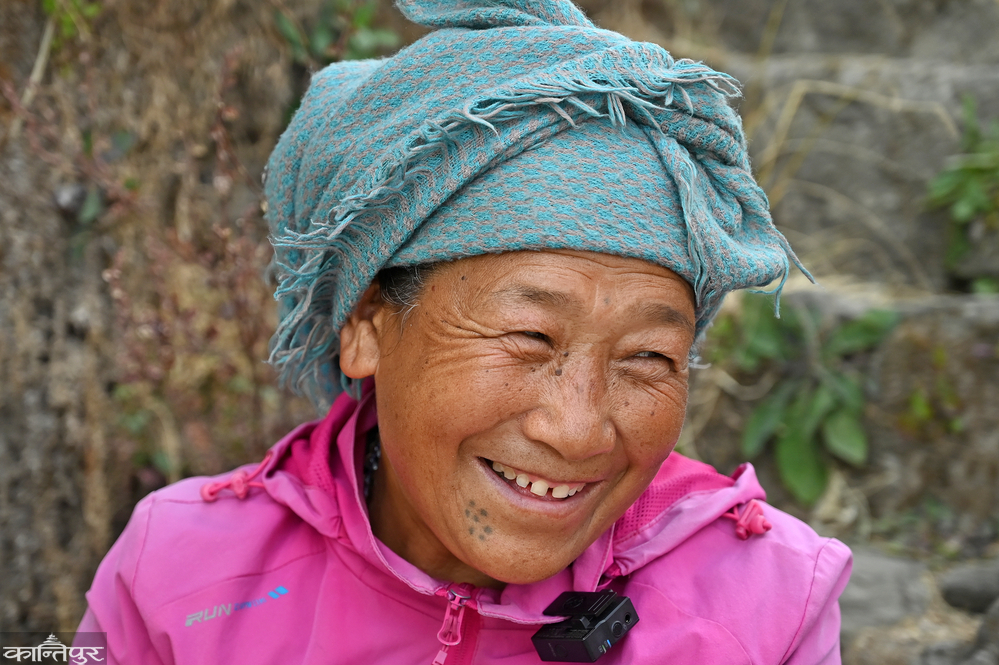
063, Putlimaya joined the land rights movement. Now she confidently keeps her word even with the Minister-Prime Minister. The slogans used in the movement are memorized. During the land rights movement of 2064, he cut corn and arubakha day and night, and in the 2067 Chaita movement, he pitched a tent on the open platform for 9 days The memory keeps coming to his memory.
Reminiscing about the early days of the movement, Putlimaya says, wiping away the wrinkles on her face, "In the beginning, the villagers laughed at her when she went on the campaign. The householders also said that they walked to avoid work. He used to make fun of them instead of taking the spare part.'
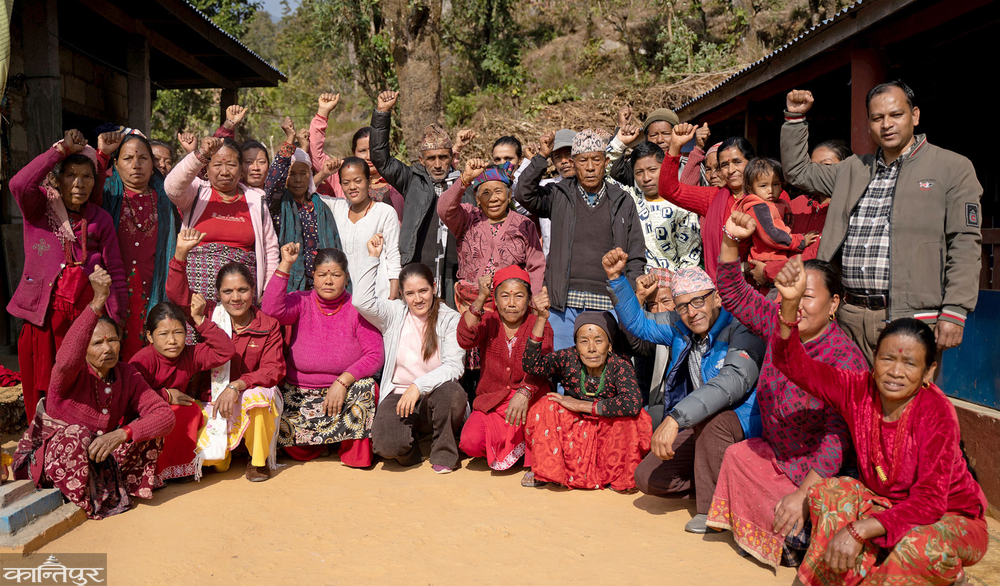
Due to their long struggle, 168 farmers have received Lalpurja. Putlimaya is also one of those who got land that way. She says, 'My 4 plants have become part of the farm. Now there is no worry that the land will be taken away. It has added strength to the struggle.' Now his eyes are full of dreams - May all the victims be saved.
...
During those days of Bhumi movement, she used to shout slogans while bulging her neck veins. His desire was another. Writer and activist Sushma Neupane learned a lot from those turbulent days. She thinks that the road of movement is her school. She has been an agitator since she was a teenager, who joined the Bhoomi movement after her aggrieved father, Bhawani Prasad Neupane. The slogan echoing in the streets was –
Women in the movement wanted land first
We shed blood and sweat, what did we get in return?
Break the feudal system, take back the parts of the trap
Our slogan, our vote, forget the promise, hurt
Break the land, rake, rake, rake...
Too much winter, rain slogan Passed by. Nowadays, he feels that his rights and expectations have never been fulfilled.
For Sushma, perhaps the Bhoomi Andolan is not a flood of rain, but a flowing river. In 2006, it was decided by the Council of Ministers meeting that the farmers who had tilled land under 'B' can register it in their own name, which was a partial achievement of their movement. Had to struggle a lot to get parts. The farmer had to submit an application with proof. The old papers were destroyed. Some of them found the receipts, temporary visas, citizenships that they submitted, some did not even have that.
Next year, in the cold of December, Sushma stayed in Dhunche for about 1 month and took down the field book of all the victims. She went from village to village to make recommendations from the local body and collect the village surgimin muchulka. That was not enough, he had to go to Kathmandu to settle the deadline of Birtawala. These agitators of the new generation did not know the whereabouts of the Birtawalas.
So for 28 days she wandered the cold and dark streets of Kathmandu with five others (Bhavani, Vishwas, Sangeeta, Hem and Khil Prasad). . One is that we are village people, we didn't know the roads and directions of Kathmandu, it was difficult to eat and live and pay the fare. Sometimes he lost his way. Sometimes a dog chased him in the street and ran away.'
Posting the deadline at the address of Birtarwala, without visiting the house, putting the deadline at the respective ward office and bringing a copy of the signature that they understood was the work of Mahaharani. But she continued to walk the path of dreams that bring happiness to the face of farmers. After receiving the letter from Mayad Tameli, he went directly to Malpot, stayed at the headquarters for a long time, collected documents from the field, and helped the farmers to maintain their records.
Sushma says, 'Some within the movement got land, and for a while there was happiness. Added excitement. However, many farmers were again deprived of getting red parts. Most of the petitions were dismissed without taking any action by the Landlord, the reason was that the red parts of the plowed land had been taken away by the farmers without the knowledge of the farmers.
40 women from Rasuwa came to Kathmandu. Everyone had a bag - a plate, a glass, a cloth and a straw. Even those who could not come to the movement sent dal, rice, salt, oil and potatoes. At that time, 1000 women from more than 50 districts of the country gathered - in 2067 Chait. They pitched tents on the open platform. Through rallies, processions, sit-ins, they expressed their pain to the ruling party, made demands, reminded the leaders of their assurances and promises.
One day there was a great wind and rain with hail, the tents were torn. Everyone had their share. After slowly recovering, he went to the hall of Bhrikutimandapa and spent a cold night. On the ninth day, a deal was struck. Everyone returned home. In the same few months, the government introduced a policy of becoming a joint Lalpurja for 100 rupees to ensure women's rights to land. A provision was also made to give a discount of 25 to 50 percent depending on the location on the fees charged for transferring land in the name of women. After that, 887 couples made joint Lalpurja in Rasuwa with Sushma's activism.
On June 3, 2071, about 300 farmers from the villages carrying pulses, rice, salted oil, vegetables, utensils, cloths, harrows, hoes, spades and shovels reached the Malpot office and sat on a sit-in. The demand was - the land should be reclaimed, the Guthi problem should be solved. On the seventh day of the
movement, an agreement was reached with the government. The government also promised to solve the problem soon. But after a decade of agreement, no solution was reached. Sushma is fed up - seeing the government. The government, which cannot give land rights to those who live on the soil, and protect those who live with paper by taking advantage of power and structural advantages.
...
The baton charge of the police, Nildam, tears and screams! This is the memory of the cold road of the land movement that he walked, the imagination of Nuwakot Vidur. Therefore, whether it is a rainy night or a full moon, he sometimes has convulsions in his dreams.
Those days of dharna in Malpot, Napi, district administration all day long in 071 are still in his memory. We used to rally on the streets with slogans. The house was on the road. We used to cook lentils and rice collected from the village and eat them on the roadside. During peaceful protests, the police used to lathi-charge, and there were clashes,” she said. She was treated for 15 days at the University Teaching Hospital in Kathmandu after her body became swollen due to police beating. She added, 'The memory of the misery and pain is on the one hand, even more sad is the fact that the demands of the movement are not fulfilled.' His photo carrying a plow was printed in the first part of "Birtako Vyatha" in "Kantipur". The photo was taken by photojournalist Kiran Pandey. She participated in the landless women's movement that lasted from 1 to 8 March 2067. She sat on a sit-in at the Kathmandu Open Forum.
After that old photo was printed, she went back to those days. The photo reminded me of the past. I had a vivid memory of walking around hungry carrying a basket on my leg," Sangeeta said. "Our small farm was also empty. That's why I joined the movement. How much time has passed without getting rights while walking in the movement, how much time has passed. How long will the movement last?'
...
Shanthakumari Glan of Uttar Gaya-4 Manigaon has been dedicated to the movement for 17 years. With the desire to get Lalpurja of Birtar, she started the movement to get land rights. He has some satisfaction that there have been achievements after the movement. She says, "After protesting for years, we took the remaining three parts of the registration exemption. The rest of the land is vacant.'
Kalika-3 Khadgmaya Nyupane of Katunje joined the land rights movement from 2066. By participating in the movement, his family got Lalpurja of about 13 ropani land, 3 ropani land was taken away by Birtawal. I went to Kathmandu and Dhunche dharna. I am a single woman. It is not easy to walk in the movement, but I am walking.'
Bhubaneswari Neupane Lamichhane of Garaghar, Kalika-2, has been involved in land movement for 15 years. His mother's farm was also completely empty. After getting married, she came to know that the home farm was still in the field. She says, 'It is very painful not to have the plowed land in your name.'
Birta participated in the movement many times, Kalika-3, Gomadevi Agasti of Betini. When the leaders come to ask for votes during the election, everyone says they will provide red parts, but no one has brought them. We would have been very happy to get Lalpurja,” she says. Husband passed away early. There is not even a piece of land in the name of the family. She has also brought electricity to the house in someone else's name.
Agasti, a housewife from Betini, kept crying while narrating the story of how she walked many times in the Birta movement. Birtawal's land is plowed with sorrow throughout his life. We went on a protest to get the spare parts, but we have not been able to get the spare parts till today," she said. Even when the last stage of his life is about to come, he is very sad that he cannot give the land to his sons as a share. She sighs, "Now I have gradually lost hope." Her tears flowing down her cheeks and falling on the floor indicate that citizens are forced to live in the darkness of despair without getting even the most basic fundamental rights and human rights.
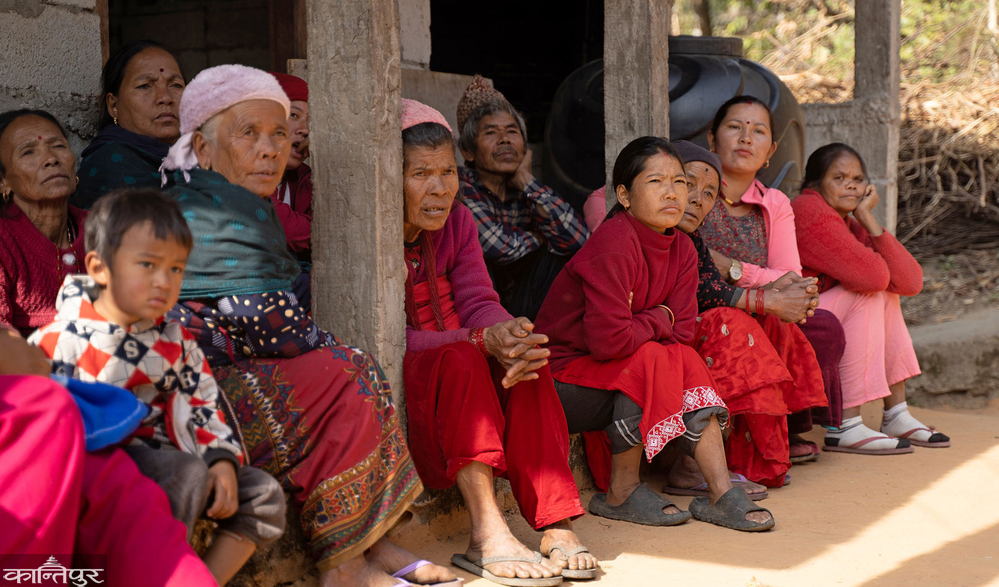 Chhaya Kumari Agasti's story is the same. Remembering the days when she walked in the movement, she kept repeating the same thing, "My family does not have a single piece of land, even the house they are living in is empty." How much will you walk in the movement now?'
...
In the book 'Bhuiyan' (2074), author Yagyash has written the life story of some representative women who joined the land movement in Nepal. He met that woman in 2070. And only a few of them have achieved success after the movement. In Yagyasha's opinion, he has protested only for a very simple life and little self-respect, which is the human right of the citizen and it is also arranged as a fundamental right in the constitution. In her memory, the woman who left her family and children at home and walked in the movement was determined and courageous.
'There was courage and struggle in the eyes of that working woman,' says Yajnash, 'somewhere by the forest, sometimes by the flood, sometimes the government chased her away. Most of them have survived in Chepuwa.'' He analyzed that the government and society turned a blind eye to their struggle and movement. He added, "It is not unheard of that public land has been seized in the name of squatters even though it is their own land, but the government mechanism should distinguish between real and fake and find the real victims and give justice."
Binda Pandey, chairperson of the Fundamental Rights and Directive Principles Committee of the Constituent Assembly at the time and the author of the book 'Steps of Equality: Feminist Analysis of Political Movement', says that Nepali politics has a history of always overshadowing women's issues after the movement.
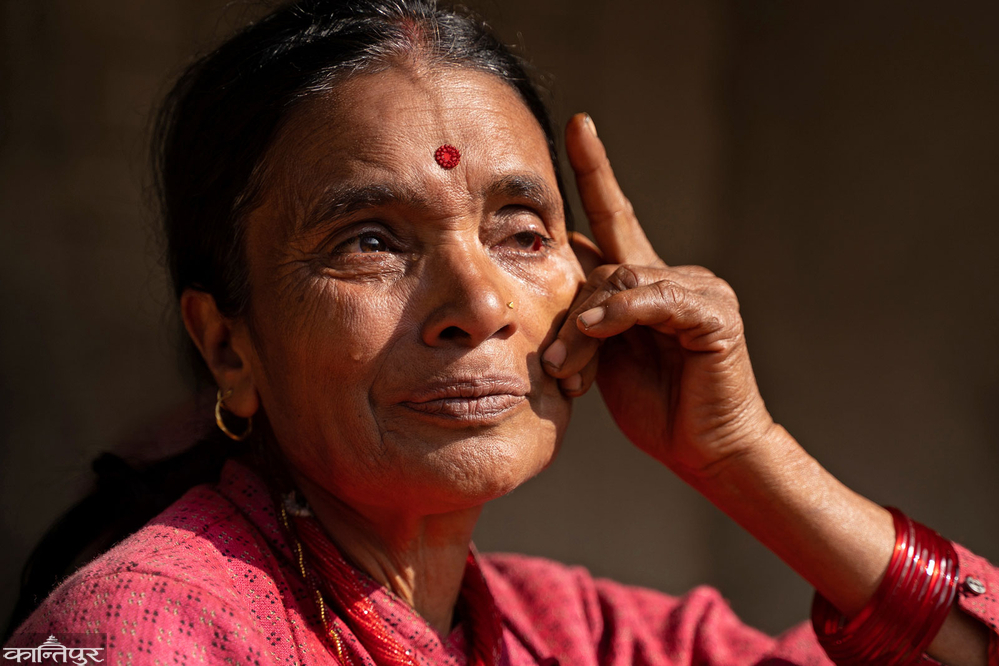
"During the political-social movement, women and their issues are kept in the forefront, but after the movement, their issues are marginalized, women are also marginalized," Binda says. And, the farmers want freedom from that prison of discrimination.

