More than 400 volunteers, nature guides and ornithologists are involved in the counting, more than 80 lakes, streams, rivers, wetlands, bird reserves are being counted.
We use Google Cloud Translation Services. Google requires we provide the following disclaimer relating to use of this service:
This service may contain translations powered by Google. Google disclaims all warranties related to the translations, expressed or implied, including any warranties of accuracy, reliability, and any implied warranties of merchantability, fitness for a particular purpose, and noninfringement.
It is not known where a bird seen on one side will reach in an instant. The nature of the bird is that it has a quick flying beak. At this time, the waterfowl flying from the high Himalayas have come down to the plains and mountains to escape the cold weather. On this occasion, the counting of waterfowl has been started all over the country.
More than 400 volunteers, nature guides and ornithologists with special skills and knowledge have been deployed across the country in bird counting which started on Saturday. The count started to find out the status of birds found in water and wetland areas will continue till January 6. The National Parks and Wildlife Department and the Bird Conservation Society (BCN) have assisted in the counting, which is being done in coordination with Wetland International and the Nepal Ornithologists' Association.
Waterfowl counts range from Koshi to Shuklaphanta in the west. Similarly, preparations are being made to count from Jagdishpur Panchhi Reserve in the south to Rara Lake in the north. Ornithologists and nature guides started counting in Manohara and Bagmati rivers and Toudah ponds in Kathmandu Valley from the first day, said Lakshman Paudyal, National Coordinator of Water-Bird Counting. According to him, counting has started in Koshitappu Wildlife Reserve in East and Shuklaphanta National Park in Far West on Saturday. "Birds will be counted in 15 places only in Pokhara, and three in Chitwan, East, West and Central," he said Bird counting has been started by dividing into parts.
Senior ornithologist Hemsagar Baral said that they will be counted in all areas after adjusting their compatibility. Birds are counted with the help of other participants under the guidance of an expert birder. The species of birds that feed, breed and spend most of their time in the water, Taltalaiya, Seemsar and surrounding areas are called water-birds or waterfowl. Since 1987, this census has also been conducted in Nepal, and information such as species of waterfowl, their number and habitat problems are recorded. Ornithologist Krishna Prasad Bhusal said that the results of the
calculation will help in making bird conservation programs and policies. "The good and weak points will be known from the count," he said, "it will also help to check the impact of climate change and the ecosystem." The report of the count will be made public during the Wildlife Week celebrated in Baisakh.
Ornithologist Hathan Choudhary said that because the arrival of waterfowl is decreasing, we should be alert early. According to him, as the border area shrinks and disappears, the winter waterfowl dependent on it are decreasing . Chowdhury said that due to the obstacles in the flight path and the increasing use of chemical fertilizers, waterfowl are also at risk. "The use of pesticides and climate change in agriculture have become a problem," he said, "unsecured electric wires and illegal theft/hunting have also added to the problem." 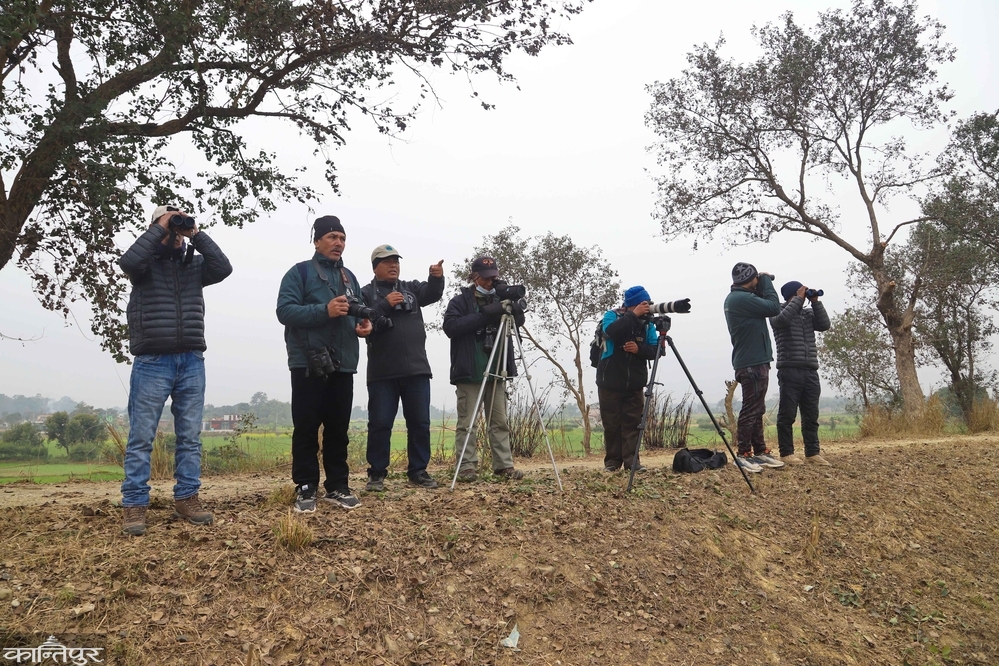
The ornithologists say that the birds coming by migration are tired from the long distance travel and because the shelter is new, the risk of natural and human predation has increased. The calculation shows that the situation of water-birds is dangerous. 13 species of waterfowl are among the world's rarest birds found in Nepal. There is a record of 897 species of birds found in Nepal. Among them, more than 150 are visiting birds in winter and more than 60 in summer. In winter, mainly: Duck, Jaleva, Chakhewa, diving bird and Gangachil etc. species come.
Birds fly 4 to 5 thousand miles to Nepal. Those birds arrive within a week to 10 days . Ornithologist DB Choudhary said, "Some birds fly directly and arrive in 3/4 days, "Some birds arrive by stopping and staying in the middle.'' Rivers, geographic series, magnetic direction are also seen. The path used by birds during migration is called the fly way,' he said, 'there are 8 such paths in the world . Among them, Nepal lies on the way to Central Asia.' The number and species of birds seen in front are noted . When a bird crosses the counter from behind and goes forward, they decrement it so that the number does not repeat itself. Ornithologists and nature guides who have knowledge about the color, texture and sound of the birds are engaged in the counting with binoculars .
According to ornithologists, birds start migrating with the onset of snowfall in the North Pole. In extreme cold, there is a problem with diet and living becomes difficult . That's why birds come here to escape the growing cold of winter. Some of the birds that have come here return after raising baby corals . Winter visitors come to Nepal from the northern countries of Russia, China, Mongolia as well as Europe, Korea and Tibetan region. Birds also come here from Central Asia's Turkmenistan, Kyrgyzstan and Siberia.

