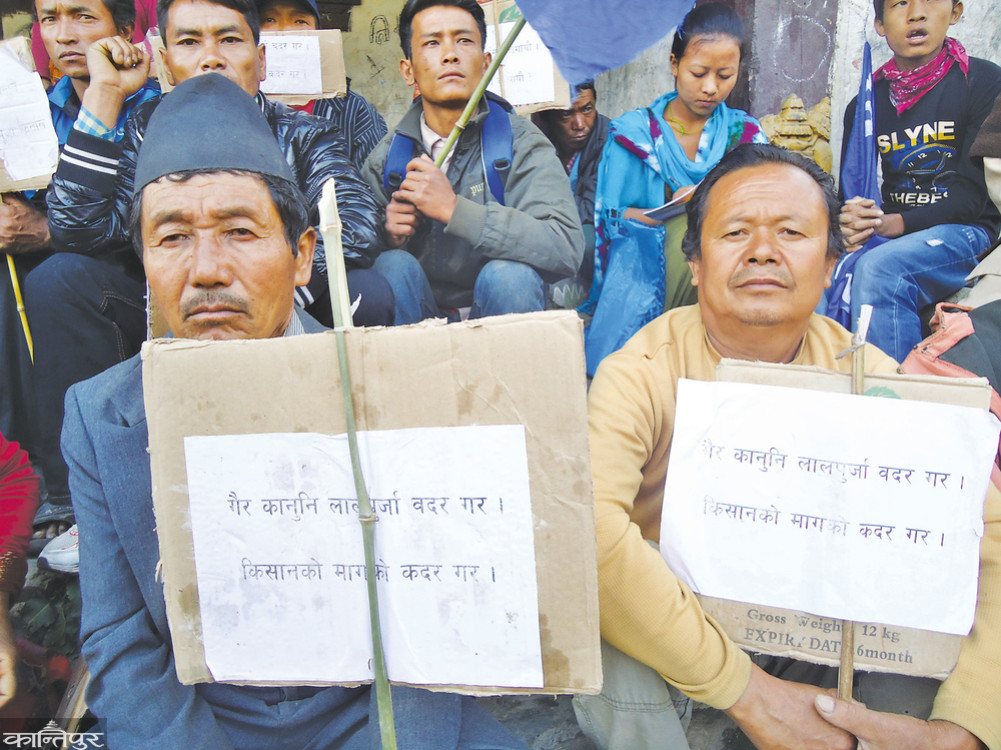
Trying to sell the land that was taken away from the farmers 280 years ago, pressuring the farmers to buy the land through middlemen mobilized by Birtawal, selling to others who don't want is increasing.
We use Google Cloud Translation Services. Google requires we provide the following disclaimer relating to use of this service:
This service may contain translations powered by Google. Google disclaims all warranties related to the translations, expressed or implied, including any warranties of accuracy, reliability, and any implied warranties of merchantability, fitness for a particular purpose, and noninfringement.
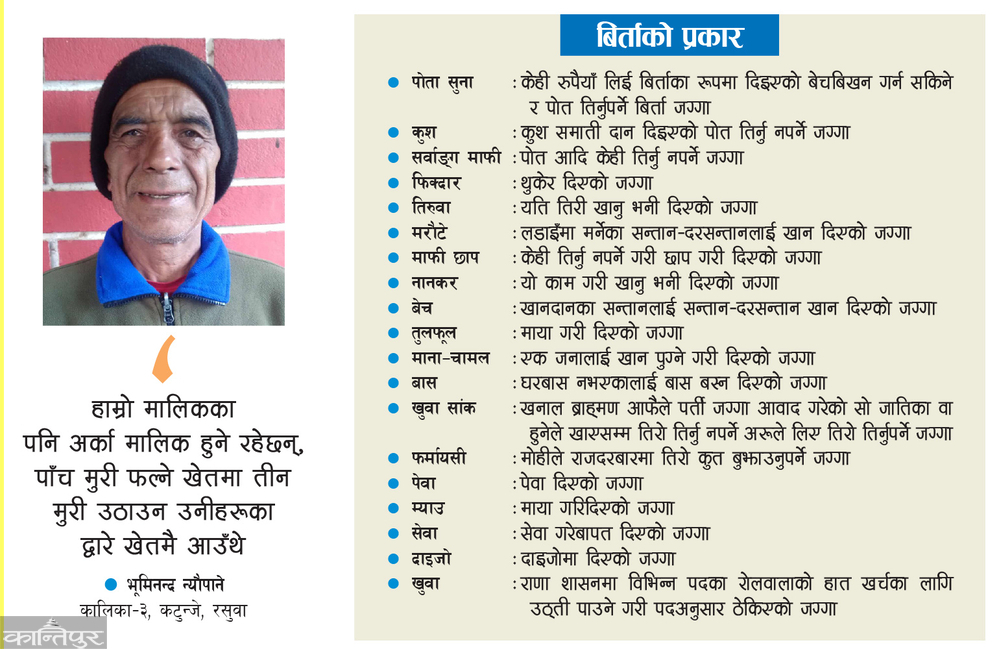
It snows every year in Rasuwa. This year too, Langtang is experiencing cold winters with snow. But in the heart of Rasuwa people, there is always a feeling of sadness. Bhuminanda Neupane (68) of Kalika-3, Katunje says, 'My mind was never at peace.'
Even though his name was Bhuminanda, he could never have land in his name, he always plowed someone else's land. Bhuminanda's heart was saddened by the pain of plowing the land in life, but not having it. There is only one reason why the mind will be restless for the rest of its life - Birta.
Bhuminanda is a representative character of a farmer dependent on Birta's land. His father-grandfather kept paying kut to the alleged landowner from generation to generation. 3 muri of paddy had to be submitted every year. There was no arrangement for irrigation, the farmers were exposed to natural disasters such as drought, heavy rains, landslides, hailstorms and even starvation. But he had to pay the fixed amount to the landlord.
Such exploitation of farmers has been a social thorn for ages. That thorn has continued till today in some form. Bhuminanda said, 'Our master will always have another master. Its owner was Jagat Prakash Upadhyay Paudel. In Birta's field, five muri usually grew, even in that, three muri would come and pick them up by Dwara. According to him, Birtawal had an agent in the village, he was called Dwara.
He always felt sad when he had to bring in only 2 mauri of rice and 10 farmers had to go home empty-handed even though he plowed the field without any rain or winter. After him, his son also experienced the same story. He says, 'There was always a knot in the heart, the pain was going on. I also thought that we should not work in this field, but it was not possible to eat two days without working in the field.'
Around the year 2025/26, Birtawala told him, 'Pay 1 thousand rupees, the farm will be transferred to your name.' There was a time when it was difficult to see the face of money. There was no source of income,' he says.
When Bhuminanda was 8 years old, his father passed away. He started plowing and farming from the age of 10 and has always been a ploughman. Birtawal lived near the city. Even to plow the land, one had to go to the door of the dwara and beg. To please the dwara he had to give 4 dams, 1 theki and one mana of ghee. He had the right to allow/not allow the cultivator to cultivate the land of Birtawal. In the same way, his father and grandfather plowed 32 plantations. Baje used to deliver the paddy as a dog, while Bhuminanda delivered the money later.
Ramraj Regmi has written in the book "History of Nepal: A Marxist Approach", "Birtawals pay a certain amount to the contractor through the headman to consume resources such as mines and forest products that they own in the contract. used to give The contractor would transfer the contract to another contractor for some commission. Like
, Jung Bahadur Rana's brother Dhirshamsher gave a contract to Ranmehar Adhikari, the copper mine captain of his Birta area, for Rs. Since he could not participate in the excavation work, he gave the contract to someone else and ran the mine.'
Bhuminanda's experience is that the contractor who was the owner of the dwara and the dwara, i.e. the owner of the owner, used to exploit the farmers.
000
vs. By 2007, one-third of Nepal's arable land had been converted into land, three-quarters of which was in the name of the Rana family. Here is a view of how Birta was distributed in Nepal.
Ramraj Regmi has written, 'After Veerashamsher became the Prime Minister, in 1895, he got 1.2 lakh bigha of land from the king in the name of his wife Rajyalakshmi only. According to the data when Birta was abolished, he and his five brothers and sons together with 3 lakh 63 thousand 369 bighas of land in Terai were recorded as Birta.'
Finance Minister Suvarna Shamsher of the government led by BP Koirala presented a 'Bill made as a means of land tax contract by abolishing the vacant land' in the House of Representatives on October 8, 2016. The Bill was sealed on November 25, 2016 and published in the Gazette on December 1. According to Grisham Bahadur Devkota's book "Nepal's Political Mirror - Part Two: General Elections and After" at that time, it is estimated that the government will get more than 80 lakhs in annual revenue because the Birta system will be abolished. Congress leaders.
In section 3 (1) of Birta Abolition Act, 2016, it is written, "The practice has been abolished from the date of commencement of this Act and all Birta lands up to the date of commencement of this Act have been abolished." is No, instead, hundreds of farmers are living in tears every day.
000
'Birta' means 'Vritti' means 'Jeevika' means the land given to a person by the state for livelihood. Section 2 (a) of the Birta Abolition Act, 2016 defines Birta land as follows: Birta land means any government property that has been acquired or is being entitled to by paying less than the amount of government property or a similar type of raker land in that place. The land must be remembered.
Nuwakot, Rasuwa, Dhading, Sindhupalchok and Lalitpur still have uncultivated land, many farmers are dependent on uncultivated land. Geologist Jagat Deuja says, "There are still farmers earning birta land, which means that birta, which was abolished in 2016, is still in practice. Although some sections of the Birta law are conflicting and can be applied ambiguously, the essence of the Act is to register the Birta land in the name of the cultivator himself. And, the state will collect the tiro of the said land.'
Until the abolition of birta, 36 percent of the total usable land in the name of members of the royal family, court priests, kings, and soldiers was within the birta system. Magnificent Jalo.
As the Shah King conquered, the land cultivated by the farmer was brought under the state and he enjoyed the land as he wished. Jhalak Subedi has written in the book 'Bhoomi, Kisan ar Rajya', 'Birta established in the land system by the Shahs and later by the Ranas is the product of this. In the Birta system, the ruler or the king used to happily donate land to the members of the royal family, generals or soldiers, employees or scholars, priests and Brahmins who were supportive of his power. Such land was of two types, one that was to be paid and the other that was to be paid. Birta once given would not be taken away by anyone until the same ruler remained or until his successor was happy. Jhalak's analysis is, 'Birta Zamin created a new class that sat between the farmers and the state and exploited the farmers. It also led to rapid colonization, especially in Dang, where the Tharu lived.'
And above, the 'dwara' experienced by Bhuminanda and his forefathers is a new class that exploits the same farmers. Suresh Dhakal's analysis in the book 'Land and Agrarian Questions: Essays on Land Tenure, Agrarian Relations and Peasant Movement in Nepal' states, 'Development with widely distributed land as The existing zamindari system displaced the egalitarian social relations and social structure in the Tharus and pushed them into an exploitative hierarchical feudal power relationship.'
Maheshchandra Regmi's book "Land Tenor and Taxation in Nepal" says, "According to the report of the National Seminar on Land Reform of October 24-27, 1970, there are 780 hectares of land in Nepal." It was under construction. That is 36.3 percent of Nepali land.'
000
History says - Prithvi Narayan Shah during the unification of the state. Conquered Nuwakot in 1801. He then distributed the land in that area as a parcel. As written in Baburam Acharya's book 'Brief Biography of Shri 5 Bahamaharajadhiraj Prithvi Narayan Shah', Prithvi Narayan divided the Birta land into four parts namely Abbal, Doyam, Sim and Chahar. They planned to ship almost half of that rice with cash.
Baburam writes under the title 'Systems for increasing Guthigana and reducing Birta', 'Birtawars were not only in Kathmandu Valley. were also on the east side. There were more Brahmins in that Birtawar. They had become rich by giving money to the Senrajas of Chaudandi in times of economic crisis, and using the earnings of Birta Batuli Mohi. During the war with the British in Sindhuli, the treasurer Virbhadra Upadhyay had to take a deal with many Birtawars to manage the expenses of the military camp. One of those Birtawars was Udayanarayan Ghimire of Manthali and from him Virbhadra Upadhyaya took a bribe of one hundred and twenty rupees. Prithvi Narayan Shah bought Birta Mato Muri 30 for 300 rupees to recruit Udayanarayan's 120 rupees. They had stolen that seven rupees after killing them.'
Even before the reign of Prithvi Narayan, the Birta custom was in vogue. The rulers of Lichchawi also distributed Birta land. It was a type of Birta – Agrahara. Brahmins or sannyasis who run gurukuls, ashrams or davasthals get agrahara. It was distributed for his livelihood and no agrahara tax was levied. Historian Maheshraj Pant says, "The practice of Agrahar was all over India. Birta custom was also maintained in religious practices. The word Birta is also found in many places in the records of the Malla period. At that time the job was the farm. At that time, when money was not in circulation, government employees were given birta, i.e. farm, as a job salary.'
Gorkha's fourth Shah dynasty king Ram Shah (reign period 1663-1693) also kept the Birta practice as the ninth level of state management. During the Rana period, Birta practice took root. V.No. In 1996, Pot Birta Adda itself has a history.
Jagat Deuja, Krishnaraj Khanal and Gopal Giri's 'Field Study Report on Birta Problem in Nuwakot and Rasuwa' has identified Birta people who are currently living in Kathmandu in that area. Jagat Prakash Sharma Paudel, Gaurinath Paudel, Gunanath Neupane, Rudranath Neupane, Homanath Poudel, Bhadrakumari Poudel, Chetkumari Dhakal, Ghannath Thakur Upadhyay, Dillinath, Lakshman Prasad were among such Birtawal. Bhattarai, Bir Bahadur Nagarkoti and Anuprasad Poudel. Krishna Prasad Lamsal, Chandrasekhar Lamsal, Govinda Prasad Lamsal, Durga Prasad Sharma, Tank Prasad Sharma, Phanindra Shamsher, Theershamsher, Cholakumari Paudel, Dambarshamsher, Chandrashamsher, Arjan, Bhim Bahadur Thapamgar, Bodhkumari Shah, Netrarajalakshmi Shah called Jayarajalakshmi, Vasantaram Bhandari, Khemrajashamsher Rana also have birta.
Ditto, Gunanath Aryal, Rameshwar Paudyal, Bishnuprasad Bhattarai, Kanakaram Bhandari, Dhruvanath Upadhyay, Kalyanath Upadhyay, Balgopal Jha, Shivprasad Bhattarai, Suvarsharaj Bhattarai, Keshav Bhattarai, Wilbhadra Bhattarai, Hari Bahadur Bhattarai, Krishna Bahadur Bhattarai, Vishwambhar, Achyut Lamsal, Surendra Prasad Lamsal and Siddhibabu Aryal are also Birtawals.
000
Farmers of low economic status had mined the land and made it arable. He should have got the legal ownership of that land. However, during the feudal regime, the peasants were not in a position to speak. Forced to deliver certain produce of their land or agreed goods or cash to Birtawal. After the law regarding the abolition of birta came, the land should have been automatically registered in the name of the mining farmers, but it was not.
On the contrary, Birtawal got the land registered by changing the law. It is one thing to plow, it is another thing to walk around carrying a piece of land ownership evidence. The current government's delay in correcting such injustice means that we have not been able to absorb the changes. What prevented the making of a law that allows those who till the land to be measured and registered based on the enjoyment of the land?' said Deuja, an agriculturist.
Land activist Biswas says that land should be registered free of charge to give justice to the suffering and harassment Nepali farmers have been suffering for many generations. "If the descendants of Birtawala take it as an opportunity to correct the shortcomings of their generation, it would be very good if they themselves take the initiative and make the land ownership certificate in the name of the farmer," he said.
Now Birtawal has started pressurizing Mohi to buy the land through an intermediary. There has been an increase in selling land to others who do not own it. Even if you can earn the land of Birta, you cannot share, sell, distribute and mortgage. "Bhoominanda says, "Farmers are in dire straits. Who will listen to our story?'
Hundreds of farmers like Bhuminanda are still waiting to own the land they are mining. They are disappointed that their situation has not changed despite the change of ruler along with the change of law and order.