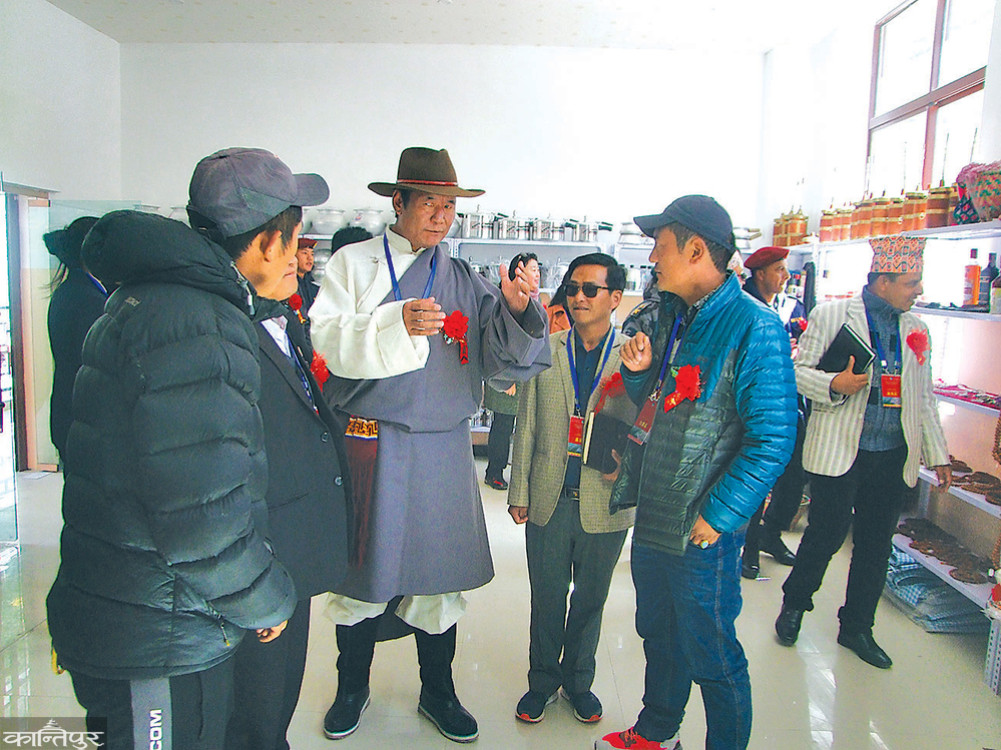
Cheten Sherpa Lama, Ward President of Phattanglung-7 Olangchungola of Taplejung, will play the role of interpreter in the talks between officials.
We use Google Cloud Translation Services. Google requires we provide the following disclaimer relating to use of this service:
This service may contain translations powered by Google. Google disclaims all warranties related to the translations, expressed or implied, including any warranties of accuracy, reliability, and any implied warranties of merchantability, fitness for a particular purpose, and noninfringement.
Government officials and public representatives of Taplejung, which is bordered by China and India, should coordinate with the neighboring countries. Whether it is a border problem or a matter of concern for the residents of border areas. In the last 7 years, three chief district officers of Taplejung went to Dingje County in China and held bilateral meetings.
The chairman of Paktanglung Rural Municipality, which borders China, and the party representative of Taplejung have also been discussing with the Chinese side. Cheten Sherpa Lama, the ward president of Paktanglung-7 Olangchungola, has been coordinating all the meetings.
The team led by Chief District Officer of Taplejung Netra Prasad Sharma participated in the border meeting last December 29 under his coordination. For the meeting, the Ministry of Foreign Affairs of Dingje County sent a letter to the Chief District Officer through Cheten.
Although the language of the letter was in English, its 'letterhead' was in Tibetan. Cheten should also be contacted to understand what is written on the 'letterhead'. The Tibetan language is mostly understood by the residents of Olangchungola.
According to Cheten, two languages are spoken in Dingje. Government officials, including the head of the county people's government, only understand Chinese clearly. However, Cheten himself cannot speak Chinese clearly. He explains the subject in Tibetan language.
Tibetan official translates into Chinese and explains to Chinese official. What the official said in Chinese, the Chinese interpreter said in Tibetan. Cheten reverses it in Nepali.
'During the meeting Taplejung Chief District Officer Sharma spoke in English,' Cheten said, 'I spoke to them (Chinese) in Tibetan.' He explained. Chheten says that since he studied at a boarding school, he can speak even in English.
Earlier, Chief District Officers Anuj Bhandari (2075), Dorendra Niraula (2076) had gone to Dingje, China for the border meeting. This year, all three people along with Sharma participated in the border meeting at a place called Ghumti. In 2080 Rabindra Acharya and in 2079 Gomadevi Chemjong Tiptala went to Bhanjyang. Officials from Dingje County also came there.
Discussions were held on issues such as opening border crossings and exchanging trade while staying at the border. Cheten was present in the meeting with Acharya. He said that although he coordinated the meeting with Chemjong, he could not participate directly because his mother had to go to Kathmandu due to illness. At that time, Tenzing Walung, an employee of the ward office, coordinated.
In 2067, an interpreter was placed with Devraj Dhakal, who went for a border meeting. Pema Sherpa, born in Olangchungola and living in China, did that. The Kanchenjunga Conservation Area Project took the initiative for the meeting.
Chheten says that China did not use a Nepali-speaking interpreter in the subsequent meeting. It is not found that there was any discussion between Taplejung and Dingje government officials before Dhakal. "I became the spokesperson of the rural municipality after the 2074 local level election," Chheten said, "As a resident near the border, I have been taking many initiatives for the meeting." has been searching. He said that he coordinated for that and was the interpreter himself. "I have corrected some things while interpreting," Cheten added, "Some things said by the CDOs about geography, names, etc. are not factual, I have corrected them."
'Being a resident here, we know the issues that need to be raised there and we have requested the CDO to raise them,' said Cheten, 'when raising such issues, we make it clear that the CDO has said so.' He said that those who did not were picked up in a somewhat forceful manner.
Prazia Sharma said that even when China sends letters, it sends them through Cheten and also directly. "Even if you come in person, you have to coordinate through an interpreter," Sharma said, "In Sadarmukam area, you won't even find a person who understands the Tibetan language script."
Chinese officials speak with Cheten via WeChat and phone. They use mail and WeChat to send documents. Cheten says that since he knows both language and script, Tenzing, the ward employee, will also coordinate. Before the federal structure of Nepal, when China provided food aid to the residents of the border areas, the then District Development Committee used Dawa Chungda Sherpa as an interpreter.
Those who were born in Olangchungola and lived in the country and abroad invested and dug a motorway from Tiptala, the border of China, to the settlement of Olangchungola. Chheten also led the coordination in collecting money, requesting China for excavator machines through the government.
Leading the locals, he submitted a memorandum to the minister and the prime minister through the district MP. It opened the way for him to get closer to the political system and administration of Nepal and China.
In the meeting led by Dorendra Niraula, Dingje County Chief Kunga praised that 'Cheten speaks but also works' says Ghanendra Maden, the head of the District Coordination Committee at the time. In that meeting, a team including Jesus chief Maden, Paktanglung rural municipality president Saroj Aveng, president of the Chamber of Commerce and Industry Taranath Ghimire went.
Anuj Bhandari also participated in the meeting led by the head of rural municipality, commercial association. Paktanglung rural municipality chairman Rajan Limbu, Maoist district in-charge Khelprasad Budhakshetri, Congress president Gajendra Prasad Tumyahang and other teams reached the border to request the opening of the border which was closed due to Corona. Cheten says that even then, he called Chinese officials to the border and facilitated it.
Chheten says that since they have to drive 35 km from the settlement near the border, they take the Nepalese representative and call the Chinese officials after fixing the time and date. It is customary to put food-garlands and introductions in such meetings. He said that earlier, Chinese officials would bring tea and snacks to the border as they had to walk from Olangchungola and it would take two days.