We use Google Cloud Translation Services. Google requires we provide the following disclaimer relating to use of this service:
This service may contain translations powered by Google. Google disclaims all warranties related to the translations, expressed or implied, including any warranties of accuracy, reliability, and any implied warranties of merchantability, fitness for a particular purpose, and noninfringement.
The Chief Justice of the Supreme Court Prakashman Singh Raut has said that the current judiciary of the country is transparent.
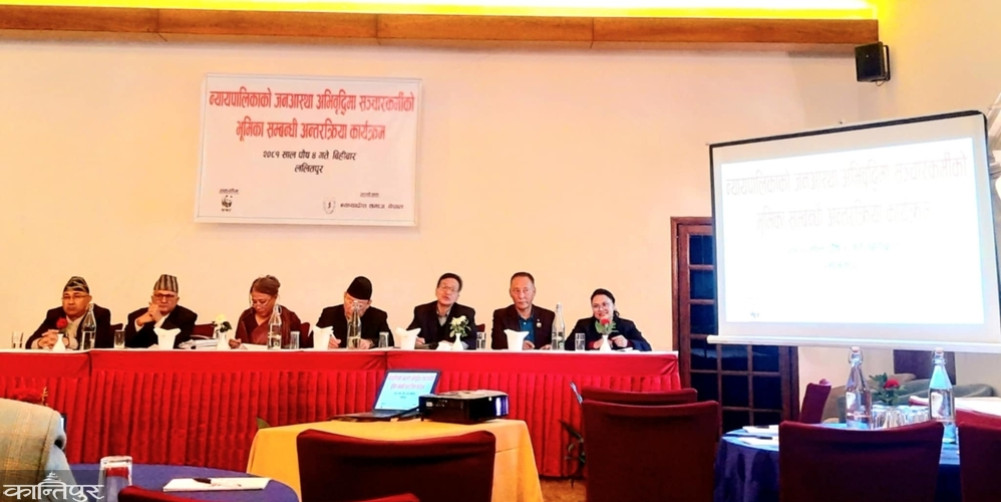
In an interactive program organized by Judges Society Nepal and WWF (World Wide Fund for Nature), Chief Justice Singh said that the judiciary is transparent and fair.
``There is an objection that someone said the judiciary is not transparent . Everything we do is open, both sides and opposites, in front of legal professionals,' he said, 'there is no room for doubts and doubts.' He also expressed his commitment to present the court in a transparent manner.
Fairness is the life of the judiciary and journalism, so he said that he used it to the maximum extent. Similarly, if the judiciary is not impartial, the court will not be able to bear its burden, he said. The Constitution has also institutionalized freedom. In the case of the judiciary, we use it intact. We cannot bear any impact and shock on this," he further said, "I want to assure you that the freedom of the press will not be curtailed from anywhere. I have not forgotten my limits and dignity. He said that the media should be sensitive to the truth because the judiciary rests on public faith.
Likewise, Supreme Court judge Sapna Pradhan Malla said that the court's medium of speech was the decision. "Not only in Nepal, but in the world, the media is raising questions about how the judiciary will do justice," she said while addressing the program, "due to the judicial independence, it is at the forefront of the rule of law in South Asia." She also mentioned that media plays an important role. She further said, "The role of the media is important to bring faith and positivity to the lack of trust and negativity." She also clarified that there will be no political, media or any other influence in the judiciary and there should be no fear of conveying truthful news. In the
program, Supreme Court Judge Til Prasad Shrestha presented a working paper on the topic of 'Role of media in increasing public faith and trust in the judiciary'.
"The court pronounces the verdict but who listens," Shrestha said, "In this, the media plays the role of a medium between the justice system and the general public." Similarly, he said that the role of the media is important for the protection of freedom. He said that the expected role of the media workers was tried to be brought through the work paper.
Chairman of the special court, Tek Narayan Kuwar emphasized that the media should convey information to the common people based on the truth.
Similarly, Nepal National Representative of WWF, Ghanshyam Gurung, mentioned that WWF Nepal's hope lies with the leadership, then the judiciary and finally the media.