A fence in the wall to separate the water used by Dalits and non-Dalits
We use Google Cloud Translation Services. Google requires we provide the following disclaimer relating to use of this service:
This service may contain translations powered by Google. Google disclaims all warranties related to the translations, expressed or implied, including any warranties of accuracy, reliability, and any implied warranties of merchantability, fitness for a particular purpose, and noninfringement.
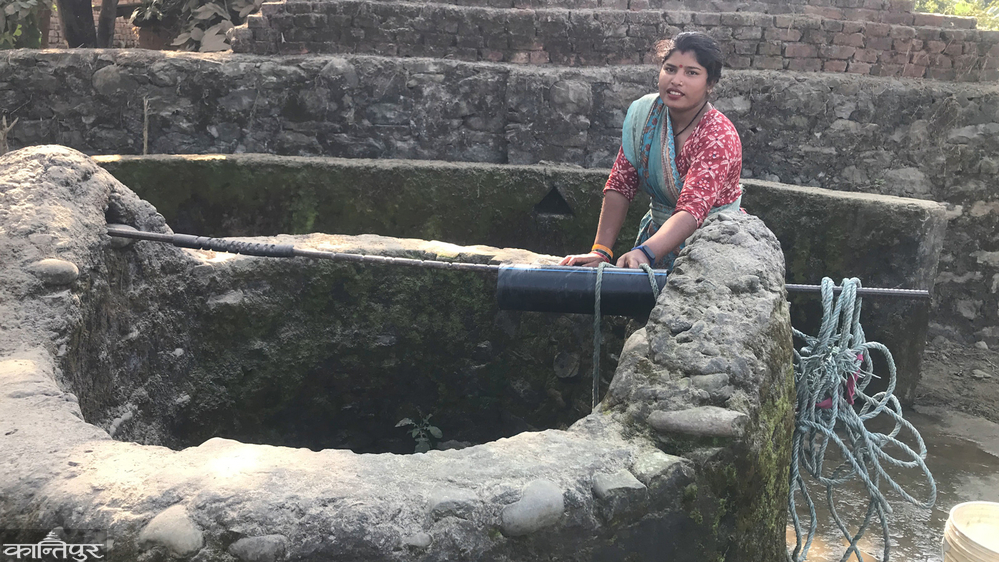
The decades-old dilapidated well is surrounded by a wall. There is another high wall on the south side outside the perimeter of the Hocho wall, which acts as a barrier to the wells of the Dalit community and the stream of the non-Dalits.
Water is the only option for 10 families of Dalit community living in Chaklekhola village of Olani in Godavari Municipality-10 of Kailali, the capital of Far West.
The physical condition of the well, which was constructed about four decades ago, is dilapidated and smelly. The house of Dan Bahadur Bhat, a non-Dalit community, is attached outside the high wall built to enclose the well. In Bhat's house, water flows through pipes. But Dalit families are not allowed to fill water in Bhat family's stream.
The Bhat family has operated a paddy grinding mill attached to the outer wall of the well used by the Dalit community. When mill chaff flies and enters the well, the water becomes more dirty.
'It has been 40 years since we drank water from this well, even if it is dirty, we are forced to drink it, there is no other option,' said Bhim Tamrakar of Chaklekhola, 'This well is only for our 10 families. For the non-Dalits, taps have been installed in their homes by boring them, but we cannot access their taps. Bhim said that the families of the local Dalit community, including Dharma Tamrakar, Chandra Tamrakar, Chet Tamrakar, Dhan Bahadur Tamrakar, and Ramesh Tamrakar, are drinking water from the well. .
While narrating that she was being forced to drink water from the well, Tara Tamrakar said, "Since the year I got married, I have started hearing that the water will come, and it will come." 10 years have passed, I don't know when it will come, now hope is dead.'
She also complained that chaff from the paddy cutting mill near the well was getting into the water, "The chaff flies from the mill and directly into the well, and the water is dirty." Dalit community has not been discriminated against, they are drinking water from the well without connecting the tap, I have built a wall to prevent chaff from entering the well.
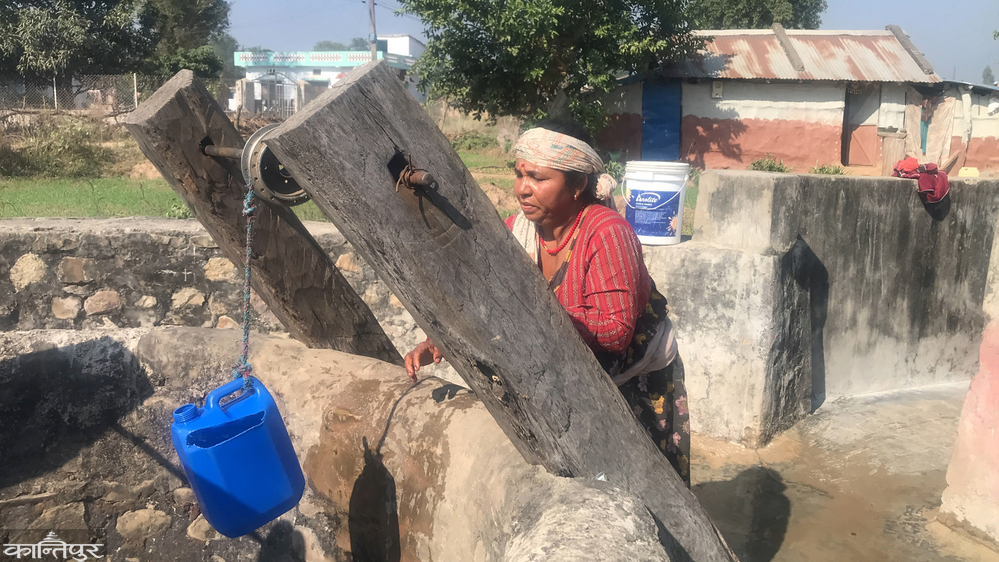
A little above Chaklekhola settlement is Thamaura village. There are also water taps connected to houses for non-Dalit families. But for the Dalit community, there is a well that is almost 40 years old. For the Dalit community of Thamaura tol, there is no other option but well water.
While approaching the well, 60-year-old Saraswati Sunar was coming towards the well to fill water with a bucket on her head. She started pulling the ghirni that she had made to draw water from the well on her own accord. Saraswati, who was drawing water by dipping a jerkin tied to a rope into the well, did not want to speak for a long time. "This is the well from which our Dalit family drinks water since we were children," she only said, "others have running water in their houses." We need water from this well.'
Jaldhara Vick, whose house is a few blocks away from the well, expressed her anger saying that even though there is running water in the houses of non-Dalits, they have to drink water from the well. We 11 Dalit families of Thamaura are forced to drink well water. Similarly, it has been 35/40 years since this well was built, even now we depend on this well," she said.
Ward President of Godavari-10 Ravindra Shahi (Guddu) said that more than 200 borings have been buried in the ward for seven years to provide drinking water to the ward residents. We have borne the entire cost of 180 borings from the municipality. In 20 borings, we have made one lakh for the community and one lakh for the municipality in a half/half partnership," he said, "The families of the Dalit community have not connected the water supply for their own reasons. There is nothing wrong with us. They are not ready to connect boring and current.'
Human rights activist Khadakraj Joshi said that there is caste discrimination even for drinking water in Thamaura and Chaklekhola. "Even now, it is surprising that Dalits and non-Dalits have separate drinking water. There are wells for Dalits, but there are clean water pipes in the homes of non-Dalits," said Joshi, who is also the Far West Coordinator of INSEC. ;
According to the data of National Census 078, out of 666 thousand 841 households in Far West, 3 thousand 382 households are forced to drink water from covered wells and 7 thousand 916 open wells. In Far West, there are 5,611 households that drink water from rivers/springs. In Kailali, 1,305 households are consuming water from open wells and wells.
Around 2023, the elders say that after the famine in Doti, Dadeldhura, Bajura, Bajhang and other districts of the far western hills, the residents of different places migrated and reached Olani while the Terai was falling. On the upper side of Olani at the foot of Chure, there is Machili river and Dharmaganga river on the lower side.
There is a river that flows on both sides of the village, and because of the forest around it, Olani was the choice of those who came down from the mountain at that time, says local Dhan Bahadur Badaila. But now Olani's identity is not what it used to be. At present, Olani in Godavari Municipality-10, 11 and 12 has become synonymous with disease, hunger and scarcity.
Although the spread has decreased in recent years, Olani was the place with the highest number of HIV infected people in Kailali until a decade ago. Food shortage is still the same. "Even in my ward, the increase in HIV infection has stopped somewhat in recent years, but now 45 people across the ward openly take medication regularly," says Godavari-10 Ward President Shahi, "Though caste discrimination is decreasing now, it has not become non-discriminatory."

