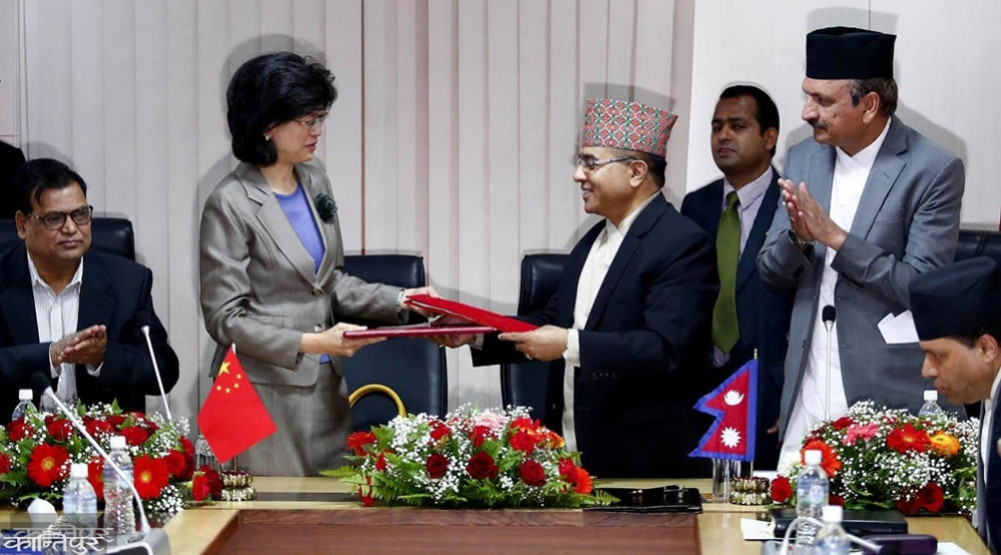
As different understandings and viewpoints started to appear between the parties, voices were raised that the memorandum of understanding should be made public.
We use Google Cloud Translation Services. Google requires we provide the following disclaimer relating to use of this service:
This service may contain translations powered by Google. Google disclaims all warranties related to the translations, expressed or implied, including any warranties of accuracy, reliability, and any implied warranties of merchantability, fitness for a particular purpose, and noninfringement.
The 'Belt and Road Initiative (BRI)' agreement signed by Nepal and China in 2017 is still secret. In the meantime, three major parties in Nepal, led by Congress, UML and Maoists, have repeatedly formed the government, but no one has given priority to publicize the contents of the memorandum of understanding.
In view of Prime Minister KP Sharma Oli's upcoming visit to China, the topic of BRI is at the center of interest and discussion. On the occasion of the visit, China wants to sign the 'BRI Implementation Plan'. But different views are being expressed by the leaders of the ruling Congress and UML on this matter. As different understandings and viewpoints began to be seen between the parties, voices were also raised that the memorandum of understanding of seven years ago should be made public.
The Memorandum of Understanding on the BRI has so far been seen only by a limited number of officials and politicians. Former Ambassador Jayaraj Acharya says that it is necessary to make the Memorandum of Understanding on BRI public. "All the documents of the agreement with the Millennium Challenge Corporation (MCC) have been placed on the website in Nepali and English languages," he said, "but no one knows what is in BRI." On what basis should we talk about BRI?'
UML leader and geopolitics expert Rajan Bhattarai says that it would be appropriate to make public the agreement/memorandum between the two countries. It should not be kept a secret. If contracts are made, they are made public, wherever there is such a practice. It is also a kind of law. It is not a matter to be kept secret," he said. "If a parliament or a parliamentary committee asks for it, it should be provided to a democratic government. Some agreements have to be passed by two-thirds of the Parliament. Bhattarai also said that there is no need to exaggerate the different understandings and interpretations seen in BRI.
'Nepal has signed the agreement and there is a difference in understanding and interpretation regarding its implementation,' he said, 'with different interpretations we reach the same place. Our foreign policy behavior should be the same with all countries.
We conduct foreign policy keeping the national interest at the center.'
Congress spokesperson Prakasharan Mahat, who was the foreign minister when the BRI MoU was signed, says, 'This BRI MoU is not a document like any other. It is a general agreement. When I was the Minister of Foreign Affairs, it was signed after seeing it myself and saying it was okay.'' He added, "Usually such documents are not brought out. If there is a dispute, it can be taken out.'
Former Foreign Minister Mahat said that connectivity, cooperation, investment and training are mentioned in the Memorandum of Understanding on BRI, but nothing has been specified about what to do. The previous agreement is only theoretical. Now the question of what to do in the BRI implementation agreement is important, he said.
When the BRI agreement was signed between the two countries, Pushpa Kamal Dahal, the chairman of the Maoist party, was the Prime Minister of Nepal. Ram Karki, the leader of the Maoists, who is now in the opposition, said that the discussions took place at the time of signing the BRI agreement. At the same time, what is BRI has been studied. "Thousands of articles have been published," he said. But what is our priority?
It is not that the parliamentary committee has not taken the initiative to publicize the memorandum of understanding of BRI. Rajkishore Yadav Nepal, chairman of the International Relations and Tourism Committee of the Parliament, said that he has requested a document from the government for study after the lack of knowledge within and outside the Parliament about the BRI Agreement. We wrote to the Ministry of Foreign Affairs last July to submit the memorandum of understanding. But the document has not arrived," he said. "Without seeing the document itself, how will the common people know about BRI and what they are trying to do with Nepal?" He mentioned that it is necessary to send the document to Parliament and make it available for public debate. According to an official of the Ministry of Foreign Affairs, although the parliamentary committee has asked for the document of BRI, a decision has not been taken from the higher political level on whether to give it to the parliament or not.
Former Foreign Secretary Madhurman Acharya says that the issue of making the BRI MoU with China public is not a big deal. "In relation to BRI, the BRI implementation plan agreement should be more transparent than the previous theoretical agreement," he said, "I have not seen what agreements have been made with China and other countries." But it does not seem that the Chinese have disclosed such agreements. The Chinese will call, make an agreement and implement it.
The four-page long draft of the BRI implementation plan agreement sent by China to Nepal has not been made public yet. Political parties are debating whether to take loans or grants under BRI or go for some other arrangement. For a long time, China has been urging Nepal to sign the implementation plan agreement. At the meeting of the 16th Foreign Secretary-level Diplomatic Consultative Mechanism held in Kathmandu on June 11, homework was done to clear up the confusion of the 'BRI Program Implementation Plan'. However, the then Prime Minister Pushpa Kamal Dahal blocked the proposal sent by the Ministry of Foreign Affairs under the leadership of Narayankaji Shrestha of his own party. At that time there was a Maoist and Congress government. At that time, the Nepalese side stopped the proposal saying that more studies were needed, foreign sources said.
Before that, during the then Prime Minister Dahal's visit to China in September 2023, preparations were made to finalize the 'BRI Program Implementation Plan'. However, the agreement process was blocked when the then foreign minister NP Saud said that there should be discussions between the planning commissions of the two countries to prepare the document. In the joint statement issued during Dahal's visit, it was mentioned that the two countries will soon sign the BRI Implementation Plan Agreement.
The BRI launched by Chinese President Xi Jinping in 2013 is considered Beijing's main international cooperation and economic strategy. Xi said that through BRI, China will work in the areas of connectivity, trade and economic growth. Under the BRI, China works in the fields of airports, ports, power plants, railways, roads, bridges and information technology. According to Chinese government media, the BRI project has been carried forward in 138 countries, mainly in South, Southeast and Central Asia, Africa and the Middle East.
In Nepal, BRI is understood only as a project. When KP Sharma Oli visited China in 2019 as the Prime Minister, a list of 35 projects to be implemented under BRI was submitted to Beijing. But a list of 9 projects was sent to China after Beijing asked to reduce the number to a single digit. Nothing has happened since then.
After alleging that Chinese loans have caused problems in some countries, including Sri Lanka, there is also doubt about BRI in Nepal. Congress, the first party in Parliament, has already decided to accept only grants through BRI. The meeting of party officials and ex-officers held last June 17 has decided that BRI can only be accepted as 'assistance or grant'.
Chinese ambassador to Nepal Chan Song mentioned that BRI is not just a project in the program "10 years of BRI and Nepal's experience" organized by "Friends of Silk Road Nepal" on March 2. He said, 'BRI is completely open, inclusive and transparent. It is being misconstrued as a debt trap, which is wrong. BRI is for cooperation. This is not a geopolitical tool.
While China and the Chinese ambassador are saying that about BRI, Nepal does not know what agreement was reached with China on BRI. While not being able to see the main document of BRI, China has recently been asking Nepal to sign the program implementation plan to advance BRI. That is why the voice of the MoU should be made public.