We use Google Cloud Translation Services. Google requires we provide the following disclaimer relating to use of this service:
This service may contain translations powered by Google. Google disclaims all warranties related to the translations, expressed or implied, including any warranties of accuracy, reliability, and any implied warranties of merchantability, fitness for a particular purpose, and noninfringement.
Today, it has been 19 years since the comprehensive peace agreement between the then Maoists and the seven parties, which included the formal end of the armed conflict, the restructuring of the state, the writing of a new constitution, the adjustment of the army and the management of transitional justice.
In the meantime, even though the work of writing the constitution and adjusting the army has been successfully completed, the issue of transitional justice is stuck at the initial stage.
While a clear arrangement to settle the cases of human rights violations during the conflict within two years after the issuance of the interim constitution by forming the Truth and Reconciliation Commission was mentioned in the peace agreement .
However, constitutionalists, human rights workers and victims say that even after 18 years, the non-compliance is a gross violation of the rule of law and valid principles of justice.
'Transitional justice was not a matter of the choice of a party leader or a particular person and no, it was a constitutional obligation that had to be fulfilled in any case,' says senior constitutionalist advocate Bhimarjun Acharya, 'but what was promised to be completed in two years This is a violation of the constitution, which has increased the risk of serious consequences in the coming days Acharya's analysis is that to give constitutional recognition to the provisions of the peace agreement, putting it in the schedule of the Interim Constitution 2063 is to make it clear that it has a constitutional obligation. 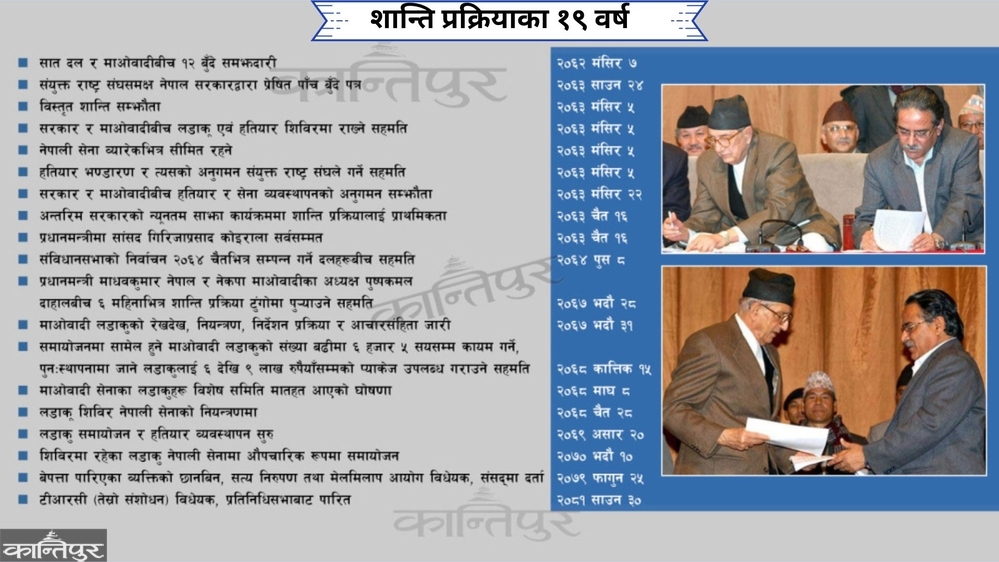
'By entangling the main part of the peace process in the transaction of political interests and power, the leaders not only played with the rights of the victims to get justice, but also violated the rule of law and the constitution', Acharya said, 'Because of this, public trust in the constitutional body has decreased and widespread resentment has increased in the society. This is not a good sign for any society.' Arguing to create a situation, he added, 'This serious delay in transitional justice will cause more chaos.' Rupp has concluded that there is no violation.
On the eve of the 19-year anniversary of the agreement, the commission also issued a statement on Tuesday with serious concern about the confused transitional justice.
Although the commission has been investigating, making decisions and making recommendations on the complaints during the conflict, the commission has expressed its displeasure that the action against the culprits involved in the violation of human rights and the compensation for the victims have not been completed according to the recommendations.
'Acknowledging that there has been a delay in providing justice to the victims of the conflict even from the top leaders of the political parties, the Commission reminds the commitment made many times before, nationally and internationally, to complete the transitional justice as soon as possible and provide justice to the victims.' The commission is firm on that.'
Recently, the Commission for Investigation and Reconciliation of Disappeared Persons Act, 2071 has been amended The commission has said that it has positively taken the process of formation of vacant commissions from the government.
'The commission is of the opinion that the commissions should be formed and justice should be rendered in a manner that can act in a reliable manner in accordance with the commitments made by Nepal in the international forum and the recognition of international values of transitional justice', the commission said. To implement the decisions and recommendations, to form commissions in accordance with international standards and to focus on the satisfaction of the victims while completing the transitional justice, the commission again draws the attention of the Government of Nepal.
Similarly, the victims have also requested the government to proceed seriously as the law has been amended and the process of formation of a new commission has started and that there is an opportunity to proceed transparently and prevent further delay in transitional justice.
'Transitional justice, the main part of the peace process, could not proceed because the parties were not serious until the day of Hijra' Suman Adhikari, the founder president of the conflict victim Sajha Chowtari, says, 'This time, it seems that the parties have become serious, the government has honestly and transparently moved forward with the work of the transitional I see that the process of justice will be completed.' The deadline for the recommendation committee to submit applications to the candidates for the third formation of the investigation commission has expired on Tuesday afternoon, the day the peace agreement completed 18 years.
'More than a hundred applications have been submitted, we have started working on them from today', former Chief Justice Omprakash Mishra says, 'The deadline for the committee is till the end of this month and we will be able to select officials in both commissions within that period.'
Human rights activists Even this time, since the environment in which the commission can work has been created, if the government is serious, it has been analyzed that the work of transitional justice will be completed.
'According to the order of the Supreme Court, the law has been amended and many new things have been included in it', says senior human rights advocate Raju Chapagai, 'Now that there has been a delay, the government has got an opportunity to avoid further delay, it should be utilized.'
By maintaining transparency and appointing qualified, non-political and people who can win the trust of the victims to the commission, the work is progressing according to international human rights laws and principles, even if it is delayed. He said that transitional justice will speed up.