If the victims do not get justice, the peace process of Nepal will be at risk, legal experts warn
We use Google Cloud Translation Services. Google requires we provide the following disclaimer relating to use of this service:
This service may contain translations powered by Google. Google disclaims all warranties related to the translations, expressed or implied, including any warranties of accuracy, reliability, and any implied warranties of merchantability, fitness for a particular purpose, and noninfringement.
An international team of jurists studying the transitional justice system in Nepal has requested the government not to kill the right of the conflict victims to get justice.
The team has also expressed serious concern that the recent amendment to the Act on Investigation and Truth and Reconciliation Commission on Disappeared Persons seeks to separate the perpetrators from the responsibility they have to bear for human rights violations.
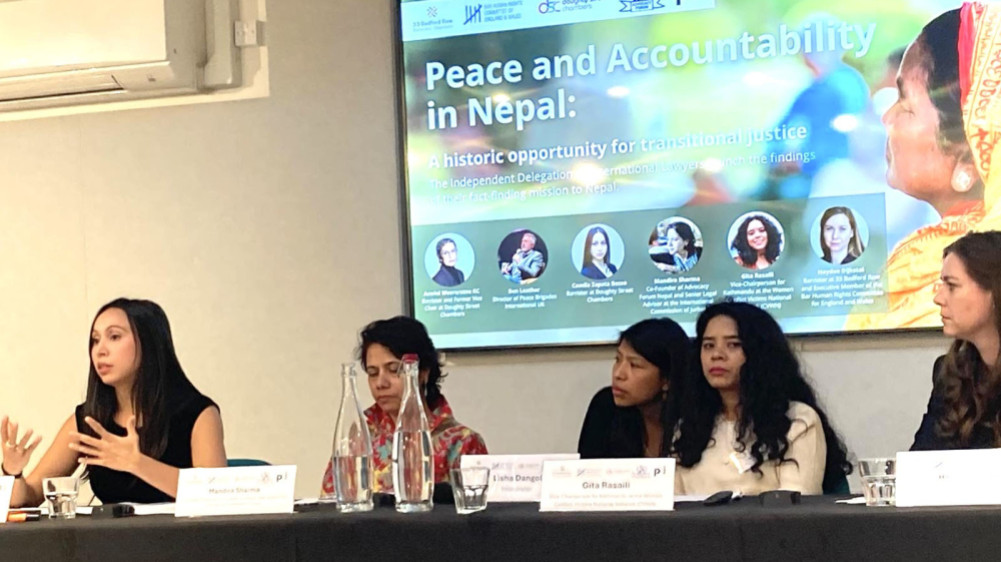
A team of jurists from America, Britain, Sri Lanka, Colombia and other countries conducted an on-site study on the activities of the peace process in a report titled 'Peace without Justice and Accountability?' released from London on Thursday evening. In the report, the government is also urged to take steps to reform the justice system. This is the first time that this team has spoken about the issues of transitional justice and its accountability, raising the question of slowness and low progress in the justice administration process of conflict-time events in Nepal.
Noting that Nepal's peace process and transitional justice process have not been completed even in almost two decades, a team of legal experts has analyzed the culture of impunity. It is mentioned in the report that many victims and their families are waiting for justice because the commitment to give justice to the victims has not been implemented in practice. Their conclusion is that despite the establishment of the Disappearance Investigation and Truth and Reconciliation Commission for transitional justice, the government and state mechanisms have failed to provide justice to the thousands of citizens who disappeared and became victims during the conflict.
Amnesty International, Human Rights Watch, International Alert and other international human rights organizations have already pointed out that the commissions are unable to work due to political interference, legal obstacles and lack of sufficient resources. A study report on Nepal brought by an international team of legal experts will bring the peace process under more scrutiny. The team includes legal experts from UK's Doughty Street Chambers as well as experts with experience in international human rights law. The
team came to Kathmandu last year for study. The team went to different places in Nepal to review the incidents that happened during the conflict and evaluate the rest of the justice process. They discussed with human rights workers and victim groups in Nepal and made detailed recommendations to the government for reforms in the areas of justice, human rights and accountability. The team concluded that the two commissions formed for transitional justice are ineffective and the victims have lost faith in them. The
team has pointed out the need to make the justice process agile and fair in cases of human rights violations in Nepal. The team believes that technical and legal knowledge is needed in Nepal for effective investigation of human rights violations. The team also suggested benefiting from international legal standards and experience for the reform of Nepal's transitional justice system. The
team members have warned that Nepal's peace process will be at risk if the victims do not get justice. According to their analysis, there is a danger of further division and instability in the society due to lack of justice. They also stated that they will inform the global legal community about the progress and challenges in Nepal's transitional justice.