We use Google Cloud Translation Services. Google requires we provide the following disclaimer relating to use of this service:
This service may contain translations powered by Google. Google disclaims all warranties related to the translations, expressed or implied, including any warranties of accuracy, reliability, and any implied warranties of merchantability, fitness for a particular purpose, and noninfringement.
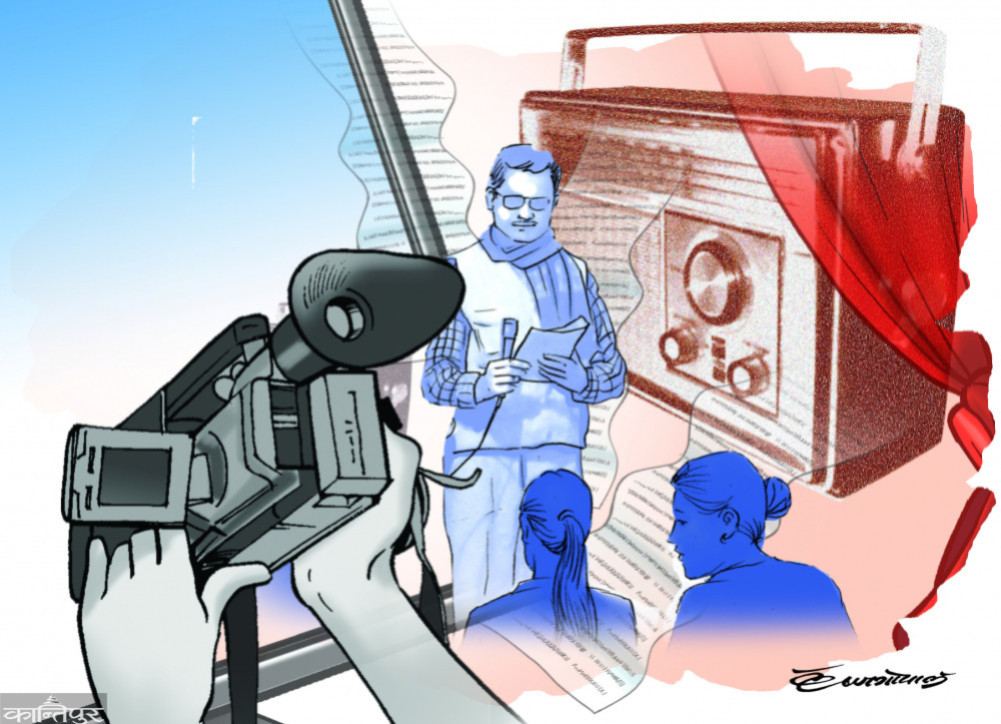
President Ramchandra Paudel on Tuesday approved the Public Service Broadcasting Bill. The law has been introduced to integrate government-owned Radio Nepal and Nepal Television and operate under one umbrella.
On 15 June 2077, the then Minister of Communications and Information Technology, Yuvraj Khatiwada, registered a bill in the National Assembly to amend and unify the law related to public service broadcasting. Four years after the
was registered, the bill was passed by the parliament on August 31. The Act will come into force on the 31st day after the confirmation by the President. Stakeholders were raising voices that radio and television should be operated outside the direct control of the government and for that they should go to the retention of public service broadcasting.
However, although the new law has integrated Radio Nepal and Nepal Television, it has not brought it out of the government's control. Although it was named Public Broadcasting Service, the government's grip is kept tight.
According to the principle that no mass media should be owned by the government in a democratic state system, experts and stakeholders have been suggesting for a long time that government broadcasting media should be converted into 'public service broadcasting'.
The High Level Media Recommendation Commission-2063 and the High Level Committee on Information and Communication-2073 formed by the government suggested that Radio Nepal and Nepal Television should be integrated and removed from the control of the government and brought under the parliament. Mass Communication Policy-2073 has also taken the same objective.
The main feature of the new law is Radio Nepal and It is to merge Nepal Television and make it a single organization. In the bill, it is said that Radio Nepal, which was established under the Communication Institutions Act, 2028, will be transformed into a public service broadcasting organization.
Public Service Broadcasting Organization aims to produce neutral, fair, factual and objective information, news and entertainment programs. However, an autonomous structure that can work accordingly has not been created.
The Minister of Communication and Information Technology has been given the right to give policy instructions for the policy making of the Public Service Broadcasting Institute and the work to be done by the institution. Under the chairmanship of the Minister or Minister of State, the Secretary of the Ministry and the majority of the members nominated by the Minister are arranged in the Council. The council will formulate the policy of the public service broadcasting organization. The structure of the board of directors of
broadcasting organizations has been made in the law to work directly under the direction of the ministry. The majority of the ministry has been kept in the recommendation committee for the appointment of the chairman of the board of directors.
There will be three members of the board of directors including one co-secretary appointed by the ministry and at least one woman nominated by the ministry. In the policy-making and directive council as well as the appointment of the chairman of the board of directors or the appointment of the members, the government direct Control has been established. The ministry also has the right to remove the chairman and members of the board of directors. Media Recommendation Commission, High Level Committee, Media Policy and Federation of Nepalese Journalists suggested that the Parliament should bring the public broadcasting service under the Parliament and run it.