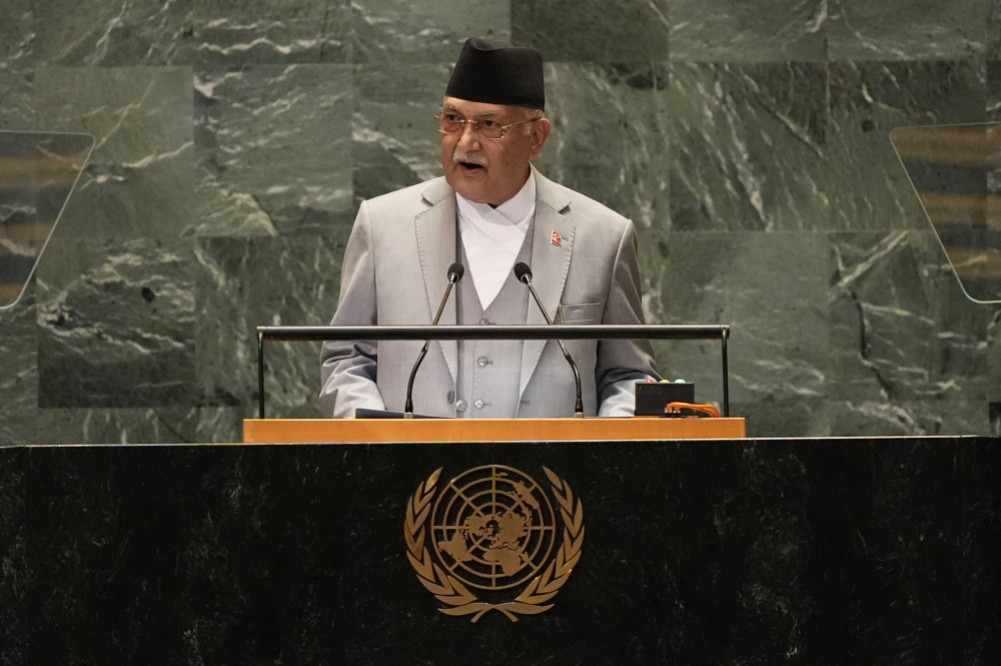
Prime Minister Oli raised issues of importance and interest to the world including the role of the United Nations, comprehensive democracy, climate change, before the international community, and discussed the growing gap between the countries of the northern and southern hemispheres.
We use Google Cloud Translation Services. Google requires we provide the following disclaimer relating to use of this service:
This service may contain translations powered by Google. Google disclaims all warranties related to the translations, expressed or implied, including any warranties of accuracy, reliability, and any implied warranties of merchantability, fitness for a particular purpose, and noninfringement.
Prime Minister KP Sharma Oli has expressed his commitment to ensure the rights of the victims with truth and justice during the implementation of the transitional justice law. While addressing the 79th General Assembly of the United Nations on Friday, he also said that Nepal is committed to issues such as human rights, women's rights and gender equality.
Prime Minister Oli mentioned that Nepal understands the importance of peace and political stability as a country emerging from conflict. He also informed that Parliament passed a bill to finalize the transitional justice process after the formation of the government under his leadership. He said that the style of compensation and reconciliation will be adopted to heal the country's conflict-era wounds. "We appreciate the support received from the international community, including the United Nations system, in relation to the peace process," he said. During the
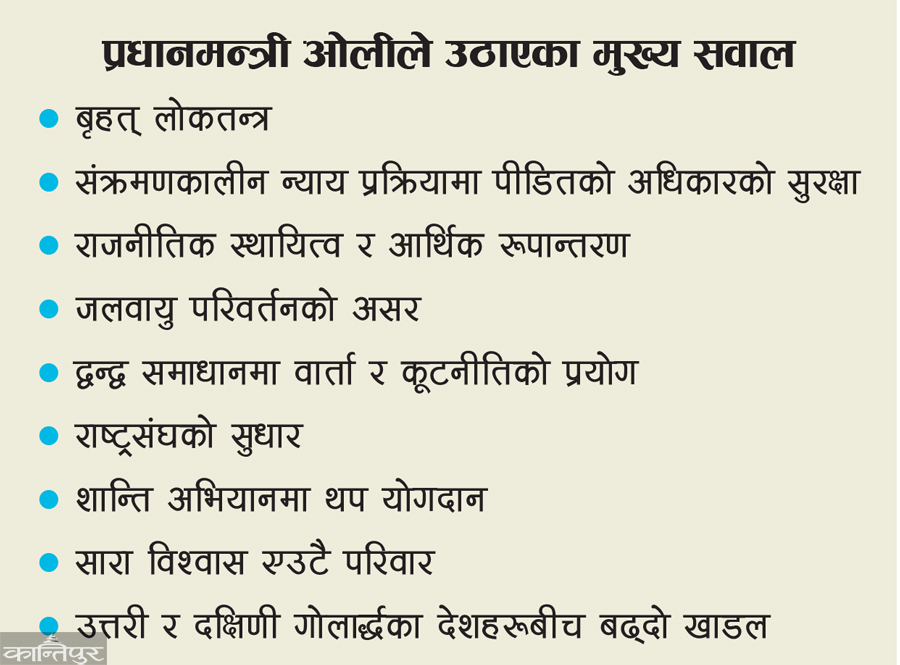
speech, Prime Minister Oli also presented important and interesting topics for Nepal, South Asia and the world to the international community. Mentioning that the world is now at a complicated moment in history, he raised questions such as climate change, the role of the United Nations, and broader democracy. He also discussed the growing gap between the countries of the Northern and Southern Hemispheres. Oli said that the difference between the rich and the poor, harmony and hatred, economic development and environmental destruction has never been as loud as it is today. "In addition to arms exchange, military spending is increasing," he said, "the situation of nuclear conflict seems greater than before."
Prime Minister Oli said that both people and the earth are standing in the crisis of climate disaster. He mentioned that they have to deal with the impact of the Covid-19 epidemic in the midst of a weak economy. He opined that nationalism and protectionism were resurgent before the benefits of liberalization and globalization. Even after a 300-year journey of industrialization and modernization, wealth and prosperity in our so-called civilized world of the 21st century are mostly concentrated in the hands of northern hemisphere countries. Poverty and deprivation are high in the southern hemisphere, especially in the less developed countries. This is a matter of deep concern,' Oli said during his speech, 'We must show leadership in order to promote meaningful cooperation and cooperation.' Prime Minister Oli said that he should enter. He also mentioned that through the 'Summit of the Future' within the United Nations, the commitment to build a safe, just and sustainable world for the present and future generations has been emphasized. Stating that three important topics 'Future Treaty', 'Future Generation Declaration' and 'Global Digital Compact' were accepted, he added, 'We must show determination in implementing these documents for the benefit of the present and future generations.'
Prime Minister Oli He mentioned that he has deep faith in broad democracy. "A broad democracy ensures equal rights, equal access to opportunities and social justice, protects vulnerable communities and provides security and dignity for all," he said. It will lead people in the direction of prosperity and happiness so that they can feel a high level of respect.'
Oli said that sovereign equality and mutual respect at the international level are the basis of broad democracy. "These principles are necessary to build a framework for a just, inclusive, equitable, representative and accountable global order," he said. Prime Minister Oli mentioned that the philosophy is included in the constitution to maintain the values of democracy while guaranteeing inclusiveness, equality, justice, proportional representation, human rights and social security for the most vulnerable groups in the society.
Prime Minister Oli said that the current government formed in collaboration with two major political parties in Nepal (UML and Congress) will promote economic transformation while maintaining political stability. He mentioned that stability and economic transformation are more important to Nepal than periodic contests in elections. He said that he is dedicated to fulfill the national aspiration of 'Prosperous Nepal: Happy Nepali'. He said that Nepal, which is going to rise from the status of least developed country (LDC) by 2026, needs significant economic resources. He also informed that Nepal aspires to become a developed country by 2043. Prime Minister Oli said that he is working diligently to achieve the Sustainable Development Goals (SDGs) by 2030. He informed that the road to achieve SDG goals is difficult for Nepal. "We are facing a financial gap of about US$24 billion to achieve the 2030 target," he said.
Prime Minister Oli also expressed the impact of climate change on Nepal and its compensation. He said climate change has emerged as the biggest threat to the earth, people and prosperity. Oli told the world community that his own country Nepal is also more affected by climate change. "We stand as one of the most vulnerable countries in terms of climate change and are listed as the 20th most vulnerable to disasters," he said.
Oli said that the Himalayas are losing their snow storage and this is endangering the availability of water for billions of people spread beyond the borders of Nepal. “Nepal is making a huge contribution to the health of our planet through its forests, mountains and rivers. Despite that, we are suffering from climate change. In this context, we call for climate justice," he said. He noted that our mountains play an important role in governing the climate and ecosystems of the oceans. Oli emphasized that the issue of the Himalayan region should be given attention in the climate talks. "Nepal is steadfast in its commitment to the Paris Agreement and the global
is on a campaign to make carbon emissions zero by 2045, five years ahead of the target, he said. Prime Minister Oli said that since climate change is a global challenge, there should be global actions and initiatives to address its effects. He said it is important to link climate-resilient measures and infrastructure for adaptation in developing countries.
Prime Minister Oli made it clear that the conflict going on in the world should be resolved through dialogue and diplomatic initiatives. "Nepal firmly believes that dialogue and diplomacy are the only means to resolve conflicts such as Ukraine and the Middle East," he said. That paves the way for sustainable peace.' Oli brought up the context of Israel-Palestine conflict and made it clear that Nepal is in favor of solving the problem there by creating two states. He said that the growing humanitarian crisis in Libya, Syria, Sudan, South Sudan, and Yemen must be addressed.
To ensure peace and stability, Prime Minister Oli said that it is important to follow the principles of sovereign equality and non-interference mentioned in the UN Charter. He mentioned that the values of love, harmony, tolerance and empathy adopted by Gautama Buddha are still more relevant today. Prime Minister Oli also raised his voice about disarmament.
Prime Minister Oli also pointed out the need for reform of the United Nations during his speech. He said that Nepal will firmly advocate for further reforms to make the UN system more effective, democratic, transparent and accountable. "We firmly believe that the only way to deal with the crisis we are facing globally is through strong multilateralism," he said.
Prime Minister Oli also mentioned the contribution of the Nepali Security Forces to world peace and informed the international community that they are ready for more contributions. Nepal is currently number one in the world in sending peacekeepers. Prime Minister Oli also mentioned that Nepal has always followed a peaceful, independent, balanced and non-aligned foreign policy based on the principles of Panchsheel, the United Nations Charter, international law and world peace. He informed that Nepal is operating its foreign policy with the deep belief of 'friendship with all, enmity with none'. "Nepal is committed to further strengthening close, cordial and constructive relations with its near neighbors and outside countries based on the principles of mutual respect, sovereignty, equality, geographical integrity, non-interference in each other's internal affairs and peaceful coexistence," was Oli's address.
Prime Minister Oli stressed on the belief that 'the whole world is one family'. He said that 'Vasudhaiva Kutumbakam' mentioned in the book 'Maha Upanishad' of the 6th century BC means 'the whole world is one family'.