The families of those who died in the war are under contract to pay around Rs 2 crore, but are unsure when Russia will provide the compensation.
We use Google Cloud Translation Services. Google requires we provide the following disclaimer relating to use of this service:
This service may contain translations powered by Google. Google disclaims all warranties related to the translations, expressed or implied, including any warranties of accuracy, reliability, and any implied warranties of merchantability, fitness for a particular purpose, and noninfringement.
If things had turned out as expected, Pritam Karki from Syangja would have got PR in Russia and was preparing to come to Nepal to take his family there. His remains arrived at the Tribhuvan International Airport on Wednesday, 10 months after his flight. His wife Rima could not go to Kathmandu to collect the remains of Pritam, who was killed in the Russia-Ukraine war.
"The brother-in-law found out that he was a relative and buried him at Pashupati Aryaghat on Thursday," she said, upset about her husband's separation, "What to do with ashes, if only I could bring people!"
Pritam from Putlibazar Municipality-5, Koliswara retired from the Nepali Army five years ago at the age of 35. Then he worked as a security guard in Pokhara for 10 months. He reached Afghanistan through a broker to work as a security guard. He did not get work for 10 months after the corona epidemic started the lockdown. He came on leave 8 months after getting the job. Spent almost three years in Afghanistan. In August 2080, he returned home on a two-month leave. It was at that time that plans were made to join the Russian army. But they didn't give anything at home.
Pritam reached Kathmandu in the second week of October. On October 15, he bought a ticket to Russia and told his wife. "The broker said that you can become a PR in a year, you can take your family there, and your income will be good," Rima said, "If I had known that there would be such a danger, I would not have let her go." When the war was going on, why did you send it to Russia?' Rima then asked Pritam. He kept repeating that it was just a rumour.
There is no danger, don't listen to others. He used to say that now only training is going on, there is no need to go to battle. After the person who went said no, it happened, she said, "Later we found out, he said that so that we don't worry."
Pritam used to call home every 9-10 days. The last time he talked to his father, mother, wife and sister Devi who was in Pokhara was on the day of Bhaitika on November 29. He said that he was admitted to the hospital and was resting because he had a pillow in his hand. The family suspects that he might have been shot at that time. After that, Pritam's phone did not come. There was no reply to the voice message. In the first week of November, the consular department of the Ministry of Foreign Affairs sent a letter to Ward about the death of Pritam. On November 10, his sister also got the news. On November 11, relatives told the news that Pritam had died in an ambush during the battle. His mother Indrakumari and wife Rima fell unconscious.
The next day, Kush's body was prepared and Pritam was cremated according to Hindu tradition. "On November 29, you talked to us until 6:00 p.m., such an incident happened at 11:00 p.m.," Rima said, "What should we do to bring the corpse?" It may take 6 months or even a year to bring the DNA after testing, it will cost 15-20 lakh rupees, he asked if we can bring it. The children are small, I told them that they should be educated or that they will bear the cost of bringing the corpse.'
Pritam reached Russia after paying 7 lakh rupees to Dalal. The family does not know who they contacted, how they got there. He was also confused. Earlier, the news did not come that much. You can take the family by making a card in one year, everyone is going together. "I didn't go because I will go and die, I will spoil the family," Rima said. His eldest son, 11-year-old Prashant, studies in Class 6 at Sainik Residential School in Pokhara. Younger son Pramish, 6 years old, studies in UKG in Sanjamai.
62-year-old Indrakumari's tears have not stopped in memory of her son. Pritam's father Hari Bahadur Karki has reached 66 years. There is no means of income in the village except farming and Pritam's half pension. As the road comes near the house, we gave some land to the road.
'The car came. It's convenient. But the farming land is gone,' said Indrakumari, 'I have earned only one son. There is no son now. Even today, he did not believe that his son had died. Since he did not see the body with his own eyes, he was wondering if his son would come to Tuplukk saying 'mother'. A letter also came from the hospital. The news came on Tuesday that Astu would arrive. Astu came on Wednesday. "They said that the body was dismembered by the bomb," she said.
33-year-old Rima has the responsibility of educating her two sons and raising her mother-in-law. She has not got a job. He is saddened that the country he fought for could not even send the dead body. "They couldn't send the dead body, it came as ashes," she said. When will it come?'
The remains of five people who lost their lives fighting for Russia in the Russia-Ukraine war arrived in Nepal on Wednesday. The remains of 26-year-old Dewan Rai of Pokhara, 23-year-old Hariprasad Aryal of Walling Municipality-14 of Syangja, Ganesh Shrestha of Bhirkot Municipality of Syangja and Anit Sah of Dhanusha were buried by their relatives on Thursday.
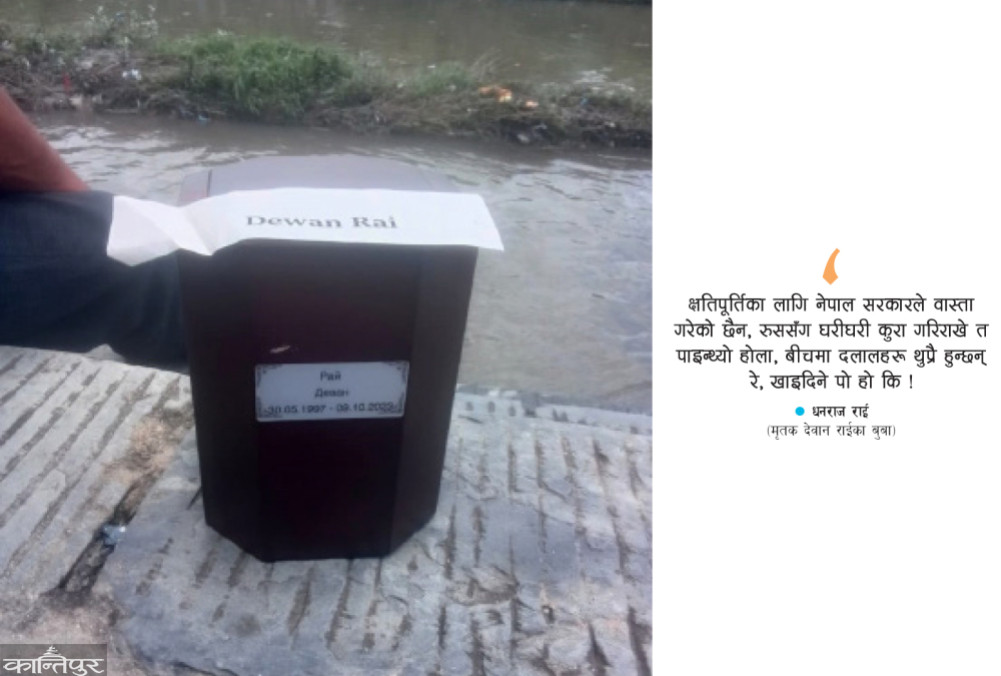
A young son in a wooden box
Dhanraj and Lakshmi Rai of Pokhara thought that the wound of losing their son in the Russia-Ukraine war was being healed. Astu arrived 10 months after the death of his son Devan. On reaching Kathmandu on Thursday, Dhanraj learned about 26-year-old Devan. While immersing the ashes at Pashupati Aryaghat on Thursday, he thought to himself, 'I wish I could see your face even once.' Dhanraj Rai, who came to Pokhara from Udaipur three decades ago, built a house here. Raised two children by doing wage labor. Built a house in Pokhara-13 Kamalpokhari. After his eldest son went to South Korea and started earning, Dhanraj started running a grocery store in Ranipauwa, Pokhara. The youngest son, Devan, lost his life in the Russia-Ukraine war. Dhanraj said, "When the young son of the earning period came to the small wooden box, he couldn't hold back. "Even to take care of his mother, he has to walk as if he was holding back."
Devan, who arrived in Russia on a student visa, was recruited into the Russian army in 080 Baisakh after seeing the attractive earnings. He used to say that there was no danger in the house. The last time Devan spoke about Dhanraj was on October 17. Devan informed the family that he would go to another camp for 15 days from the camp where he was staying and there would be no phone or internet. He never called after that.
The news of Devan's death on October 22 after joining the Russian army and fighting against Ukraine came on November 1. Dhanraj applied to the Ministry of Foreign Affairs to bring his son's body. Sometimes they called the Nepali embassy in Russia, sometimes they ran to the consular department of the Ministry of Foreign Affairs in the hope that the body would be found. After two months of waiting, the Nepali Embassy in Russia decided that they could not send the body. Devan's body was cremated in Russia on February 3 with the consent of the family after it was not possible to bring the body. After seeing that Astu would be delayed, Devan's family reached Lingchungbung in Udaipur, the ancestral home, and cremated them according to the Kirati tradition. "It is a tradition to bury our dead body, mark the bridegroom's cross on it, and move bananas, so we did it accordingly," said Dhanraj.
First the disappointment of being out of touch, then the news of death, the sadness of the body not coming and now the arrival of Astu. Dhanraj says that even if he wanted to, these events could not remove his son from Dildimag. If everything happened at once, it would be easy to forget. When this happens, we will remember," he said on Friday. "There will be tension again until the compensation is settled again. When will this pain end? Even though the consular department has assured that Russia will compensate the families of the deceased, it is not yet decided when and how much they will receive. "Nepal government did not care. He said, "There are many brokers in between. Khaidene po that π'
Lahure with the desire to become Russia from Tiktok
Ganesh Shrestha of Syangja was deprived of Lahure after being asked for money at the last stage of selection in the Indian Army. The desire to be Lahure was not dead. On Tiktok Live, Dalal showed his way to join the Russian army. 32-year-old Ganesh of Bhirkot Municipality-4 Changchangdi reached Russia on October 3 after paying 6 lakh rupees to the same Nepali broker found on Tiktok. According to family sources, Dalal showed Ganesh the greed that he could get 'PR' in one year and take his family away, he would not have to go to war because of 8 months of snow, and he could live in 'Green Zone' without going to 'Red Zone' with low salary. After a three-year stay in Qatar, he decided to join the Russian army after the feed store and chicken farm he ran together with his brother Deepak Shrestha in Bayarghari in Syangja went bankrupt.
Ganesh signed the contract 15 days after joining the Russian army. 1 lakh 92 thousand rubles per month in the said contract (about 2 lakh rupees) salary, 30 lakh rubles (about 4.5 lakh rupees) for amputation in war and 13 million rubles (about 2 crore rupees) for death were mentioned. His family was last contacted on November 17. He told his 72-year-old mother, brother, sister-in-law and two sisters that he was going to travel for three days to fight and that his mobile phone would be switched off. He said that he would send the salary of Rs 5-6 lakh home after his return. After that he became uncontactable. The Nepalese who were in the war with him informed the family that he was injured and taken to the hospital. There was no news after that. In March, the news of his sudden death came through the Nepali Embassy in Russia. According to the information received at the embassy, he was seriously injured in an attack by the Ukrainian army on November 18 while he was on his way to the war zone. He died on November 26 while undergoing treatment at a military hospital. The body was cremated on June 26 with the consent of the family. His remains also arrived in Nepal on Wednesday. His sister-in-law Sumi Shrestha understood the matter. She was immersed in Pashupati Aryaghat on Thursday. "The old mother is sick at home, she is afraid that something will happen to her son," she said.
It was too late to know about the danger
Ganesh Shrestha and Hariprasad Aryal of Syangja stayed in the same room for 15 days before going to the barracks. Hariprasad of Waling municipality-14 Mankhu left his job in the Nepali army and came there. After learning the news that Sandeep Thapaliya, a Gorkha who was in the Russian army, had died during the war, the families of Ganesh and Hari asked them both to return to Nepal. But Hariprasad used to say to his family, 'The job in Nepal slipped, he came here after paying the money to the broker, what will happen now.'
Not feeling any danger while living in Moscow, he trained as a gunner. After 15 days of training, he felt the danger only when he was deployed to the battlefield. He learned that after signing the contract with the Russian army and wearing the uniform, he could not leave for a year. By then it was too late. Hariprasad had a 'video call' with his mother, father, sister and sister-in-law for about one and a half hours on November 29 last year. He reached Russia from Nepal via Dubai on October 3 and joined the Russian army within 5 days. The last time he posted a video on Facebook on December 18, he wrote, "This is how life is, lived, met, died." He was in touch with the family till November 19. After that, there was no contact.
Brother Raju inquired. The Nepalese who were in the Russian army sent a message that Hari Prasad could not be saved. Raju didn't believe it. Only after the consular department of the Ministry of Foreign Affairs officially informed Bodhraj Kunwar on December 17, Raju told the family about the death of his brother.
Hariprasad, who passed class 12, joined the Nepali Army at the age of 18. Father is an Indian pensioner, two brothers Kamal and Raju are employed in Dubai. Hariprasad was not satisfied with the earnings of the Nepalese army. He learned the language to go to South Korea, took the exam, but his name did not come out. Also applied to Oman Police and Kuwait. He was frustrated after failing even there. Raju said that he reached Russia without informing anyone while preparations were being made to call his brother to Dubai. "I didn't even go to consult the family, I had to hear that all of a sudden," he said sent On January 5, Kush's body was cremated in Nepal. His remains were buried at Pashupati Aryaghat by his relatives on Thursday.
The locket identified the body
After studying overseer, 22-year-old Anit Sah decided to study engineering. He planned to go to Russia when he heard that there was a good opportunity at a low cost. He went to Russia a year ago after spending 6 lakh rupees. After 5 months of going there, he joined the Russian army along with his friends. When the family members found out that he had joined the army, they asked him to return. Anit was in regular contact with his family for 2 months after joining the army. "I joined the army for a year, now I am not allowed to go back. They said that I would train in the camp for 5/7 months," Amin's brother Amit said, "We used to talk for two months after the recruitment. After 4 months of no contact, nothing happened.'
Anit's family consists of her parents and brother who is living in Dhanushadham Municipality-8 Bhiman of Dhanusha. Anit's item arrived on Wednesday. Brother Amit died in Kathmandu on Thursday in Pashupati. My brother went to study. A group of 20/22 people were recruited into the Russian army by a broker there,'' said Amit, 'when they found out that they were out of touch, they did nothing when they asked the government to search for them.' Amit said that after the embassy showed him the locket (sikri) worn by his brother while walking from home, he confirmed the death and committed the crime. He said that even though the embassy was to show the body before cremation, it informed only two days after the cremation. "We could not even see the body of my brother who had gone to study," said Amit.