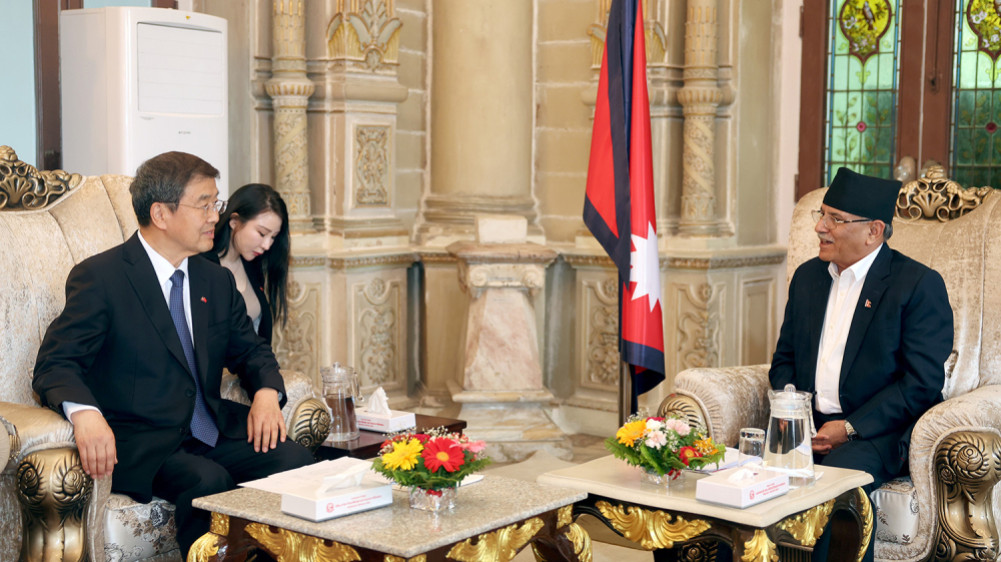
CPPCC Vice President Bater, who arrived in Kathmandu on a four-day visit on Friday, met the Vice President, Prime Minister and Foreign Minister
We use Google Cloud Translation Services. Google requires we provide the following disclaimer relating to use of this service:
This service may contain translations powered by Google. Google disclaims all warranties related to the translations, expressed or implied, including any warranties of accuracy, reliability, and any implied warranties of merchantability, fitness for a particular purpose, and noninfringement.
Vice President of the Chinese People's Political Consultative Conference (CPPCC) Batar held a courtesy meeting with Prime Minister Pushpa Kamal Dahal on Sunday. Batar, who arrived in Nepal on a four-day visit on Friday, has already met the Prime Minister as well as Vice President Ram Sahay Prasad Yadav and Deputy Prime Minister and Foreign Minister Narayan Kaji Shrestha.
The government side mentioned that bilateral relations, mutual cooperation and the implementation of various agreements and agreements between the two countries were discussed in those meetings. But experts say that the visit from the Chinese side is focused on security and political aspects. The CPPCC is the highest political advisory body of the Communist Party of China and the government.
According to Prime Minister's Foreign Affairs Adviser Rupak Sapkota, Prime Minister Dahal and Vice President Batar discussed bilateral relations and mutual cooperation. Dahal thanked the Chinese government for bringing the traditional 14 checkpoints in the Nepal-China border area into operation and for gradually implementing important agreements. He expressed his belief that other agreements between the two countries will also be implemented gradually.
Sapkota said that they also discussed about expanding and continuing the exchange of parliamentary practice between China and Nepal in the future. Vice President Bater mentioned that China attaches great importance to the relationship with Nepal and it will be further enhanced in the coming days. The Prime Minister is currently seeking multilateral and bilateral support for the economic development of Nepal with countries with friendly relations including China and India and for upgrading from a least developed country in 2026. During the political meetings and dialogues during the visit to India, the Prime Minister presented our national vision based on economic and financial politics, said Sapkota.
Likewise, Vice President Yadav, in a meeting with Vice President Batar on Friday, mentioned that he is fully confident that the opening of Pokhara International Airport will make a significant contribution to Nepal's tourism market. Expressing happiness that China's 'Sichuan Aircraft' has chartered flights between Chhendu and Pokhara and resumption of flights between Chhendu and Kathmandu, he also expressed confidence that commercial flights will start between Pokhara and various cities in China in the coming days.
Yadav mentioned that he was happy to learn that the Chinese government has waived the visa fee for Nepalis visiting China with effect from May 1, 2024. In response, Vice President Bater said that China is in favor of strengthening and strengthening the federal democratic republican governance system of Nepal. Batar had a meeting with Deputy Prime Minister and Foreign Minister Narayankaji Shrestha on Saturday. The Ministry said that during the meeting, further promotion of relations between the two countries, cooperation in economic and development fields and people-to-people relations were discussed.
Former ambassador Dinesh Bhattarai believes that the visit of the Chinese political party leader to Nepal is meaningful. The party (Chinese Communist Party) is strong in China. All parties take decisions there. It is necessary to look closely at party officials coming and meeting in Nepal," he said. "The involvement from China is increasing now. The current visit is a continuation of that. China has security-political interests in Nepal. But Nepal's desire is for China to alleviate poverty through development and build infrastructure, increase connectivity, he said.
Another ex-ambassador Vijaykant Karna commented that there is more cooperation between the Communist Party of Nepal and the Chinese Communist Party recently. He said that more interest was given to party relations than to the relations between the two countries. Nepal should build infrastructure from China. He wants economic prosperity in Nepal. But for the last 15 years, except for the completion of the first phase of the ring road, work has not been done as desired in other areas," he said. He made it clear that China is paying attention to more strategic interests in Nepal. No one knows about the benefits of the recent visits from China and Nepal to the Nepali people. We need to pay attention to this," he said.