Formation of a high-level task force to study the Russian affairs, the situation of 5 Nepalis in the custody of the Ukrainian army is still unknown
We use Google Cloud Translation Services. Google requires we provide the following disclaimer relating to use of this service:
This service may contain translations powered by Google. Google disclaims all warranties related to the translations, expressed or implied, including any warranties of accuracy, reliability, and any implied warranties of merchantability, fitness for a particular purpose, and noninfringement.
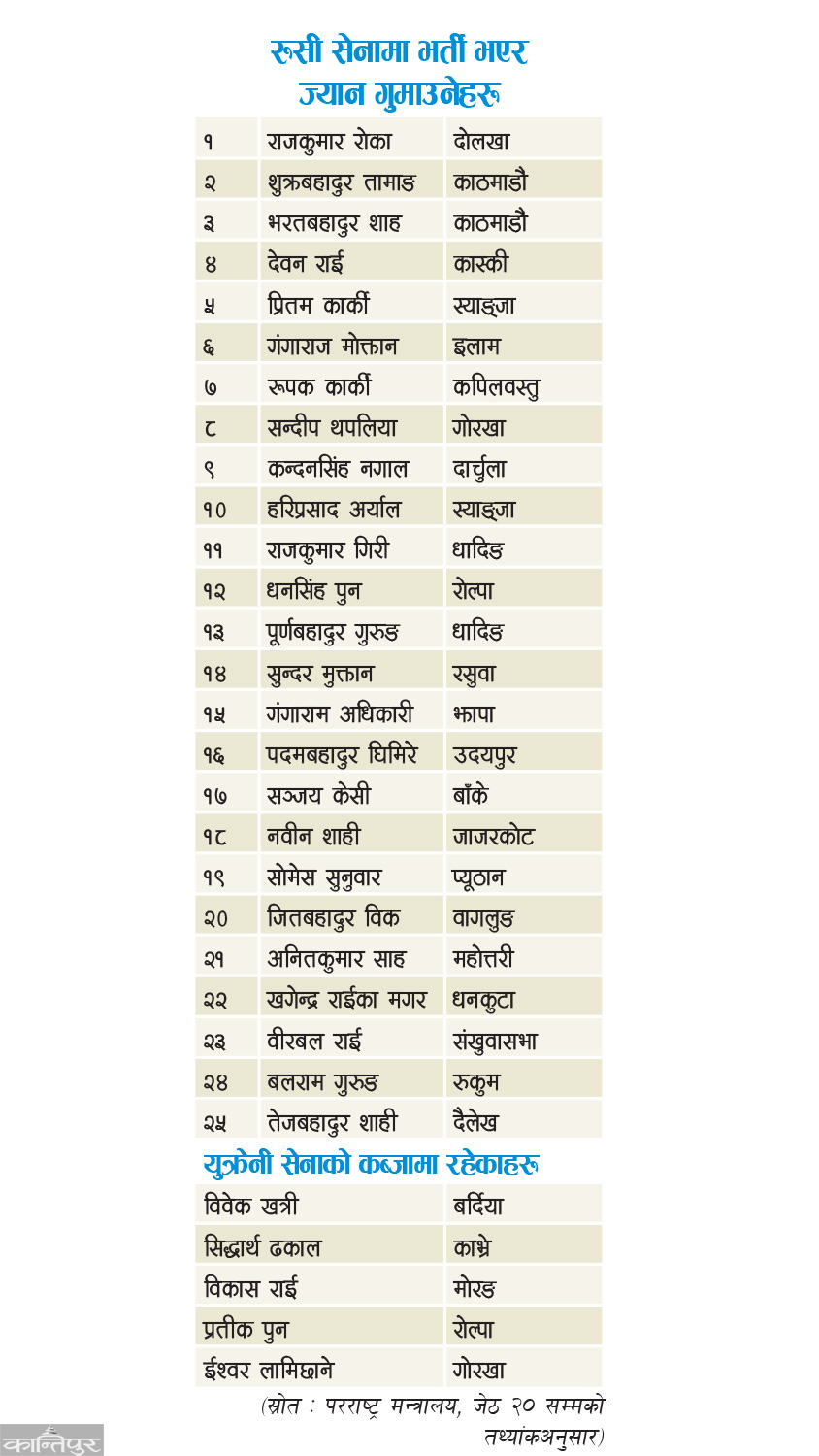
Two more Nepalis who joined the Russian army have died. According to Ministry of Foreign Affairs sources, the number of Nepalis who were illegally recruited into the Russian army and died in the war with Ukraine has now reached 25. According to the data till May 20, 25 people have died.
Balram Gurung of Rukum and Tej Bahadur Shahi of Dailekh were added to the 23 deaths earlier. The Nepali Embassy in Moscow informed the Ministry of Foreign Affairs and the Russian Government informed the Nepali Embassy about their death.
Despite continuous efforts of the Nepal government, the Russian government has not given Nepal the data of how many Nepalis are recruited in the Russian army, how many are injured and how many have died. Despite repeated requests and letters from the Nepalese government to the Russian government, the Russian Foreign Ministry has not responded to Nepal stating that the matter belongs to the Ministry of Defence.
On February 24, 2022, Russia is illegally recruiting Nepali people in the war that started after Russia attacked Ukraine. Deputy Prime Minister and Foreign Minister Narayankaji Shrestha had a telephone conversation with Russian Foreign Minister Sergey Lavrov on February 24 regarding the same issue. In the
conversation with the Russian side, he asked to send the bodies of Nepalis who died in the war to Nepal, to provide compensation to the families of the Nepalese who died in the war, to send back those who were injured and joined the Russian army, not to recruit Nepalis into the Russian army, to inform the Nepalese government of the number of Nepalis who were recruited into the Russian army. Din, who joined the Russian army and was captured by the Ukrainian army, asked to arrange a high-level visit. But Russian Foreign Minister Lavrov did not want to discuss other issues even though Russia is ready to compensate the families of those killed during the war.
The status of 5 Nepalis who joined the Russian army and are being held by the Ukrainian army is still unknown. Among the captured Nepalis are Vivek Khatri of Bardia, Siddharth Dhakal of Kavre, Vikas Rai of Morang, Pratik Pun of Rolpa and Ishwar Lamichhane of Gorkha. Although the Nepalese government has tried to release them in cooperation with the Russian government, the initiative has not been successful so far.
Working group formed to study Russia affairs
A high-level task force has been formed under the leadership of the Ministry of Foreign Affairs to study the events and the future path in Russia. In a meeting held on May 11 under the leadership of Deputy Prime Minister Shrestha, a high-level task force was formed under the leadership of Ganesh Dhakal, head of the Europe-America Division under the Ministry of Foreign Affairs, to resolve the ongoing crisis in Russia. According to foreign sources, Deputy Prime Minister Shrestha, another Deputy Prime Minister and Home Minister Ravi Lamichhane, Labor and Employment Minister DP Aryal and Education Minister Sumana Shrestha participated in the meeting and formed a working group to study the Russian affairs and make suggestions.
The task force has been tasked with submitting recommendations on the ongoing activities related to Russian affairs and how to proceed. The task force has one member each from the Ministry of Labour, Ministry of Education, Ministry of Home Affairs, Consular Department and Immigration Department. The task force has been given one month's time. Nepal's relationship with Moscow has also become more complicated due to the death of Nepalis who joined the Russian army during the war. "A high-level working group has been formed to study the situation," the foreign source said.
The working group will discuss the conditions of the work permit to be obtained from the Ministry of Labor when going to work in Russia, the NOC (No Objection Letter) issued by the Ministry of Education to the students, the police report required when going abroad, the work to be done with the Consular Department, and the procedure at the Immigration Department when leaving the country. A report is being prepared after studying the subject.
The Ministry of Labor had already formed a working group under the leadership of a deputy secretary to conduct a 'study on the involvement of Nepalis in the Russian army and human trafficking in the name of individual labor permits'. A working group was formed under the leadership of Deepak Dhakal, Deputy Secretary of the Ministry, a year ago. The task force included Vikas Kumar Rajak, Usha Gautam and Niraj Thagunna along with Dhakal. The task force submitted a report to the ministry in December 2080, which has not been made public yet.
The main findings of the study of the report of the task force received by Kantipur include the use of state power to recruit Nepali citizens including citizens of other countries in the Russian army, the use of various methods of attraction, extensive propaganda and the involvement of agents in an organized manner to prevent Nepali citizens from joining the recruitment process. It is mentioned that the efforts that have been stopped should be made more effective.
Similarly, it is mentioned that there are certain data available about the number of Nepalis participating in the Russian and Ukrainian army. The situation is still the same. In the said report, it is said that there has been an increase in the activities of gangs that bring Nepali citizens to the destination country under the name of visit visa and force them to work as bonded labourers. In addition, it is said that there is a lack of sufficient coordination and cooperation between the Foreign Employment Department, Immigration Department, Nepal Police and concerned agencies in order to suppress the gangs of human trafficking through the labor approval of foreign employment. According to the
working group's suggestion, it is the responsibility of the state to rescue its citizens who are at risk, and it has been mentioned that the government of Nepal has already requested the Russian and Ukrainian governments through diplomatic channels for the return of their citizens. In addition, in reference to the fact that the Nepalese who were recruited into the Russian army and returned with the help of various local agents managed to escape and return to Nepal through India, it is suggested that there is no alternative to rescue their citizens immediately with the help of the Nepali diaspora in Russia and Ukraine and if necessary, coordinate with neighboring and other countries. is. According to the suggestion of the
working group, it has been emphasized that the recruitment of Nepalis in the army of countries other than countries with special treaties and agreements is against the policy of non-alignment of the state and it is desirable to discourage it. The report of the working group also suggests that there is a need to make necessary provisions in the law so that those who join such activities will be punished up to not being able to go for foreign employment in the future.





