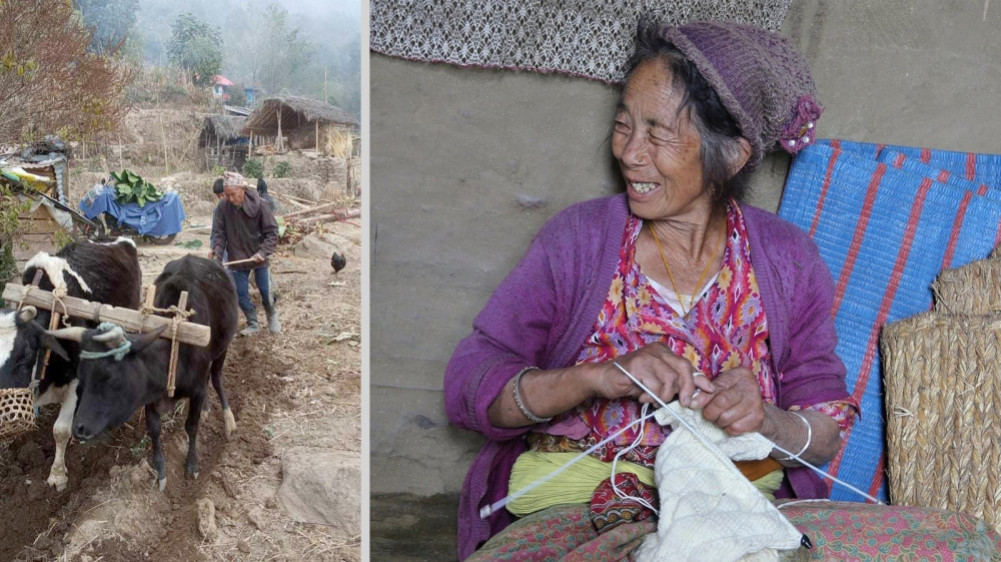
When the road was dug randomly to connect the village with the road, not only the house was taken away, but the agricultural fields were also left barren.
We use Google Cloud Translation Services. Google requires we provide the following disclaimer relating to use of this service:
This service may contain translations powered by Google. Google disclaims all warranties related to the translations, expressed or implied, including any warranties of accuracy, reliability, and any implied warranties of merchantability, fitness for a particular purpose, and noninfringement.
Uddhav Bahadur Rai of Bhojpur's Salpasilichho Rural Municipality-4 Panlung followed the agricultural profession throughout his life. Now, even at the age of 75, he is equally involved in fairs. However, even in the Sarsila farm, which is used to grow food for the family, it has stopped growing as much as it has been labored over the past few years.
Around the year 038/039, he sold his farm and moved to Madhesh, and bought a 15-plant Sarsila farm that was irrigated by a private garden. To reach the farm, you have to go down for an hour through the Tenzing Hilary road along the banks of the Irkhuwa river. The farm was irrigated by a private well brought from the Puwa river on the west side. Even if there was only one crop, 30 to 35 muri of paddy would grow . Uddhav Bahadur's wife Ratna Kumari found it very easy to run a kitchen in a family of seven after rice started coming into the house.
6 years ago, the local agricultural road network was connected to the local agricultural road network, but the locals were happy to be able to drive in the village even though the road was dug up, destroying, destroying and damaging the farmlands that have been used for generations. When the unpaved road became a pothole after the rains, the damage to the fields started to increase. Uddhav Bahadur is among the farmers who have been suffering due to the road.
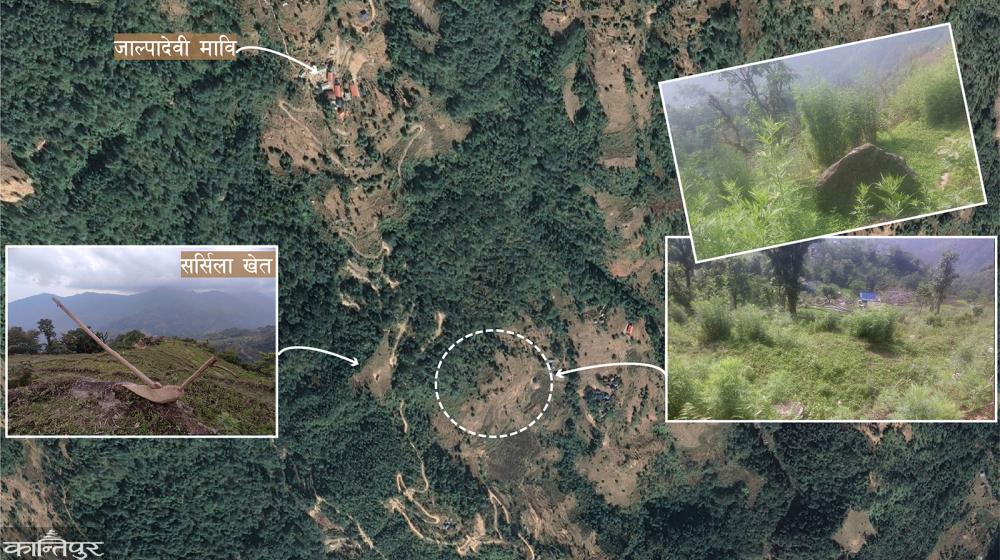
In January 074, a road track was opened from Tenzing Yaksadanda to Mastir Jalpadevi Mavi and villages through Sirsila Khet. The dirt and mud from the roads dug in the steep and sandy land were washed away and covered the fields . The road was upgraded one year before the second local level election. Those who got the contract to dig the road said that the road dug to save the Sarsila field has not reached a turn and there is a risk of landslides.
He didn't think it was right to dig a road over the hill so that the fields he had been planting for four decades would become barren. He came to the conclusion that if he alone will affect the development of the village, then why not? He allowed . At present, the road is about 100 meters long. Earlier, when the farming season came, the leaves that fell in the fields would once reach Sohore . Since the road was dug through Kulo four years ago, it has to be built three to four times every year. After this, Uddhav Bahadur's life started suffering from the road.
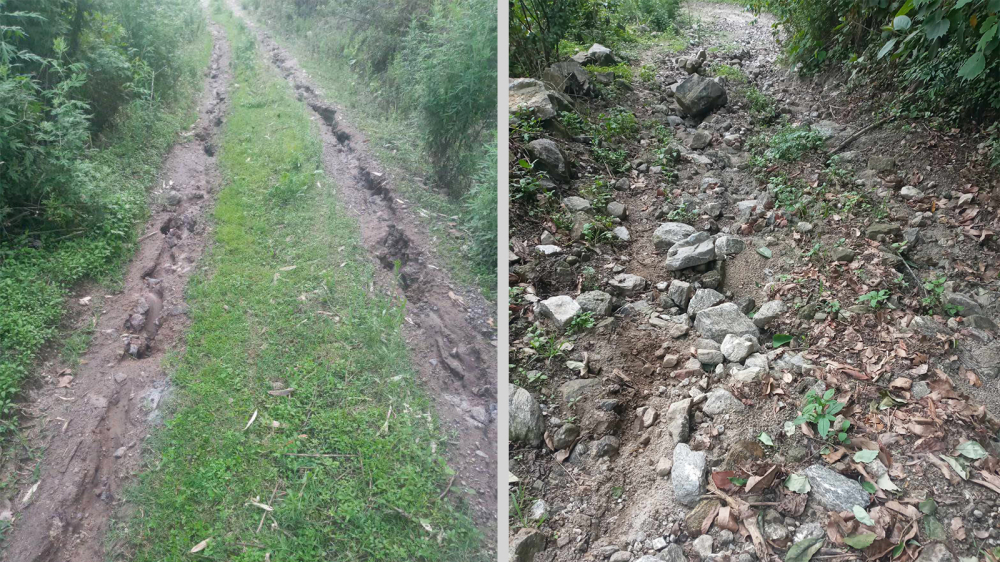 Photo Courtesy : Vinod Rai
The first year we had to find the village destroyed by the road. Every year, the flood that flows through the road carries stones, gravel, sand, gravel and piles it in the ground, and it keeps collapsing in places. It costs 15/20 thousand every year to repair it by using people . Irrigation is not enough in the field when it is needed . The crop has decreased due to lack of irrigation . Now hardly 15 muri grows . Uddhav Bahadur said to Kantipur, "We have also cultivated a little lemon due to the lack of irrigation. The rest of the fields will have to be planted anyway. Our (family) is the breadwinner. Farm is .'
Sirsila Khet falls under Jalpadevi Mavi . The road distance from Yaksadanda to Jalpa Mavi is about five km uphill. Not only Sarsila field was damaged by this road, but one of the three parts of Sanjeev Khaling family's field of Salpasilichho-4 Wasepla is lying barren so that no paddy ever grows. In the year 074, when the road track was opened one km from the farm, large stones and piles of soil were dropped on the farm . The lower part of the farm was also cut by the road. Rudraksh plants and sheds were buried. Due to the loose and sandy soil, landslides keep falling . The bull keeps entering the field . He said that it will be difficult to grow 15 muri in the field that used to grow 30 muri. "We even tried to stop digging, we told them that we could not stop development without digging," Sanjeev said, "Now it is difficult to raise the effort put into the farm, we have to buy rice and eat it." "The road has been taken through our farm, we are still paying the tolls, since the land is for the road, the tolls should be reduced!" he added.
Prakash Rai, another resident of Panglung, agrees that the road has affected farming. But he says that it cannot be denied that development leads to destruction. "Development is also needed, we have to lose something to get something, my farm has been wiped out," he said. It is also difficult for vehicles to move on the roads that have been built by spoiling the grain farms of the farming families. "The place is steep, the water washes away, we can't see a car since June, it's difficult to ride a bike, we have to walk for an hour to reach the village," Prakash said.
Vinod Rai, a teacher of Jalpadevi Mavi, said that the road dug randomly without a channel to drain the water would become useless if it rained a little. "If we do not build a channel to drain the flood, the whole road will be washed away, we teachers and students are afraid of landslides even to go to school in Barkhamas," he said. As mentioned by the mentioned characters, due to the road, the agricultural land located in hilly, steep and weak terrains is eroded, production decreases and the overall livelihood is affected . One of the many reasons for reducing agricultural production is the ubiquitous construction of roads. According to the agricultural calculations of the National Statistics Office, in the last one decade, 14,964 hectares of agricultural land has been subjected to 'soil erosion and physical degradation'.
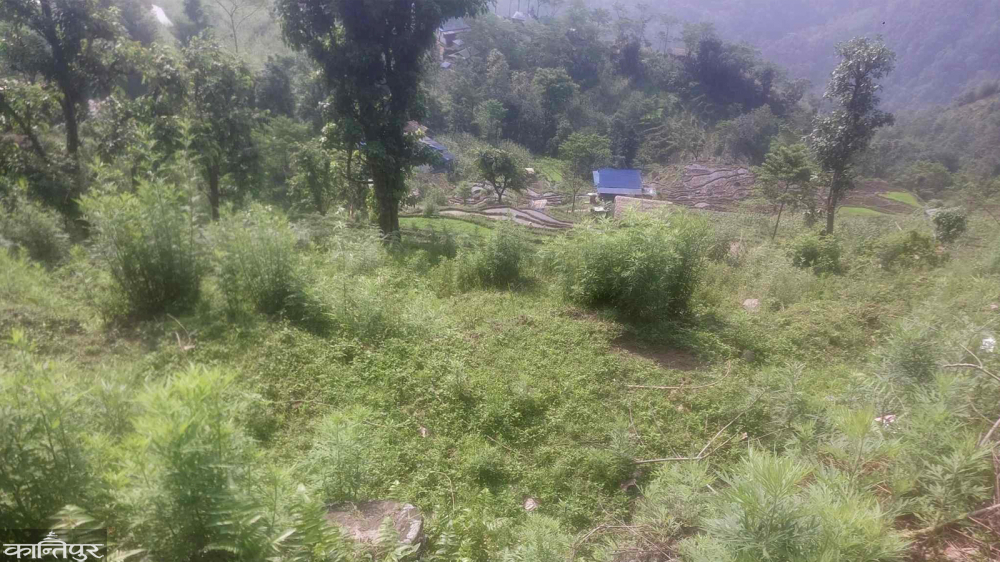 Photo Courtesy: Sanjeev Khaling
According to Hemraj Regmi, Chief Statistician of the Statistics Office, not only soil erosion, landslides, dry landslides and earthquakes have destroyed agricultural land, roads are also the main responsible for this. 'Roads are dug up randomly, there is a tendency to dig roads even in undigested terrain,' he says, 'because of this, landslides occur after rains, destroying agricultural land and making it a bog.' . Regmi adds, "If it is in the plains, it is stable, even if there is a flood this year, there is a high possibility of cultivation in the next year or two. In the mountains, that possibility is very low, it cannot be cultivated at all." According to the economic survey of 080/81, agriculture is the main occupation of about 62 percent of the families in the country. Likewise, 67 percent of the total population is in the farming family. Based on these figures, 78 lakh 77 thousand population of farming families in hilly areas are more or less affected by the damage caused by the road to the arable land . According to the census of 078, the total population of the hill is 1 crore 17 lakh 57 thousand 624 people.
The construction of the local road in the Tangkhuwa river watershed area of Dhankuta, a neighboring district of Bhojpur, had the same effect on the farmers of Salpasilicho. According to the journal published in the year 2017, "Unpaved road construction in the Tankhuwa river watershed area and the damage it caused to agricultural land", after the implementation of the federal structure, road construction activities to connect every ward increased. It is mentioned that not using the proper knowledge, skills, and design to build roads has affected the environmental resources, agriculture and livelihood of the watershed area. 'Roads naturally connect local people with access to markets, education and health,' the journal said, 'Unfortunately, roads such as these roads have dramatically destroyed land and greatly increased the risk to the livelihoods of communities in the watersheds due to the lack of engineering in cutting land, walls and drainage. .'
Not only in Bhojpur and Dhankuta, such damage is found in the hilly and hilly districts of Karnali and Sudurpaschim. Until 1974 years ago, even the families who were able to live off of the produce of the farm are forced to go to seasonal labor in India due to the impact of dug roads everywhere. The Ministry of Physical Infrastructure, Energy and Water Resources of Karnali Province in the year 074 from Narayan Municipality-4 Bhirmaura to Dungeshwar Rural Municipality of Dailekh and Narayan Municipality in the year 078 ward no. After the construction of the road from Bhaisikhor to Bhirmaura on 4th, the water source and irrigation canal were buried and the crops of 28 farming families were destroyed. The agricultural land of 8 families was buried and became barren. The agricultural land of the rest of the family is being destroyed every year due to road landslides. "Since the agricultural land and crops are decreasing, the pressure has increased for the people here to go to India and go to the Gulf countries to avoid two problems," said Prakash Negi, a food rights activist from Dailekh.
According to the records of the Ministry of Physical Infrastructure and Transport, 34 thousand 267 km of roads have been extended by the federal government and 67 thousand 246 km have been extended by the provincial government and local levels, so far a total of 1 lakh 1 thousand 513 km of road network has been connected across the country. is . This data is up to February 080/081. According to the economic survey report published by the Ministry of Finance on May 13, 55 percent of the state and local level road networks are built in the mountains, 29 percent in the plains and 16 percent in the Himalayas. However, most of the local roads dug in Hachuwa have added more suffering than comfort to the common people.
078 Khaptadchanna Rural Municipality of Bajhang suffered a large amount of loss of life and property when the floods came along with the unseasonal rains from October 31 to October 3. The farms were washed away and destroyed. When the local people's representatives used heavy equipment (dozers) on the pretext of digging roads and connecting villages, a flood occurred in Khaptadchanna, which has a steep and weak terrain. Many of the flood victims left the village before the second local level election after waiting for 6 months for the government to build houses. They went to India to work as there was no farm to live in and food to eat.
Even though roads are said to be the main basis of development, the trend of haphazard construction has affected the livelihood based on agriculture . The contribution of the agricultural sector (agriculture, forestry and fisheries) to the country's gross domestic product is decreasing. It has decreased by 3.58 percent in the last five years. According to the records of the National Statistics Office, the contribution of the agricultural sector to the total domestic product last year was 23.92 percent, while it was 27.5 percent in the year 075/076.
The government has created an environmental protection act and regulations to prevent any plan or project from affecting the environment, social and livelihood. However, effective implementation has not been done. Even if there is no implementation, the affected will not protest. "The road is what people want, even if it is designed straight, they say build it in my yard by turning two km until it meets," says advocate Anil Kumar Shrestha, "that's why they don't look at it from the environmental aspect, building it like this will have an impact, even if it's not 'anti-development'". Shrestha, who is also a co-professor of Kathmandu School of Law, has acted as a mediator in more than 100 cases between irrigation, drinking water and road projects, but he said that he was not aware of environmental issues in road projects. "Environmental issues of other projects often come up, I have not found any environmental issue related to the road in my 'notice' until today," he added.