We use Google Cloud Translation Services. Google requires we provide the following disclaimer relating to use of this service:
This service may contain translations powered by Google. Google disclaims all warranties related to the translations, expressed or implied, including any warranties of accuracy, reliability, and any implied warranties of merchantability, fitness for a particular purpose, and noninfringement.
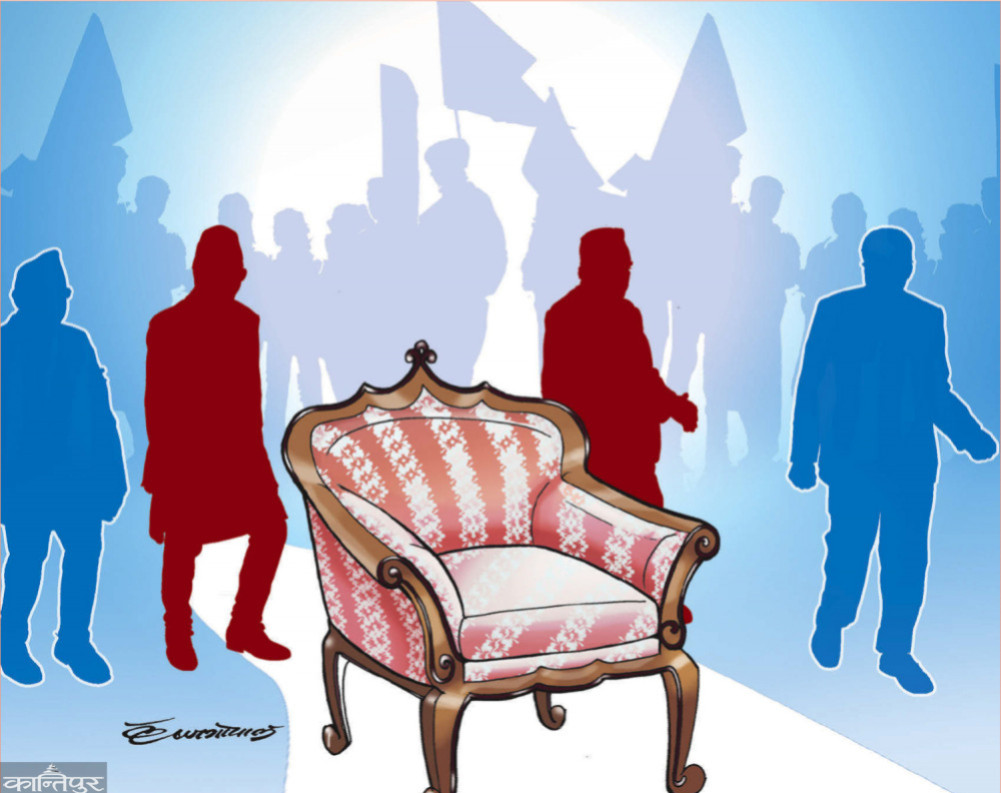
In the meeting called by Congress President Sher Bahadur Deuba on Wednesday, the participation of United Samajwadi Party president Madhav Kumar Nepal and the party's chief whip Metmani Chaudhary has raised many doubts about the current power alliance.
After the meeting that lasted for about two hours in Budhanilkanth, Chowdhury gave an interview to Kantipur Television and predicted that 'Madhav Nepal will soon become the Prime Minister', and the politics has become more turbulent. Is the political course of Madhav becoming the Prime Minister of Nepal moving forward as Chaudhary said?
In particular, Deuba had called a meeting to discuss whether to allow the UML and Maoist alliance to form a government in Madhes province or to continue with the Jaspa-led government by giving a vote of confidence. After the separation of UML and Maoists, Chief Minister of Madhes Province Saroj Kumar Yadav has fallen into the minority. While he is preparing to take the vote of confidence on May 23, Jaspa president Yadav, who has left the central government, has been requesting Deuba to save the Madhes state government. Even with the support of Congress and LOSPA, the JSP-led Madhes-Pradesh government will not be saved . The relationship between Yadav and Janamat Party President CK Raut Water is equal. Since there is no possibility of his support, Deuba called the President of the United Samajwadi Nepal in the meeting. If the
was the subject of the central alliance Deuba used to call RPPA to the meeting as well. There is no doubt that the discussion between Congress, JSP, United Samajwadi Party and LOSPA without calling the RPP was mainly focused on the issue of the Madhes-Province government. Total in Madhes Province In 107 seats, these four parties get 55 seats . Which can save Saroj Kumar Yadav led government .
According to Jaspa President Yadav, the central discussion topic was the government of Madhes-Pradesh, but the conversation was not limited to this. There were discussions to find an alternative to the central alliance. In response to Kantipur's question that efforts are being made to change the alliance of the centre, Yadav said, "The alliance cannot be changed and it is not impossible". No government is permanent in Nepal. However, it does not appear to be immediate.'
Prime Minister Pushpa Kamal Dahal is the most upset about Nepal's participation in the meeting called by Deuba. Understanding the psychology of Dahal, Jhalnath Khanal, the respected leader of the United Socialist Party, tried to reassure him that his party's support was in favor of the current alliance. Dahal also talked to Nepal over the telephone. Arriving at Biratnagar, the Prime Minister refuted the criticisms about the government's lifespan and said, "Madhavji's behavior seemed to connect with the opposition and the ruling party from some time ago." When I spoke with me this morning, it was 'cleared' that Madhavji is not and will not be out of the current equation. Deuba, Madhav Nepal and Yadav were prime ministers alternately. Yadav was the Health Minister along with the Deputy Prime Minister at that time. JSP was divided by Prime Minister Pushpa Kamal Dahal and UML President KP Oli after receiving information that there was an alternative alliance within the government. 12-seat Jaspa is not complete now . The new party led by Ashok Rai with seven MPs is in the government, the Yadav party with five MPs is in the opposition coalition.
How likely is the alternative alliance ?
Among those who did not participate in the government and did not support, 88 of the main opposition Congress, 14 of the RPP, 5 of the Jaspa led by Upendra Yadav, 4 of the LOSPA led by Mahanth Thakur and 1 of the Jan Morcha The opposition coalition has a total of 112 MPs. The opposition coalition needs 26 more MPs to gather 138 members for an alternative government.
The president of the United Socialist Party of Nepal has been keeping his foot in the boat of both the ruling party and the opposition. Nepal is not satisfied with power sharing. Also, due to UML President Oli's 'hepai' style, he is in a position of umpire in the power coalition. Nepal is a silent spectator in the division of power and power. In the midst of many pressures, the Chief Minister has been found in the Sudurpaschim Province, but the Cabinet has been saying that there is no cooperation in the expansion. After not getting any role in the current alliance, Nepal is standing in favor of an alternative equation in which it will be the prime minister and Leaders close to him say that he is working with and supporting Deuba.
When adding 10 seats of the United Socialist Party, only 122 MPs are with the opposition. Now 16 MPs are not enough for him. How to raise disabled MPs? According to a Congress leader, this issue was also discussed in the meeting of the four parties held at Deuba residence on Wednesday.
According to one of the leaders who participated in the meeting, the case pending in the court regarding the division of the Jaspa After the final hearing, it will be decided whether the alternative alliance will take a decisive turn or not. If the court's decision is in favor of Yadav, there are preparations to unite the party immediately with the Unified Samajwadi Party. Despite that, the majority in the opposition coalition is not enough. 9 more MPs are required. The majority will be achieved only if the 11 MPs of the People's Opinion and Civil Liberation Party, who have supported the government but have not participated, can be drawn. At that time, public opinion and civil emancipation will be the decisive force.
The meeting held at Deuba's residence has also concluded that there is no other option but to wait for the court's verdict on the writ filed in the court regarding the division of Jaspa . JSP split on 23rd Baisakh when President Yadav was abroad. After the party split, he returned home on Baisakh 25. When the Political Party Act 2073 was inoperative, the Election Commission recognized the division of parties based on it, and Yadav approached the court with a writ on 31 Baisakh. This certificate has been given to the political party Janata Samajwadi Party, which was formed out of a political party named Janata Samajwadi Party Nepal, to be registered with the Election Commission in accordance with Rule 5 of the Political Party Act 2073 and Political Party Regulations 2074. It is said in the certificate given by the Commission to the president of Jaspa, Ashok Rai. On the
writ, the court on June 2 Issuing a short-term order, the Commission has been asked to keep all decisions and actions as they are . May 8th Both sides were called for discussion. However, the hearing of the case has been postponed as it cannot be seen.
How did the law become inactive?
The then Prime Minister Sher Bahadur Deuba had brought an ordinance by amending the Political Party Association Act on July 32, 2018. By amending the Political Party Act, an ordinance was brought with the provision that the party can be split on the basis of 20 percent central members or federal MPs. On the basis of that ordinance, a new party was formed under the leadership of Mahant Thakur from UML and Nepal from Jaspa. After that, the Parliament did not move a replacement bill to accept the ordinance. According to the constitutional provisions, the said ordinance was automatically revoked by the President on 078/06/11.
After the repeal of the ordinance, the old law automatically activates the bathing tradition . This is more a matter of parliamentary tradition than legal. In parliamentary practice, after the new law is automatically repealed by the ordinance, a separate bill should be taken to the parliament to revive the old law. There is a trend of taking the bill by looking at "constitutional practice, and the spirit and spirit of the prevailing law and national and international practice". According to the same tradition, the then Home Minister Narayankaji Shrestha on 18th January 2080 The bill was registered in the parliament .
'According to Part 29 of the Constitution, the Political Parties (Second Amendment) Ordinance 2078 has amended some of the provisions of the Political Parties Act 2073 and after the amendment, the said ordinance has been repealed by the President on 06/11/078 according to the prevailing law, constitutional practice, And looking at the essence and spirit of the current law and national and international practice as well, the amendment bill is necessary to remove the legal provisions changed by the ordinance and maintain the previous provisions of the law, so a bill has been prepared to amend the Political Party Act 2073. mentioned . By removing the provision of sub-section (2) of section 33, which was changed by the ordinance in the
bill, 'If at least forty percent of the members of the central committee of a party and the parliamentary party of the federal parliament form a new party or join another party or if such members also form a new party. It is mentioned that a member of such a parliamentary party is not considered to have left the party.
Deputy Prime Minister and Home Minister Ravi Lamichhane withdrew the second amendment bill related to political parties, which had been registered and notified to Parliament by the then Home Minister Shrestha on 4th May 2080 . The main purpose of this is that if the court gives a verdict in favor of Yadav, it would immediately bring an ordinance and maintain the new party led by Ashok Rai . Lamichhane was forced to withdraw the bill amid the obstruction of the parliament based on the assumption that the court could make a decision on May 8. For this reason, the Parliamentary Inquiry Committee There was a delay in becoming . Until May 8th, the ruling party, especially UML president KP Oli, was not in favor of forming a parliamentary committee to investigate the cooperative case. For some time, Oli was in favor of maintaining the obstruction of the Congress. Oli thought that parliament can be terminated only on the pretext of that. The ruling party has become flexible to form a committee after the case has moved on saying that the court will not look into it.
'You will know not to try for an alternative alliance just by looking at the decision of the JSP Partition Court', a Congress official said, 'The theory is being confirmed that the current alliance is very dangerous, but the number has not reached . The day the number reaches the atmosphere, and only the alliance takes shape . There is no scene of formation and collapse of alliances.'