We use Google Cloud Translation Services. Google requires we provide the following disclaimer relating to use of this service:
This service may contain translations powered by Google. Google disclaims all warranties related to the translations, expressed or implied, including any warranties of accuracy, reliability, and any implied warranties of merchantability, fitness for a particular purpose, and noninfringement.
The government has continued the old plans in the health sector in the next year's policy and program submitted to the parliament through President Ramchandra Paudel. The programs that have been announced for the past few years and could not be fully implemented, such as the construction of a basic health hospital, institutional structure for quality control of medicines and food items, and increase in hospital hours, have also been presented this year.
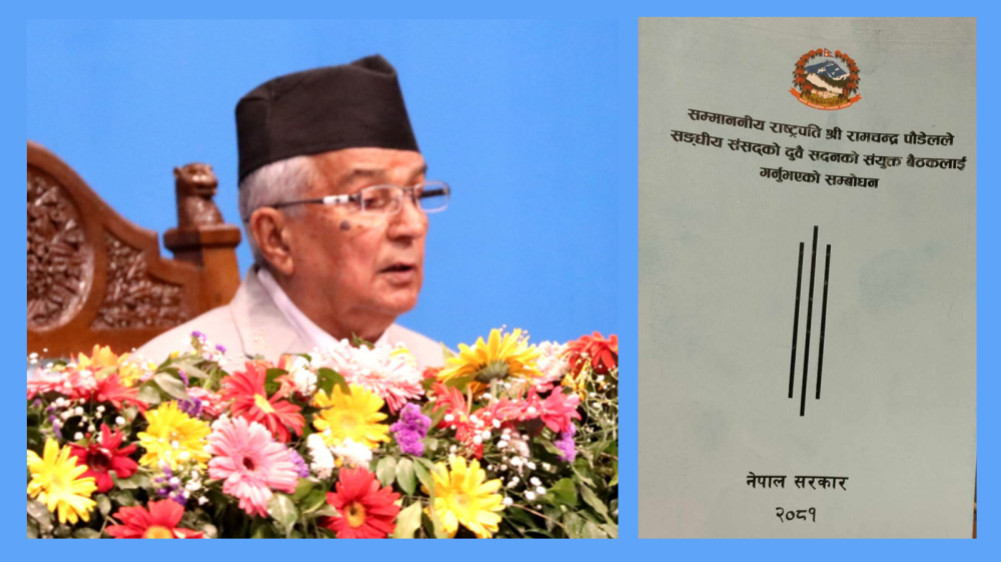
President Paudel presented the policy and program for 2081/082 on Tuesday at the joint meeting of both houses of Parliament. In this year's policy and program, to increase coordination between the three levels of government, from making healthcare services easy, quality and accessible, mental health, electronic record system in government hospitals to Yoga and Ayurveda have been placed.
The 5, 10 and 15-bed basic hospital that will be built by the government at the local level has also been made a major topic in the policy and program this time. President Paudel said that as a progress of the government last year, the construction work has been prioritized by prioritizing the local hospitals under construction, but there has been no concrete achievement. In most of the places, the construction of the hospital has started but it is in a standstill.
In the policy and program of 2077/078, the then Prime Minister KP Sharma Oli-led government announced that basic hospitals with 5, 10 or 15 beds will be built at every local level based on geography and population. According to the same policy, a ministerial decision was made to build 396 basic hospitals on July 28, 2017 and 259 on December 12. But the construction of most of the hospitals has been stalled for three years.
Oli laid the foundation stone for building 396 hospitals at the local level on 077 December 15. It was also interpreted by the then government as a 'big revolution' in the health sector. The construction of the hospital which laid the foundation stone in the first phase was not completed and it was decided to build 259 more hospitals at the local level . But not all the hospitals have been built yet, the construction is also very slow .
Among the 396 basic hospitals that have laid foundation stones in the first phase, there are 47 5-bed, 107 10-bed and 242 15-bed hospitals. The Ministry of Health and Population has already ensured the expenditure of about 58 billion rupees for the construction of these hospitals. For the 259 additional hospitals in the second phase, the Ministry of Health says that the resources have not been ensured.
Out of the 396 foundations laid in the first phase, 315 hospitals are under construction, according to the ministry. Due to the dispute of some, the work has been stopped in the middle . Similarly, 98 out of 259 of the second phase are under construction.
OPD in two shifts
President Paudel has announced that the policy and program presented this year will be conducted in two shifts in government hospitals with large structures and resources . Outpatient services will be conducted in two shifts in hospitals that have sufficient manpower, including Veer Hospital, National Trauma Center, Kanti Children's Hospital, said in the policy and program. However, the same kind of announcement made by the government last year has not yet been implemented.
"In addition to ensuring the system of one doctor and one hospital in community hospitals, outpatient services will be arranged from 8 a.m. to 8 p.m.," it was announced in last year's policy and program.
The government has looked at the health services provided by the three-level structure separately since the country's federalism, but it has tried to correct it in this year's policy and program. Basic health facilities will be guaranteed to every citizen by integrated and coordinated mobilization of the three levels of health service system, physical infrastructure, manpower and resources. The health services flowing from the union, state and local levels will be classified,' it is said in the program, 'federal hospitals will be restructured on the basis of workload.' has announced to strengthen service delivery. The government has announced the upgradation of Shaheed Gangalal National Heart Center, Human Organ Transplant Center, Charitable Obstetrics and Gynecology Hospital, Kanti Children's Hospital.
'Kanti Children's Hospital will be equipped with facilities by building more infrastructure and upgrading it. Shahid Gangalal National Heart Center will be developed as an organization capable of producing specialists in heart diseases," the announcement said, "Federal hospitals or health science institutes at the state level will be gradually upgraded to 500 beds. Human organ transplant institutions and services will be upgraded and expanded.
The government has also announced that fetal and newborn examination services will be started to identify congenitally disabled or abnormal conditions at the Charitable Obstetrics and Gynecology Hospital. In addition to this, the government has announced through policies and programs that arrangements will be made to provide geriatric wards in all hospitals so that senior citizens can get healthcare easily.
In order to make the service flow of all government hospitals smooth and easy, the government has mentioned in this year's policy and program that the records and service flow related to treatment in all federal and provincial hospitals will be made based on electronic system . "There will be no need to do the same type of tests repeatedly and medical records will be updated by arranging for electronic records of health institutions to be accessible to each other," said the policy and program.
Mandatory health insurance
The government has announced that the health insurance program, which is being criticized everywhere as being in a state of failure, will now be compulsory for all. President Paudel has mentioned that arrangements will be made for mandatory participation in health insurance for all organized sectors, including government and non-government across the country. In addition to this, the government has also announced that institutional arrangements for food and drug regulation will be made to ensure proper use of medicines and safe food use. "Quality testing and regulation of drugs and medicinal materials, health equipment, cosmetics and nutritional supplements will be made more effective," the policy and program states, "The capacity of the national drug laboratory will be increased with the system of drug quality control."
government Last year, it was also mentioned that the Department of Drug Management will be transformed into the Department of Food, Medicine and Health Technology, and arrangements will be made to produce 98 types of medicines in the country, which are necessary for the delivery of basic health services. Similarly, it was also announced that financial and other facilities and concessions will be provided to be self-sufficient by producing medicinal and health materials in the country. This topic is also included in the policy and program of the next financial year.