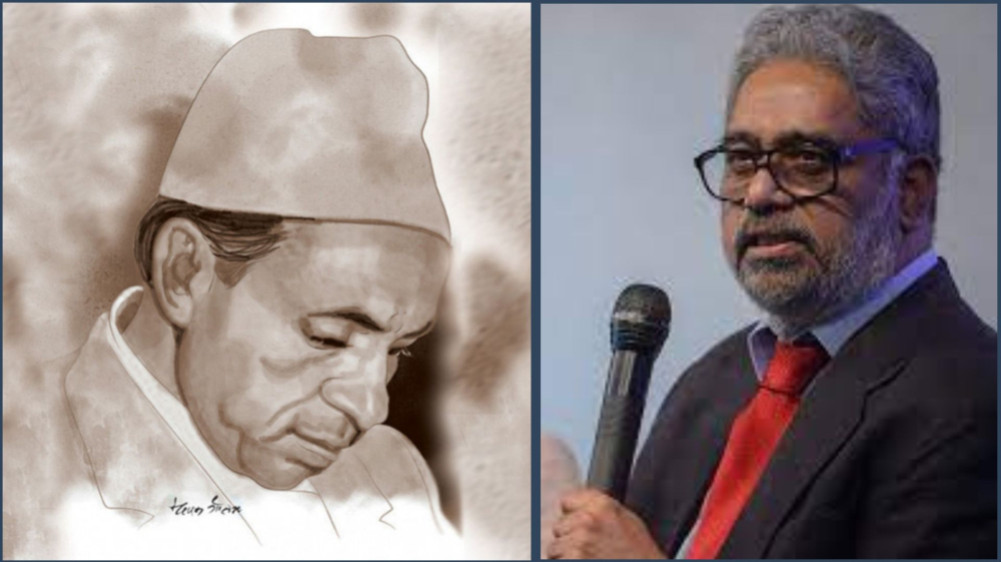
Delivering a lecture on 'Nepal-India Relations: Possibilities and Paths'
We use Google Cloud Translation Services. Google requires we provide the following disclaimer relating to use of this service:
This service may contain translations powered by Google. Google disclaims all warranties related to the translations, expressed or implied, including any warranties of accuracy, reliability, and any implied warranties of merchantability, fitness for a particular purpose, and noninfringement.
In the third edition of the 'Professor Yadunath Khanal lecture series' organized by the Ministry of Foreign Affairs, India's renowned geopolitical expert Professor C. Raja Mohan is going to give a sermon on Tuesday. According to the Ministry of Foreign Affairs, he is going to give a speech on 'Nepal-India relations: possibilities and ways'.
The first edition of the lecture was presented two years ago by Professor Surya Subedi of the University of Leeds, UK. Former Foreign Secretary Madhurman Acharya gave a speech in the second edition. Professor Raja Mohan is going to give a presentation in the third edition.
Who is the diplomat khanal?
After the establishment of democracy in the country (year 1951) and membership of the United Nations (UN) (year 1955), Nepal was rapidly establishing bilateral relations with various countries on the one hand, and on the other hand, during the Cold War, it emphasized the non-alignment movement without joining any pole of the American or Soviet Union. ; Yadunath Khanal was given the responsibility of handling international relations on behalf of Nepal in the complex geopolitical situation of the world at that time. The Ministry of Foreign Affairs is going to organize the ``Professor Yadunath Khanal Lecture'' in honor of Khanal, who has shown excellent skills in carrying out his responsibilities as Foreign Secretary, Ambassador, and Advisor to the Prime Minister on Foreign Affairs.
Professor Khanal's contribution to Nepal's foreign policy, diplomacy and important issues of the country's national interest was to be given a lecture in his name by the Ministry of Foreign Affairs. According to the ministry, lectures on topics related to foreign policy and diplomacy, which are directly related to Nepal's national interest and international relations, have been held every year. People involved in foreign policy formulation and implementation, intellectuals and other stakeholders have been participating in the program held every year.
Khanal was the foreign secretary and ambassador to India twice under King Mahendra Shah. During the reign of King Birendra Shah, he became ambassador to America and China. After the establishment of multi-party democracy in the year 2047, Prime Minister Krishna Prasad Bhattarai of the interim government and Girija Prasad Koirala, who became the Prime Minister, became the foreign affairs adviser. Khanal, who was born in August 1913 in Manung, Tanahun, died in October 2004.
When the diplomat Khanal was in charge of international affairs, the world was divided into two poles and there were various problems all over the world due to poverty. Somewhere the political upheaval and somewhere the British rulers were going back home . After the return of the British government from India, Pakistan was separated. Later Bangladesh was born. There were issues including the entry of Soviet troops into Afghanistan. In that background, Khanal made a significant contribution to Nepal. Khanal emphasized that Nepal should adopt a policy of non-alignment during the tension between the US and the Soviet Union.
'Yadunath Khanal's biography helps to understand how scholarly critics and diplomats are made in an underdeveloped society like Nepal,' former Ambassador Jayaraj Acharya has written in the book 'Yadunath Khanal: Biography and Thoughts', 'Yadunath can understand both Kautilya and Kissinger in diplomacy and apply it in their own practice. Acharya expressed his happiness that the government is going to hold a series of lectures on international relations remembering Khanal.
Khanal studied English at Trichandra College in Kathmandu and later became a professor in the same college. In his book 'Nepal's Non-Isolationist Foreign Policy' (Nepal's Non-Isolationist Foreign Policy), he has also made it clear about Nepal's relationship with India and China.
"Our relationship with India and China has always been difficult and has become more complicated in the nuclear era due to the weak thinking and speech of politicians". Their declaration has nothing to do with their own performance,' he wrote in the book, 'Nepal, which is determined to maintain friendly relations with them as much as possible, has found the policy of dynamic neutrality to be the most suitable for them.' He has mentioned that he enjoys working even though he comes with doubts.