We use Google Cloud Translation Services. Google requires we provide the following disclaimer relating to use of this service:
This service may contain translations powered by Google. Google disclaims all warranties related to the translations, expressed or implied, including any warranties of accuracy, reliability, and any implied warranties of merchantability, fitness for a particular purpose, and noninfringement.
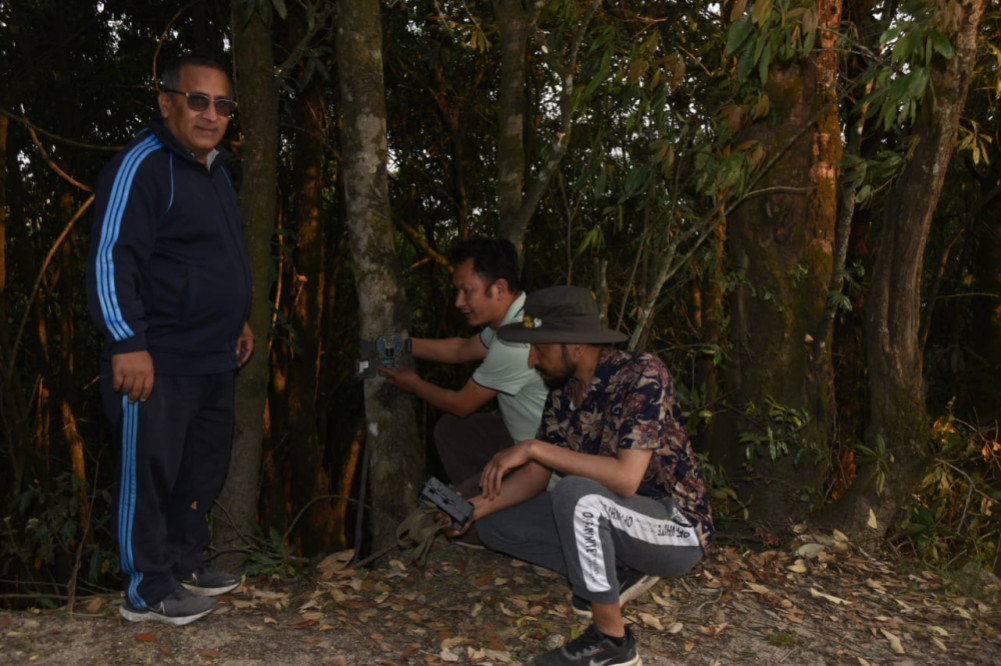
Installation of camera traps has started in Shivpuri Nagarjuna National Park to investigate leopards. Tilak Thapa Magar, a research student in the Central Department of Zoology, Tribhuvan University, is going to use camera trap technology to investigate the number of leopards and their activities.
There is a plan to study by placing 1 pair of cameras in each 1X1 square kilometer grid, currently 26 pairs of cameras are placed in 26 locations. In this study, which will last until June, 70 pairs of cameras will be placed in about 70 locations.
Each camera will be kept for at least 21 days. This study investigates the number, behavior and behavior of leopards in Shivpuri Nagarjuna National Park. And information about the activity will be received. Recently, as the conflict between humans and leopards is increasing in Nepal, it is expected that this study will help to reduce the conflict between humans and leopards by keeping information about the behavior and estimated number of leopards.
The study was supervised by Dr. Tribhuvan University, Associate Professor of the Central Department of Zoology. Hariprasad Sharma, Dr. Kedar Baral (Ministry of Industry, Tourism, Forest and Environment, Gandaki Province) and Dr. Naresh Subedi (National Nature Conservation Fund, Khumaltar, Lalitpur) and Ramji Gautam, Shivish Bhandari, Bimalraj Shrestha, and Surya Devkota is there.