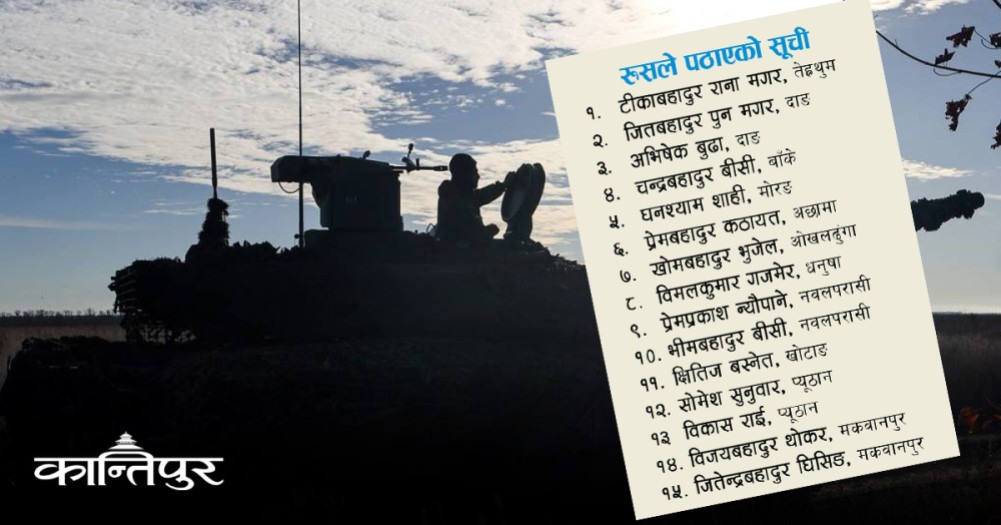
Russian spy to send 'DNA' sample of family member
We use Google Cloud Translation Services. Google requires we provide the following disclaimer relating to use of this service:
This service may contain translations powered by Google. Google disclaims all warranties related to the translations, expressed or implied, including any warranties of accuracy, reliability, and any implied warranties of merchantability, fitness for a particular purpose, and noninfringement.
Another 15 Nepalis who joined the Russian army have died. Russia has requested the Nepalese government to send the DNA samples of the close family members for identification and genetic testing of the deceased Nepali citizens. Those 15 who died were not in contact with their families for five months.
The Ministry of Foreign Affairs does not confirm the identity of the deceased Nepalese until the Russian government issues an official death certificate. The Ministry of Foreign Affairs has previously officially confirmed the death of only 17 people. Including these 15 who have not been identified, the number of Nepalis who died in the Russia-Ukraine war has reached 32.
On February 23, the Russian government sent a letter to the Nepal Embassy requesting to send a DNA sample. "In order to identify the body of a Nepali citizen working in the Russian army, it has been requested through a letter from the Russian Ministry of Foreign Affairs to contact his family members and provide his identification mark and DNA sample of a close family member for genetic testing," said the letter sent by the Nepali Embassy in Moscow to the consular department.
15 family members have been contacted by the consular department for DNA testing. Tika Bahadur Ranamgar of Tehrathum, Jit Bahadur Pun Magar and Abhishek Budha of Dang, Chandra Bahadur BC of Banke, Ghanshyam Shahi of Morang, Prem Bahadur Kathayat of Acham, Khom Bahadur Bhujel of Okhaldhunga, Bimal Kumar Gajmer of Dhanusha, Premprakash Neupane and Bhim Bahadur BC of Nawalparasi, Kshitij Basnet of Khotang, Somesh Sunuwar and Vikas Rai of Pyuthan. , a letter has been received to send the DNA sample of the families of Vijay Bahadur Thokar and Jitendra Bahadur Ghising of Makwanpur.
The families of Jit Bahadur Pun Magar of Dang and Khom Bahadur Bhujel of Okhaldhunga have already cremated Kush's body.
At least 96 of those who joined the Russian army and went to fight in Ukraine have no contact with their families. Their families had already submitted a request to the consular department asking for a search.
Vijay Bahadur Thokar of Makwanpur, who is on the list of those who have requested DNA for body identification, was not in touch with his family for five months. According to wife Harimaya, Vijay was last contacted on October 6. "Before going to the red zone, you said that I might not be in touch for a week," Harimaya said, "Now suddenly I got a call from the consular department saying that I had to send a DNA sample." Thokar, who was working in Kathmandu to build a house, had come to Russia after spending 8 lakh rupees.
Similarly, wife Anjali's last contact with 34-year-old Kshitij Basnet of Satatel, Khotang, who reached Russia on August 28, was on October 2. Kshitij, who has been a security guard in Dubai for four years, went to Russia from the UAE. Before going to Luhansk, Ukraine, you sent a message at 8:47 am on October 2. He said that we would be in the forest for one to one and a half months,' he said.
Russia has also asked for a DNA sample from the family of Bimal Kumar Gajmer of Dhanusha who is in Kshitij's team. In this team, a team of 9 people including 7 Nepalis and two Egyptians reached the Red Zone. According to Vimalkumar's brother Pawan, the last conversation between the two was on October 24.
According to Keshav Timalsina, President of the Non-Resident Nepali Association of Russia, the bodies of those killed in the Russia-Ukraine war are being collected in the city of Rostov. "After bringing it to Rostov, there will be a DNA test to identify it," said Timalsina, "the Russian army will take the body to any place in Russia." If the family is willing to bring it to Nepal, it is allowed. However, the family has to bear the expenses of taking them from Russia to their home.' According to the Nepalis in the Russian army, at least 700 Nepalis have been assigned to the Russia-Ukraine border. The government of Nepal does not have the exact details of how many Nepalis were killed and how many were injured in the red zone. Those who came in contact with the Red Zone are also giving the details of their friends being killed in front of them.
Kriti Bhandari, the coordinator of the awareness campaign for the safety of the lives of those recruited into the Russian army, said that 272 people have not been in contact with their families for a long time. Bhandari complained that the government agencies are neglecting to provide timely information to the families of those recruited in Russia and to facilitate the families. "We have asked the Ministry of Foreign Affairs to create a mechanism to directly facilitate the families of those who joined the Russian army," she told Kantipur, "Nobody responds to the victimized families. Sufferers in mental agony must be moved here and there. We did not get the level at which the government should have been serious.
The number of Nepalis who have joined the Russian army and are not being repatriated and rescued in time is increasing. Although the government continues regular dialogue with the Russian side, the Nepalese have not been able to cancel the contract with the Russian army. Speaking in the House of Representatives on Monday, Deputy Prime Minister and Foreign Minister Narayankaji Shrestha said that the government is continuing diplomatic efforts with high priority to bring back the Nepalis who joined the Russian army. The government of Nepal has already sent a diplomatic note to Russia for the third time. Nepal has again written to Russia, which has not responded to the diplomatic note, mentioning the condition of the Nepalis recruited in the Russian army, compensation and the context of bringing them back. But Nepal's demand has not been addressed by Russia.
The list sent by Russia
1. Tika Bahadur Rana Magar, Tehrathum
2. Jit Bahadur Pun Magar, Dang
3. Abhishek Budha, Dang
4. Chandra Bahadur BC, Banke
5. Ghanshyam Shahi, Morang
6. Prem Bahadur Kathayat, Achham
7. Khom Bahadur Bhujel, Okhaldhunga
8. Bimalkumar Gajmer, Dhanusha
9. Premprakash Neupane, Navalparasi
10. Bhim Bahadur BC, Navalparasi
11. Kshitij Basnet, Khotang
12. Somesh Sunuwar, Pyuthan
13 Vikas Rai, Pyuthan
14. Vijay Bahadur Thokar, Makwanpur
15. Jitendra Bahadur Ghising, Makwanpur