We use Google Cloud Translation Services. Google requires we provide the following disclaimer relating to use of this service:
This service may contain translations powered by Google. Google disclaims all warranties related to the translations, expressed or implied, including any warranties of accuracy, reliability, and any implied warranties of merchantability, fitness for a particular purpose, and noninfringement.
Kathmandu Valley is now full of festivals. From searching for jewels in Kathmandu, to the 12-year Jatra of Halchok Akash Bhairav, to the Biskah and Tongue Release in Bhaktapur, Jatras are going on. Vaishnavidevi in Hadigaon, Chandeshwari in Tokha, Bajrayogini in Sankhu have the splendor of Jatra.
In Lalitpur, on 1st of Baisakh, the great bath of Rato Matsyendranath was performed, while the famous Bajrabarahi of Chapagaon, Balkumari in Sunakothi, Jelkumari in Lele, Balkumari and Tikabhairav were performed.
is celebrated for 8 nights and 9 days. The Jatra started from Chait 28 is celebrated with great pomp for Baisakh 5 i.e. 8 nights and 9 days. During the Jatra, there is a custom of taking Bhairava's chariot from the five-storied temple courtyard to the upper tol and the Kwane tol to take the chariot of Bhairav to the lower tol. Pulling the chariot is considered as the main attraction of the Jatra. Thus, wherever the chariot can be taken to the lower or upper tol, that tol is considered victorious.
Meanwhile, Sushil Tamkhu of Lakolachen, Kicher Bhaktapur Municipality-4, died while pulling the chariot on March 31. While taking the chariot from Gahiti tol to Yosinkhel, the police said that tobacco was consumed.
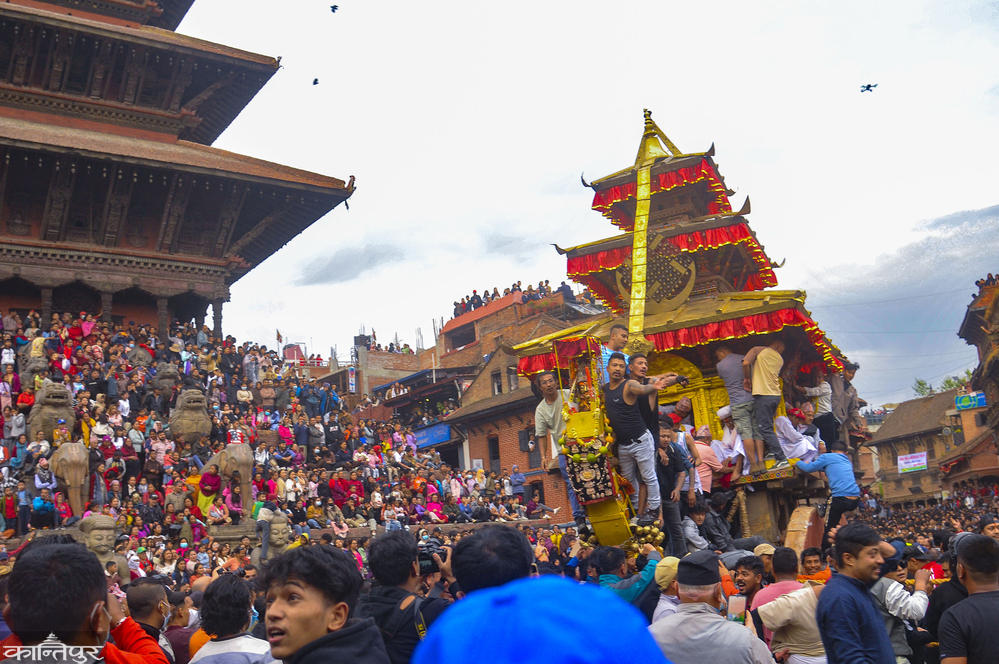
Bisca: On the occasion of Madhyapur Thimi, Bishnuveer, Siddhikali, Balkumari, Dakshin Barahi and other festivals are celebrated and in Madhyapur Thimi, Sindurjatra with 32 khats and tongue piercing festival is celebrated in Bode in the afternoon . 28-year-old Sujan Bagh Shrestha has continued the Jatra after piercing his tongue for the third time this year.
Biska: Jatra in Tokha too
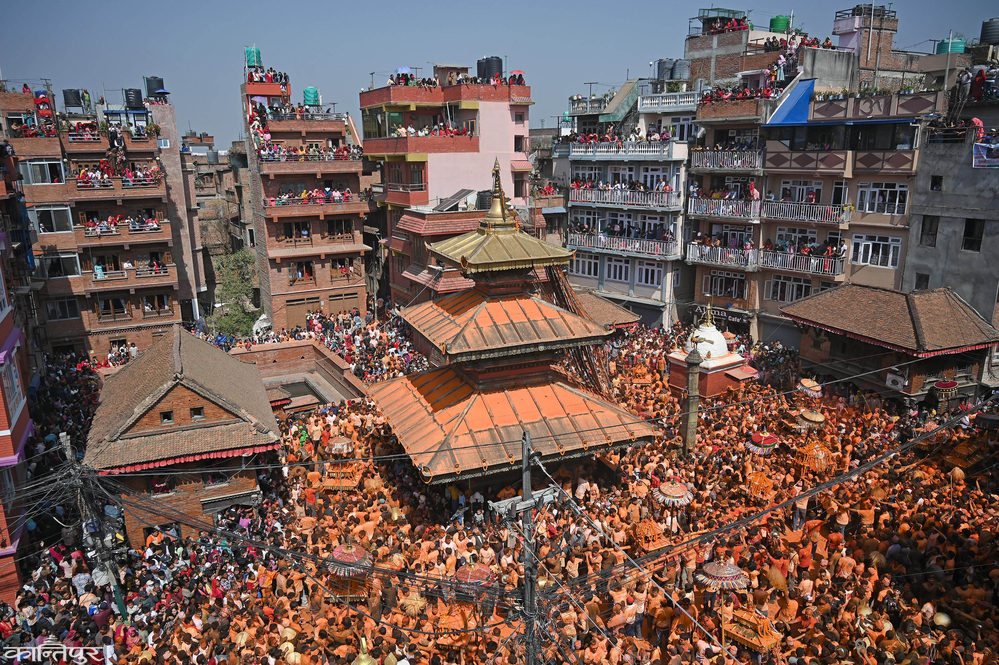
Tokha residents have celebrated Biska: Jatra, wishing for the peace of the souls of Nag and Nagini . In the Jatra celebrated for eight nights and 9 days, the idols of Muskaneshwar Mahadev, Ganesha, Saraswati, Masankali, Sapnatirtha Ganesha, Kothu Ganesha and Chandeswari, which were decorated in a pagoda-style manner, were paraded around the city on a vermilion jatra.
The people of Tokha take a bath in the Narayan pond to mean finding jewels . On Baisakh 1, home chanting was done at Bhutkhel Pig: Dyo (pith) for Jatra. On the occasion of the Jatra, Goddess dance called 'Yan Pyankh' is shown on Baisakh Krishna Chaturdashi and Ausi night. According to the former president of Tokha Neva Guthi, Devraj Dangol, Tokha has a tradition of worshiping seven goddesses including Chandeswari as the goddess of protection, Sapnatirtha who heals diseases, Saraswati the goddess of learning, and Kothu Ganesha who is worshiped in the palace.
Halchok Akash Bhairav's 12-year Jatra
Halchok Akash Bhairav's 12-year Jatra, which started on Baisakh 1, is now being celebrated with great fanfare. There is a tradition of celebrating Jatra Baisakh throughout the month. Halchok Akash Bhairav, Chandi, Kumari, Parvati, Mahadev, Ganga, Akashdevi, Barahi, Mahakali and Dakshinakali are danced in the Jatra. The head of state was present and offered prayers for the Jatra on 1st of Baisakh.
According to Halchok Akash Bhairavanath Guthi, dances on Baisakh 3rd, 6th, 11th, 12th, 13th, 18th, 19th, 20th, 21st, 25th, 27th, 31st respectively: Keltol, Maru Dabli, Asan Dabli, Damai Tol, Vatu Chikanat, Nyatpachwa, Pahko Twah, Brahmtol, Khushibu, Sohkhutte, Nyokha and last day Tamsipakha. It will be performed at Dallu Chowk and Dallu Chautara.
According to Nripendra Lal Shrestha, the publicity coordinator of the Akash Bhairav 12-year Jatra, there is a tradition of not dancing in other places as well. According to Halchok Akash Bhairav Guthi, the Jatra was conducted by the then King Gunakamadeva in Nepal Samvat 107. As mentioned in the
genealogy, King Gunakamadeva was given darshan by Mahalakshmi and according to her orders, various deities including Akash Bhairava were created and installed in Halchok by Tantric methods to free the kingdom from the fear of Satru. 25 lakh 40 thousand rupees and 13 lakh 30 thousand rupees from Nagarjuna Municipality have been allocated to conduct the Jatra.
Bajrayogini Jatra in Sankhu
The three-eyed Bajrayogini, adorned with a neck and nagmala in both hands, a bhoto in the body, a khadg in the right hand, a lotus flower in the left, and a crown studded with precious pearls, is taken around the city . Along with Bajrayogini Devi, Swayambhu Chaitya, Singhamukhi, Baghmukhi and Basundhara Devi's khatlai were also taken in the city tour with cultural paraphernalia.
According to Prakashman Sakwa, a local culture expert of Sankhu, there is a tradition of offering sacrifices to all the five khats in the course of circumambulating the city. In Nepali language, a special type of roti placed inside a clay pot is called Marikasi. There is a popular belief that those who get a disease will benefit from children . That's why the local culture experts of Sankhu say that there is a back and forth between the locals to get the medicine.
Mallakalin Khadge was brought from Hunman Door Darwar as a royal representative for the Jatra. Bajrayogini is worshiped as Dasamaha Vidyadevi by the Hindu sect, Bajrayogini by the Buddhist sect, Ugratara and Dhorjefambu, Mankamana by the Tibetan lamas . Legend has it that the Jatra has been running continuously since 1818 and was run by King Shankhadev of Sakhu.
Rato Matsyendranath's great bath
Rato Macchindranath, who is considered to be the god of the age, was worshiped on the auspicious day of Baisakh 1. According to Kirtikaran Joshi, the astrologer of Mastyendranath, at midnight after the Mahasana, the idol of Matsyendranath is covered with a white cloth and placed in the foothills of the temple while playing Sih Baja (an instrument played during funeral processions in the Newar community).
After the great bath, the Neku community, called Lapuh Chaigu, paint the statue with clay brought from Mhaipi. Then on the day of Baisakh Krishna Triyodashi, according to the Buddhist tradition, the ritual ceremony, name ceremony, food ceremony, upanayana, chuda ceremony, ihi (belly wedding) and ten ceremonies will be performed for both men and women. After the end of Daskarma, on the day of Vaishakh Shukla Pratipada, the idol of Matsyendranath is taken out of the temple and taken to Pulchok on a chariot. The Rath Yatra starts from the fourth day.
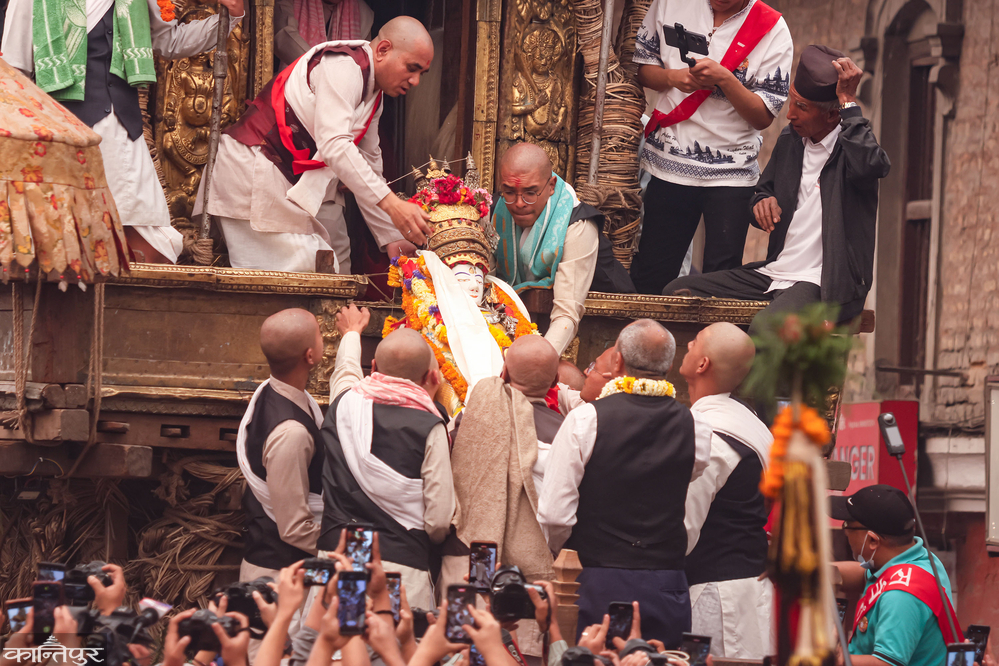
In Mahasnan Jatra, the idol of Matsyendranath along with cultural items and Guruju's paltan was taken from the temple of Matsyendranath in Tabhal to Lagankhel and placed in the 'Nhavu Dabu' there and given a Mahasana.
Water was brought from the 'Nhavu village' in Karyabinayak forest in Bungmati, the well of Kumbheshwar and the well of Tahbahal. People flocked to watch the Nahav Jatra . Similarly, Khat Jatra of Bal Kumari, Bal Kumari and Tikabhairav is celebrated in Lalitpur's Sunakothi, Bajrabarahi in Chapagaon, Jelkumari, Balkumari and Tikabhairav in Lele.

