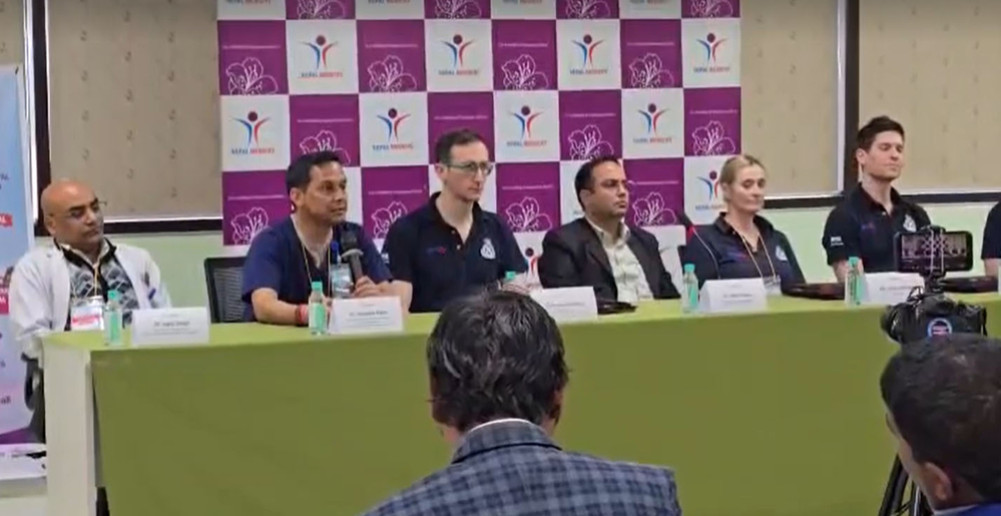
The training was organized at Nepal Medicity with the aim of enhancing the capacity of health workers in 'retrieval medicine'.
We use Google Cloud Translation Services. Google requires we provide the following disclaimer relating to use of this service:
This service may contain translations powered by Google. Google disclaims all warranties related to the translations, expressed or implied, including any warranties of accuracy, reliability, and any implied warranties of merchantability, fitness for a particular purpose, and noninfringement.
The five-day Advanced Training and Training of Trainers (TOT) training on 'Retrieval Medicine' has been completed.
The training was organized at Nepal Medicity with the aim of enhancing the capacity of health workers in 'Retrieval Medicine'.
Retrieval Medicine is a branch of medicine that provides advanced emergency medical services required for the safe transfer of critically ill patients from one place to another. It especially includes pre-hospital care, ambulance services, helicopter rescue and life-saving skills during transfer.
Through the training, an effort has been made to make doctors, nurses and paramedics skilled in emergency medical services and pre-hospital care, especially helicopter rescue. In addition, the organizer stated that the training has been an effort to prepare the participants as trainers who can train other health workers in the future.
Nepal Medicity's Emergency and High Altitude Service Chief Dr. Sanjay Karki informed that the participants in the training were provided with the necessary skills in safe transfer of patients in emergency situations, ability in pressure situations and pre-hospital care. According to him, the training has prepared the participants for international level studies related to 'retrieval medicine' and will enable them to obtain a degree in the subject from Glasgow in the future.
About 90 percent of the participants in the program were doctors, while the rest were nurses and paramedics. Doctors from Grande, Normic, Hams, Nepal Medicity and Narayani Bayodhya Hospitals, as well as health workers from Pokhara, Lumbini and Birgunj, also participated.