Kumar Nagarkoti quit smoking yesterday. Rajan Mukarung must have quit too. You should also quit smoking and alcohol from today, exercise regularly and keep your heart healthy. Otherwise, you may find it difficult to read 'Utkarsh'. Because stories like 'Beyond the Mirror' take you to a state of mental zenith.
We use Google Cloud Translation Services. Google requires we provide the following disclaimer relating to use of this service:
This service may contain translations powered by Google. Google disclaims all warranties related to the translations, expressed or implied, including any warranties of accuracy, reliability, and any implied warranties of merchantability, fitness for a particular purpose, and noninfringement.
Literature is also a market.
It has arrived in the literature market with a bang – ‘Utkarsh’!
You may have to pay a huge emotional price when reading this book.
Because nothing is free in the market. Nothing is available for free.
Why did I talk about market, price, fee, free at the beginning? To understand this, you should listen to me very carefully until the end.
Now, let’s talk about the story. The story of a long story.
00
In terms of long stories, the one we Nepali writers have read the most is Uday Prakash’s ‘Mohandas’. It is a story of the cruel state system, the deprivation of a person’s privacy, and the heartbreaking struggle of a poor and diligent young man Mohandas to regain his lost identity or prove that he exists. It is also read as a short novella.
If Mohandas is considered a convenient example, in some ways it seems that a short novel can also be considered a long story. The ‘Ular’ I wrote could be called a short novella, no different from a long story. Both ‘Mohandas’ and ‘Ular’ are works of around fifteen thousand to twenty thousand words.
In English literature, George Orwell’s novella titled ‘Animal Farm’, written in around forty thousand words about the Russian Revolution of 1917 and the subsequent dictatorship of Stalin with simple language, symbolic and satirical story conventions, is also classified as a long story.
However, our tradition of writing long stories is a little different. We generally call them ‘long stories’ if they are longer than fifteen to twenty pages. In this sense, our long story writing tries to match the tradition of writing stories like ‘Usne Kaha Tha’ and ‘Kafan’ by Indian writers Chandradhar Sharma Guleri and Premchand respectively. Uday Prakash's 'Tirich', 'Palgomaraka Scooter', 'Pili Chhatariwali Ladki' can also be placed in this category.
In the context of Nepali story writing, Archana Thapa's 'Kathputala', the current prolific story writer Lalit Bista's earlier 'Mohapath' and the current 'Utkarsh' are no different from exemplary story writings of this tradition. I myself have included some long stories in 'Ziyara', carrying on this same story tradition. Recently, 'Utkrisht Nepali Lama Katha' has been published under the editorship of Avinash Shrestha. His writings on the long story play an important role in this. If you read it carefully, it will be useful for story writers and story scholars.
However, there is one thing that should not be misunderstood: a story that is a little longer than a normal story does not make it a long story. The identity of a long story is not the number of words or pages, but the craft of plot creation. Compared to ordinary stories, long stories focus on character development, depiction of a specific event related to that character, and the social and psychological aspects of the character with depth, subtlety, and detail. There are not as many characters as in a novel. In long stories, importance is given to a small number of characters and the events that revolve between those few characters, and the smooth development and conflict of such characters and events.
In ordinary stories, the story has to be told in a short time. However, in long stories, the writer gets ample time and ample creative freedom to tell the story and bring the story being told to a credible and meaningful conclusion.
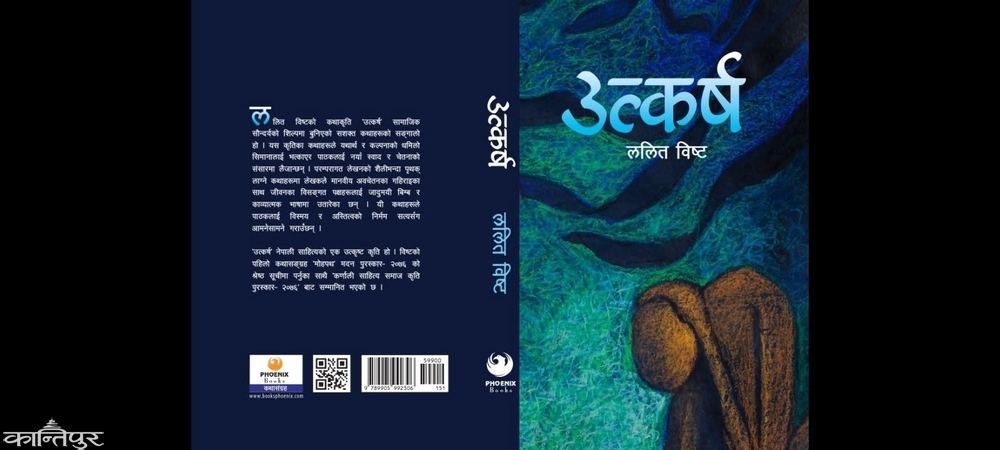
I can't say much about others. However, while writing some long stories, I experienced some difficulties. There was a plot, there was also the enthusiasm to write the story. However, while writing, I have faced many dangerous situations such as the story getting out of my control from time to time and getting scattered here and there, it is difficult to strike a proper balance between the three components of the plot, namely setup, confrontation and resolution, the focus is diverted from the main story and other characters are portrayed and unnecessary time and words are misused in subplots, the plot is difficult to maintain interest and curiosity, and the story itself is not fluid and only the events keep progressing but the plot remains static! Lalit Bista, the storyteller of ‘Utkarsh’, must have also experienced such a risky thing of writing a long story. However, the beautiful thing is that Lalitji successfully brought that experience to a meaningful conclusion and the result of that was his first story collection ‘Mohapath’ and the result of that is his second story collection ‘Utkarsh’.
‘Utkarsh’ is not my type of title. It is true that I told this to the author myself while giving suggestions after reading the manuscript. In fact, there is no story titled ‘Utkarsh’ in this collection. Later, I thought that he wants to make the reader’s mind wander with the same sense of Utkarsh, connected to the characters, story, and events, and that is why he chose such a Sanskrit-based name. Or, he may have his own unique argument about this.
I think Narayan Dhakal is good at choosing Sanskrit-based titles. His Pretkalpa, Tin Sambatsar, Durbhiksha, Pit Samvad, Atmahanta, Vrishab Vadh, all these are titles that I like. However, I myself fell for Ular, Lu, Jiyara Janara.
But, what is in the title? Whatever is, is in the story. Therefore, it is a very stupid act to keep complaining about the title.
Lalit Bista has not chosen an easy plot. Therefore, the characters, their social and mental status are also not easy. Through uncomfortable plots, uncomfortable characters, uncomfortable events, he has conveyed what he wants to say to the reader. There are two ways of conveying. One way is like a mother serving food to her child. Most mothers serve food according to the taste and preferences of their children. The other way is the Mithila Thali or Thakali Bhojanwala method. In this, the personal taste of the dish and the social and cultural aspects associated with it are 'promoted' more than the taste of the customer. The mother's thali connects you to home. The Mithila Thali or Thakali Thali connects you not to the 'comfort zone' of your personal taste, but to the Mithila region or Thakali environment. Lalit has adopted the second method. He has not written the story according to what the reader likes, he has told the story on his own terms, according to what he wants to tell the reader. This is a dangerous method. But what kind of writer is a writer who does not take risks! It would be better for such people to stop writing and studying and go around Singha Durbar or ministerial residences with a few packs of marijuana in search of government appointments and government handouts. Their future would be that much better. Reading the stories in this collection is a fun homework for
readers. You cannot read the stories in it while watching Netflix or Messi's hat trick. You have to either watch the cinema or Messi or read the story with concentration. The reason is, the atmosphere of the plot created by Lalit Bista. His stories seek their own kind of reader's consciousness and atmosphere. Because even though his stories seem to revolve around one axis, there are many axes within the story. When I have to go back and forth in the context of 'Zeera', I say - I have worked on a multi-layered story. What is this multi-layered story? I don't know the theoretical aspect of it. However, I will try to explain what I understand through an example. Listen.
Imagine you are sitting in a dark hall watching a magic show. During the magic show, the magician asks for the ring you are wearing. He then waves his hand in the air and makes the ring disappear. This is the first stage of the magic. It is like the beginning of the story. It is like the first part of a three-act play, i.e. the ‘set-up’.
You wonder where the ring went. With this, you enter the second part of the three-act play, i.e. the ‘confrontation’. In this process, the magician brings you a large box. He opens the box. Inside it is not a ring, but another slightly smaller box. He opens that box. Inside it is another slightly smaller box. A box inside a box. Another small box inside a box. Dozens of large and small boxes and boxes are scattered on the stage. Finally, the magician takes out the smallest box. A small box like the one you would find in a jewelry store. Your ring is safe in that box. You are shocked to see that the ring lost in the air is found in a small box inside such a box.
But, the picture is still left, my friend!
Because now you have to watch the third part of the story, i.e. the resolution. The magician again throws that ring into the air and makes it disappear. You are shocked again. And the magician tells you to ‘touch your pants pocket’. You touch it. The ring is in your pocket.
You are shocked again.
Then you clap your hands.
Story writing is not magic. It is not a miracle. It is a responsible act. ‘Multi-layered story’ is also like this. The author is a magician. The story you are reading is a contour. Keep reading, another story inside. Then another story. Finally, shocked. Shocked.
I would like to tell the ‘friends’ present here that this is not a completely new technique of story writing. Less is written, but others have written it too. Lalit Bista has also written 'Utkarsh' with the same technical skill. That is why when you read the story of a retired officer in the story titled 'Avkaash', you get to enter the world of the story of an innocent character hired for laughs with pleasure. When you read 'Peedhiko Naach', you get to read the story of Devkumari along with Radha. You also get to experience the life of Nirvi and Chandni. And you also get to experience the life of Mohit. Until you read the last few pages of this story, you are reading a different story. But, as soon as you read the last pages, the story becomes different. This is just an example, he has shown this miracle in almost all his stories.
But, what I have to say here again is that writing a story is not magic. It is not a miracle. It is a responsible act. Lalit Bista is a storyteller with a sense of responsibility.
Lalit Bista seems very aware of how to make the reader his strong companion in the story or in his story journey. That is why he controls or holds the reader in his grip from the first paragraph of the story. The reader reaches the end of the story wondering what will happen next and reaches a point where he is very burdened and holds his head and starts to cry. At such times, it seems that the author is standing in some interlude of his own story, looking at the impatient reader after reading the story he has written and saying in the style of ‘Now what will happen to you, friend?’
This vulgar style of making the reader a ‘Kalia’ is also a readable work.
I am not a critic, I am a storyteller. Therefore, I do not consider it necessary to explain each story. It is not necessary. Every reader should be able to understand the story in their own way. But I will say this, Lalit Bista is a strong storyteller of this time, and to read him, you must also have a strong heart. Kumar Nagarkoti quit smoking yesterday. Rajan Mukarung must have quit too. You should also quit smoking and alcohol from today, exercise regularly and keep your heart healthy. Otherwise, you may find it difficult to read 'Utkarsh'. Because stories like 'Beyond the Mirror' take you to a state of mental exhaustion.
'Garbhanad', 'Darbar', and 'Bheed' in the collection are not long stories. But they are strong stories. It seems that these three stories are the reading bonus you get for reading seven long stories. Buy seven, get three free.
Now from here, I will connect you with the market-based sequence from the beginning.
I have already said at the beginning, in this era of market economy, nothing is free in the world. To read three for free, you have to pay the price of seven.
After reading ‘Utkarsh’, you may not enter the literary market for a few days. Because the stories of ‘Utkarsh’ leave a mark on your mind. At this time, you may be feeling empty inside.
Why go to the market empty-handed!
Nothing is available for free in the ruthless market.
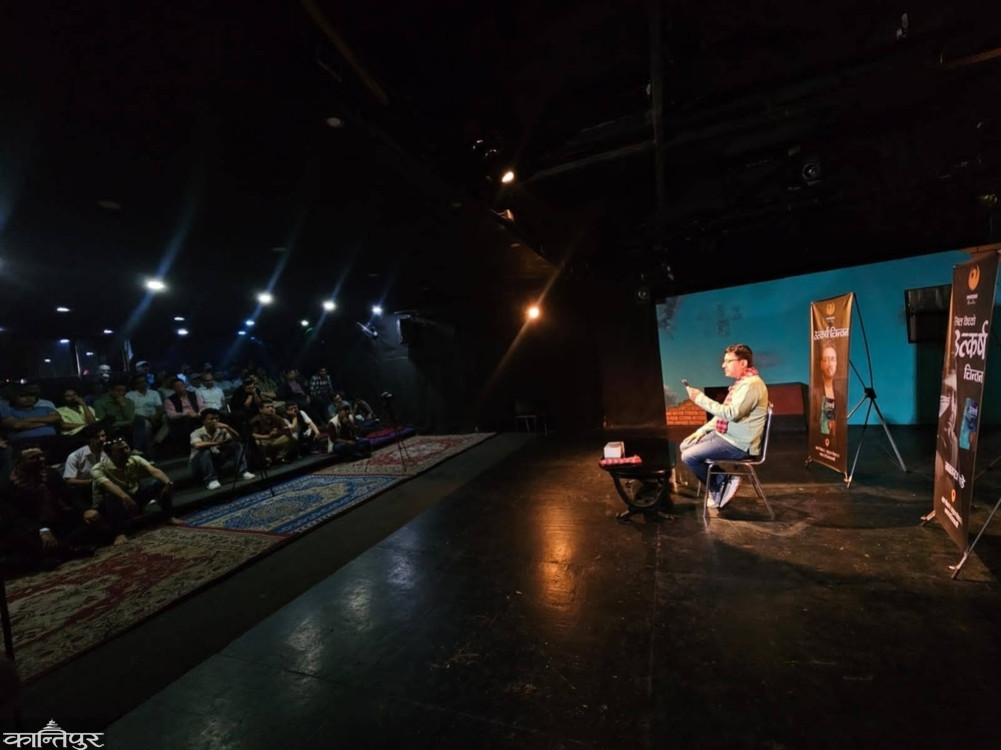
(Nayanraj Pandey’s speech at a discussion program organized in the capital on writer Lalit Bista’s collection of stories ‘Utkarsh’ on Saturday)