The fifth edition of the Ilam Literature Festival saw in-depth discussions on topics ranging from poetry to short stories and from tourism to the digital age.
We use Google Cloud Translation Services. Google requires we provide the following disclaimer relating to use of this service:
This service may contain translations powered by Google. Google disclaims all warranties related to the translations, expressed or implied, including any warranties of accuracy, reliability, and any implied warranties of merchantability, fitness for a particular purpose, and noninfringement.
As singer Yama Baral said, Ilam is currently shrouded in a veil of clouds. A heated debate has begun within that cold veil since Friday.
The fifth edition of the Ilam Literature Festival saw in-depth discussions on topics ranging from poetry to short stories and from tourism to the digital age.
In the first session titled 'Poetry: From Heritage to Reels', poets Binod Bikram KC, Rima KC, Samdarshi Kaila and Ramesh Chandra Adhikari spoke.
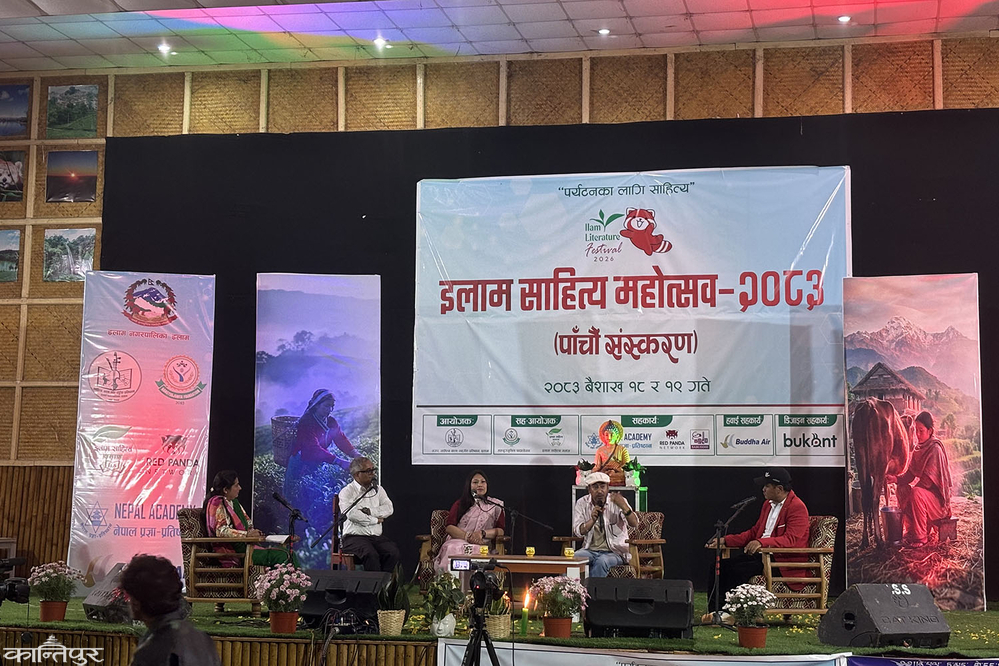
Samdarshi Kaila admitted that the form of poetry is changing with the digital medium, but its spirit is still alive. 'The form changes, but poetry never dies,' was his conclusion.
Poet Binod Bikram KC compared poetry to 'oxygen' and said, 'Poetry is not only for peace, it is essential for life.' In her opinion, poetry is a matter of existence, beyond the market, where the depth of experience holds meaning rather than the sale.
Reema KC said that poetry is born from experience and gives different meanings to the reader. 'Poetry is like a flower—its fragrance and identity change according to taste,' she said. Ramesh Chandra Adhikari, holding the view that poetry itself builds the identity of the poet, underlined the relationship between the creator and the creation. Walika Thapaliya facilitated.
In the second session, journalist Basanta Basnet stood alone on the stage. In a speech titled 'Digital Masubhat and We Are Journalists', he pointed out the danger of intellectual independence with the rise brought by the digital age.
'Yesterday we were not afraid of the king, but today we have started to fear the invisible crowd,' he said. According to him, the digital space has made information democratic, but the same space is giving birth to 'new feudalism'.
Basnet's concern was clear, even though we appear to be free, that freedom is under someone's control.
'The space for dissent is narrowing,' he said, 'We must now be vigilant to protect intellectual freedom.'
Then, in the session 'The Splendor of Tourism: The Basis of Prosperity', the possibilities of eastern Nepal were explored. Niroj Kattel, Sushila Sapkota and Amir Rai debated the future, challenges and opportunities of tourism in the eastern region including Ilam. The facilitator was Giriraj Baskota. The speakers emphasized the need to link not only natural beauty, but also cultural diversity and local identity with tourism.
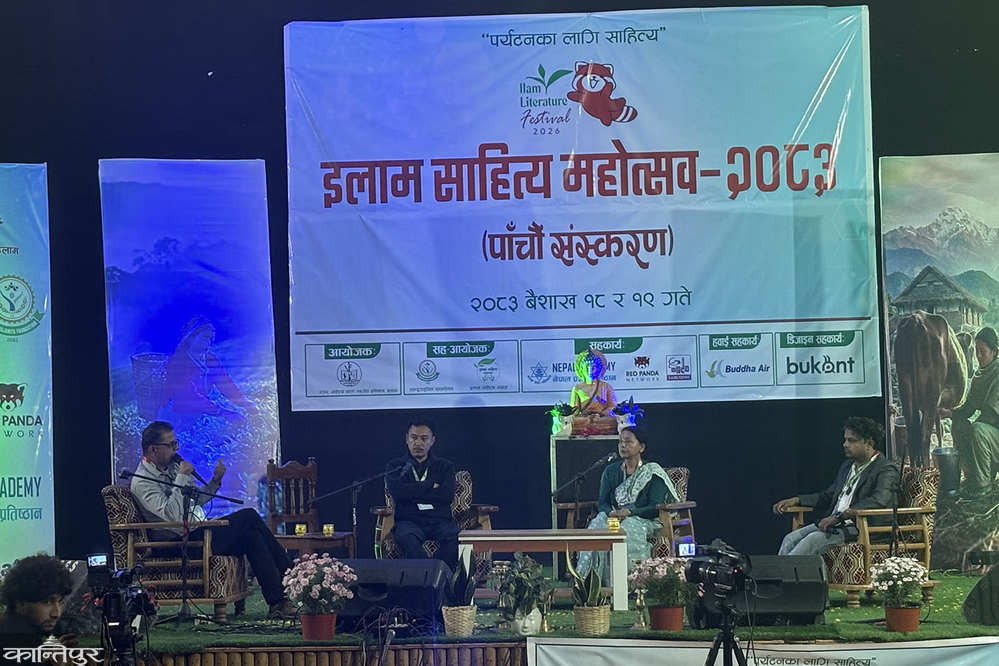
In the final session 'Stories and Anecdotes', writers brought stories of their own journeys. Writer Uma Subedi shared the struggles she faced on her writing journey as a woman. 'The path to becoming a writer is not easy,' she said, 'Being a woman is even more challenging.'
Short story writer Keshav Dahal considered writing to be a spiritual practice beyond technical practice. 'A writer does the work of questioning, criticizing and spreading the spirit of rebellion,' he said.
Madan Puraskar winner Amar Neupane described creation as an invention that develops through continuous spiritual practice. Regarding his relationship between poetry and fiction, he said with a smile, 'I was in love with poetry, I married fiction.'
Shyam Singhak, author of the novel 'Koilakhad', commented on the new generation of writers, 'This is the time when the face of the writer sells more than the book.'
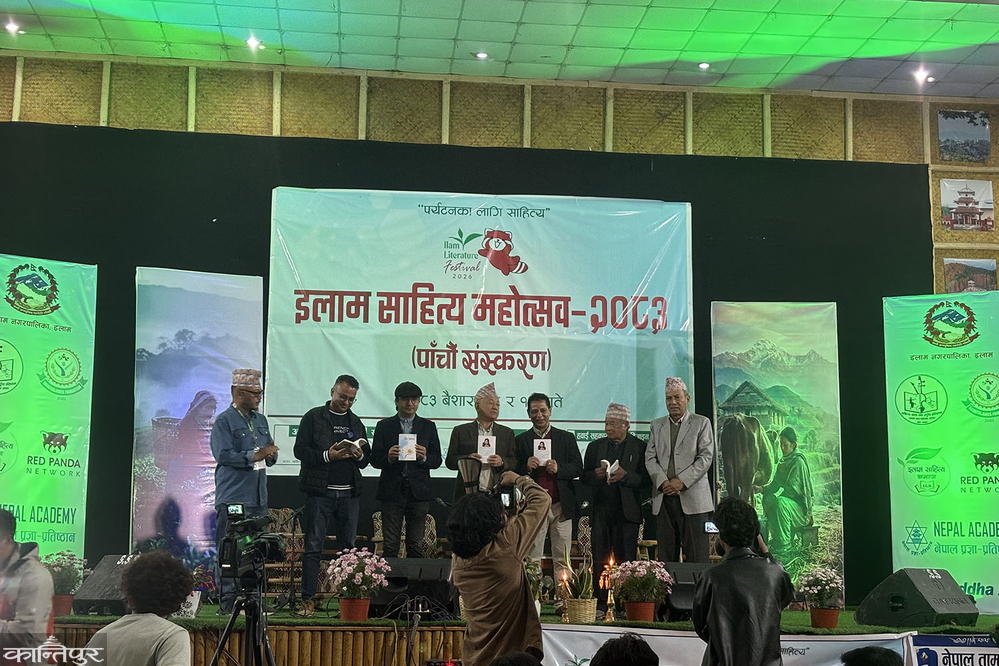
During the festival, filmmaker Dinesh DC, poet Sundar Kurup, playwright Kavita Nepal and singer Pushpan Pradhan were honored. In the inaugural session, Ilam City Mayor Kedar Thapa, former MP Mahesh Basnet, and Himalaya Karmacharya said that such a festival has made Ilam even stronger on the literary map.

