The first Bagmati Environmental Literature Festival concluded on Sunday with a program of poetry readings on environmental issues.
We use Google Cloud Translation Services. Google requires we provide the following disclaimer relating to use of this service:
This service may contain translations powered by Google. Google disclaims all warranties related to the translations, expressed or implied, including any warranties of accuracy, reliability, and any implied warranties of merchantability, fitness for a particular purpose, and noninfringement.
Jiri in Dolakha district is in the lap of the Gaurishankar Himal. Jiri, with its lush greenery and cool climate, has been called a paradise on earth. What was Jiri like yesterday, what is it like today, and what will it be like tomorrow? Not only Jiri, but also the world, where did it come from, how to protect it? A discussion has been going on here for two days since Saturday, and writers are participating in it.
The first Bagmati Environmental Literature Festival has been accompanied by discussion sessions as well as ghazals and poetry. Before the inaugural program of the festival organized by the Ministry of Forest and Environment of Bagmati Province and Jiri Municipality, a procession with cultural tableaus of the local communities took out. Provincial Forest Minister Bharat Bahadur KC inaugurated the festival. After the inaugural program, writer and writer Sanjeev Upreti gave a scholarly speech and said that human-centered thinking has increased environmental problems and various kinds of complications in the world. 'Human-centric activities have caused the earth's temperature to rise unnaturally. Animals and plants are becoming extinct. This has happened because we have come to understand the world from a human-centric perspective,' he said.
He said that a balance should be maintained between development and environmental protection, and that we should understand the warnings given by nature. 'Perhaps it is because we do not have the ability and knowledge to listen to and read nature, or because we have forgotten this art, that nature opposes us, and that opposition brings crises like excessive rainfall and drought,' Upreti said. He requested us to reflect on the fact that humans need nature, but nature exists even without humans. He was of the opinion that literature created by taking into account how the earth and the environment understand humans would be eco-literature. 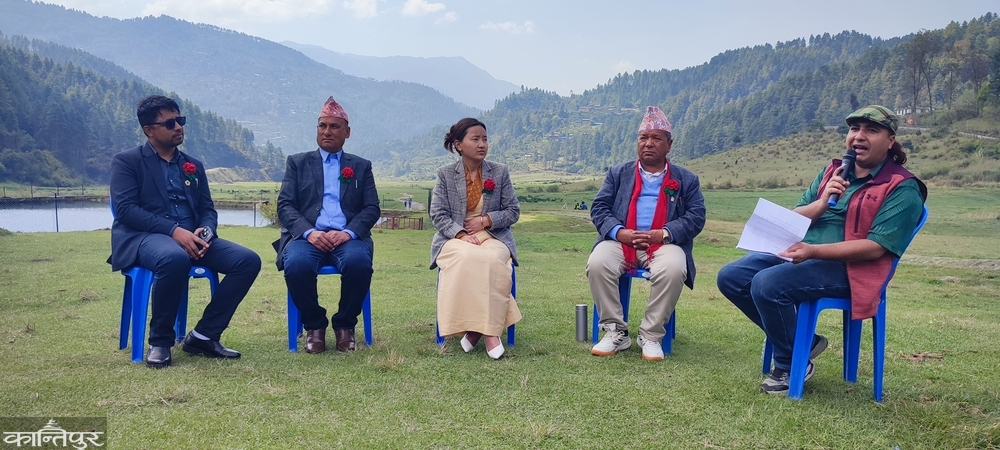
'We ourselves have declared ourselves to be intelligent beings on this earth. If any other species had to be named after humans, they would have called them Suikhutte Bhashmasura,' said Ramesh Bhushal, a writer and journalist who has been writing about the environment, the main speaker on the second day on Sunday. He said that out of millions of creatures in this world, humans alone consume the most of the earth's resources, but they are the only ones who are the most unhappy and suffer the most from lack. 'Never before has the temperature of the earth increased because of any one species,' he said. He said that the role of humans in increasing the climate crisis is to blame.
He was of the opinion that the earth is facing a crisis due to the increase in polluted air along with the climate. 'There is cementism here. It has become a difficult task that cannot be preserved. They say that plans for using cement should be done immediately. Many perversions have been associated with cement,' said Bhushal.
After Bhushal's remarks, the program was held outside the hall in an open area. With a green meadow and a small lake in the background, where there was once an airfield but is now grazing cows, Kantipur journalist Deepak Sapkota conducted a session on 'Jiri of Yesterday, Today and Tomorrow'. Famous Swiss geologist Tony Hagen had reached Jiri in 1950. In 1953, the team of Sir Edmund Hillary and Tenzing Norgay, who became the first climbers of Mount Everest, reached Solukhumbu via the Kathmandu-Jiri route.
Tony Hagen had called Jiri the Switzerland of Nepal. It also became known as the gateway to Mount Everest. The current state of Jiri and its future form were discussed based on this background. The indigenous Jirel community lives in the area of Jiri municipality. The name Jiri also came from the Jirel language. 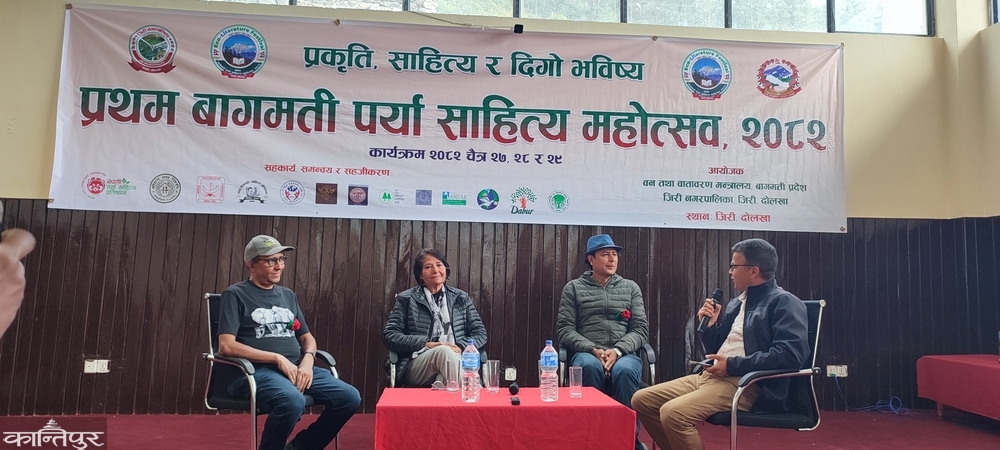
'According to our ancestors, Jig means a scary wild animal and Ri means forest. In this way, the name Jiri came about by saying Jigri Jigri,' said Engineer Hira Jiril, who is the central president of the Nepal Jiril Association. Tanka Bahadur Jiril, the first mayor of Jiri Municipality, said that development, education, health and infrastructure works were progressing in Jiri in 2018 on the initiative of Swiss citizens.
'It takes a community to build a school in other places. As soon as a school was built in our country, a settlement settled around the school,' said Keshav Kumar Karki, former principal of Jiri Secondary School. Dr. Urgen Sherpa, a doctor at Jiri Hospital and a local resident, said that with the increase in tourists, environmental concerns have increased in Jiri. 'If agriculture is increased here, if organic agriculture is adopted, this will also develop tourism and protect the environment,' was the opinion of Dr. Sherpa.
With the construction of the airport in Lukla, those going to Mount Everest stopped coming to Jiri. But the construction of the Everest Road from Jiri to Solu, which is about 200 kilometers long, will boost tourism, said founding mayor Tanka Bahadur Jirel. Former principal Keshav Kumar Karki promoted the beauty of Jiri and said that the community can also benefit from the development of tourism by promoting agriculture. He emphasized on promoting the natural beauty and original social culture here.
In the program, Rajkumar Baniya had a discussion with Bhupin Khadka, Archana Thapa and Dadi Sapkota about how environmental issues are included in literature. Similarly, discussions were held in various sessions on the topic of connecting writers with the environment, including environmental issues in the curriculum. On Saturday evening, a poetry festival was held with Kumar Nagarkoti. Ghazals were presented before that. The first Bagmati Environmental Literature Festival concluded on Sunday with a program of poetry readings on environmental issues.

