Author Parajuli says that the change of 2007 BS was the biggest turning point since the creation of modern Nepal.
We use Google Cloud Translation Services. Google requires we provide the following disclaimer relating to use of this service:
This service may contain translations powered by Google. Google disclaims all warranties related to the translations, expressed or implied, including any warranties of accuracy, reliability, and any implied warranties of merchantability, fitness for a particular purpose, and noninfringement.
The book 'Sandhikal: The Foundation of Social Change', which tells the story of the advent of democracy in Nepal, has been released. The book 'Sandhikal' written by historical sociologist Lokranjan Parajuli was released at the Arshala of Nepalaya on Saturday.
The book was released after author Lokranjan Parajuli gifted his book to historian Mahesh Raj Pant, Gen-G activist Raksha Bam and sociology student Yadav Aryal.
Author Parajuli said that the change in BS 2007 was the biggest turning point after the creation of modern Nepal. 'After 2007, the Raiti were accepted as sovereign citizens. A free environment was created to speak, read, write, print and organize,' said author Parajuli. 'The seven years brought great enthusiasm to the ground level. It brought about upheaval in the fields of social organizations, media, schools, colleges, libraries, etc.
Writer Lokranjan Parajuli said that while explaining the anti-Rana regime movement, the contribution of social, literary, radio, education, and cinemas was not discussed. ‘Just as the last blow of the axe does not contribute to the fall of a tree, similarly, no change is caused by the last cause alone,’ said writer Parajuli. ‘Many people, including poets, artists, cinema halls, radio, newspapers, etc., play a role in change. I have dug into that foundation in the Sandhikal period.’
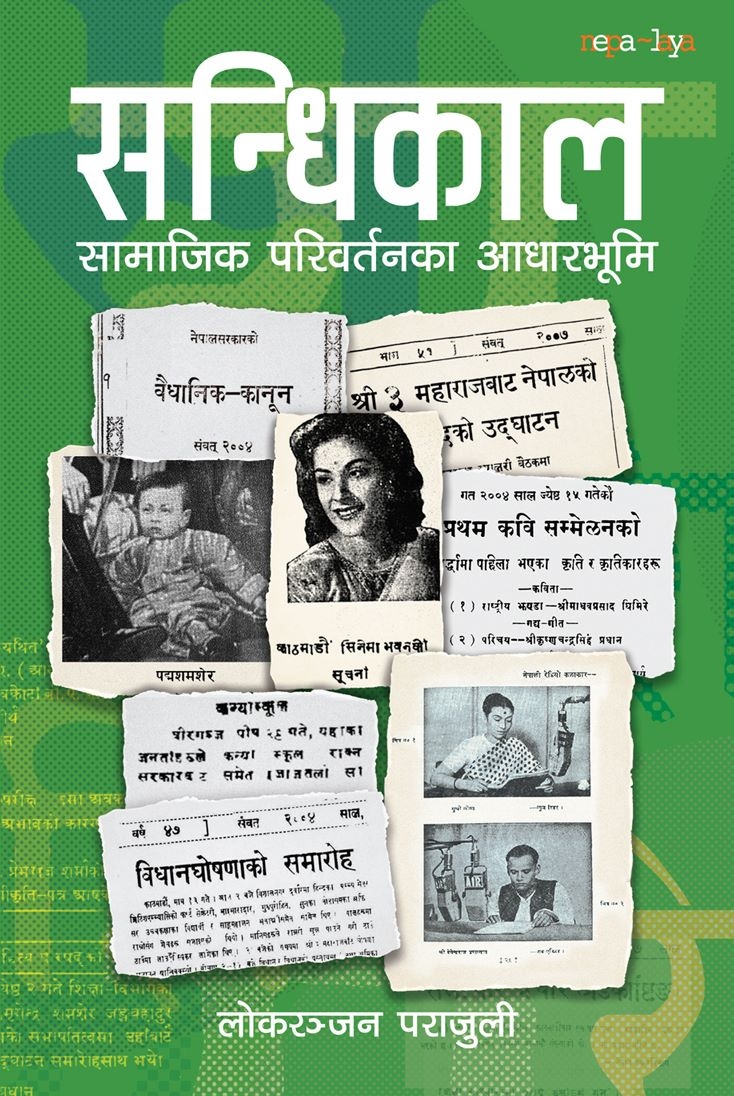
Even though democracy came on Falgun 7, 2007, writer Parajuli says that its foundation was being prepared a little earlier. In his study, the period between four and seven years is the Sandhikal period. Sandhikal means the time when one era ends and another era begins.
The story of the democratic path that Nepal walked 75 years ago is included in the book ‘Sandhikal’, said Bimal Acharya, editor of Publication Nepalaya. ‘I used to read book talks regularly. There was a permanent question there – what kind of books should be written in Nepal? And the answer was also permanent – books written after in-depth research on Nepal’s history, politics, society, education, culture, geography, etc. should be written,’ said Editor Acharya. ‘The book – Sandhikal is a strong answer to that permanent answer that many give,’ he said. ‘The social basis and dimensions of the epochal change of the seven years have been explored in ‘Sandhikal’.
Publication Nepalaya had organized the launch of ‘Sandhikal’ through advance registration. ‘It is mentioned in the book Sandhikal, released today, that the great poet Devkota organized a poet conference on tickets during the Rana period. We also tried to make the launch event ticketed,' says Nepalaya team leader Kiran Krishna Shrestha, 'Since the Arshala Hall has limited seats, we made it ticketed. We have been encouraged by the enthusiastic participation in it.'
Lokranjan Parajuli, the author of 'Sandhikal', is a historical sociologist affiliated with the social study-research organization Martin Chautari. He has a PhD in sociology from Bielefeld University, Germany. Parajuli has published more than a dozen books in his writing-co-writing, editing-co-editing. The latest book he co-edited, 'Nepal in the Long Nineteen Fifties', has been reviewed by Indian historian and author Ramchandra Guha.
He is the editor of two prestigious journals in Nepal, 'Studies in Nepali History and Society' (SINAS) and 'Samaj Adhyayan'. Parajuli has deep knowledge about Nepali society, education, history and politics.
The 308-page 'Sandhikal' is priced at Rs 675.

