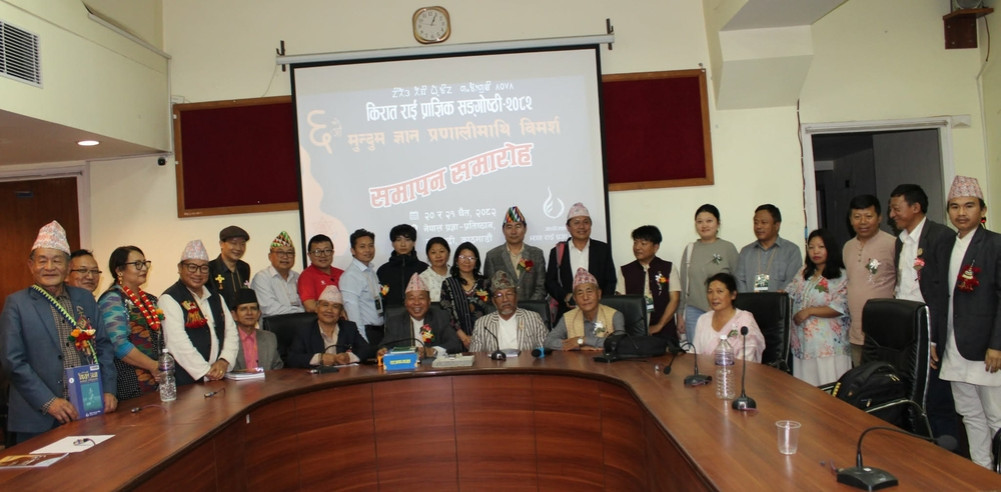
The demand was made public by issuing the Yalakhom Declaration after the two-day 'Sixth Academic Symposium on Mundum Knowledge System-2082' held in Kathmandu on Saturday, organized by the Kirat Rai Pragya Parishad and in collaboration with the Nepal Pragya Pratishthan.
We use Google Cloud Translation Services. Google requires we provide the following disclaimer relating to use of this service:
This service may contain translations powered by Google. Google disclaims all warranties related to the translations, expressed or implied, including any warranties of accuracy, reliability, and any implied warranties of merchantability, fitness for a particular purpose, and noninfringement.
The Kirat Rai Academy has demanded that the Mundum Knowledge System be listed on the UNESCO Intangible Heritage List.
The demand was made public by issuing the Yalakhom Declaration after the two-day ‘Sixth Academic Symposium on Mundum Knowledge System-2082’ held in Kathmandu on Saturday, organized by the Kirat Rai Academy and in collaboration with the Nepal Academy.
‘For thousands of years, collective ancestral knowledge has been transmitted orally in the Kirati society and practiced lively with new knowledge, which is called the Mundum Knowledge System,’ the first point of the declaration states, ‘Since the Mundum Knowledge System, which is useful for the global human society, has the potential to represent Nepal’s original intellectual heritage in international forums, we demand its listing on the UNESCO Intangible Heritage List.’
23 working papers were presented at the symposium. In which there was a comprehensive discussion on Mundum and Mundum philosophy, Sakela, Mundum worldview and decolonization, description of creation, treatment methods and justice system. Similarly, there was an intensive discussion on topics such as Suptulung, family and gender, human language science and Mundum words, migration, travel descriptions and rituals.
‘What is noteworthy here is that in Kirati society, according to linguistic diversity, the words Mundum, Mundum, Munthum, Muddum, Mudum, Muktum, Mukdum, Mugdum, Muntum, Mindum, Ridum, Tamr, Tumlo, Pelam, Dumla, Yangma Khau are used, the first word of which is considered to be ‘Mundum’,’ said council member Bhogiraj Chamling while reading the declaration.
The second point of the declaration states that it will be possible to develop ‘Nepali socialism’ and build greater ownership over it only by basing it on the Mundum and Nepal’s original indigenous knowledge systems related to politics, economy, culture, environment, etc. ‘We demand the establishment of schools and universities for teaching the Mundum knowledge system and to make arrangements for teaching in community and government educational institutions,’ the third point states.
In the closing session, Naradamani Hartamchhali, Chancellor of the Nepal Academy of Fine Arts, said that the Kiratis consider Mundum to be the main source of culture, tradition and civilization in the form of cognition. ‘It is necessary to synthesize the debate, documentation and transmission of Mundum from an intellectual perspective and move forward,’ said Chancellor Hartamchhali. ‘Since the oral knowledge system is the basis of the philosophy of life and the concept of world mobilization in Mundum, we are moving towards local to central to global. Now we need to move towards integration by taking it from global to central to local.’
Pragya Parishad Chancellor Jayakumar Rai said that efforts are ongoing to make the traditional oral knowledge system compatible with international knowledge and science among the world community.