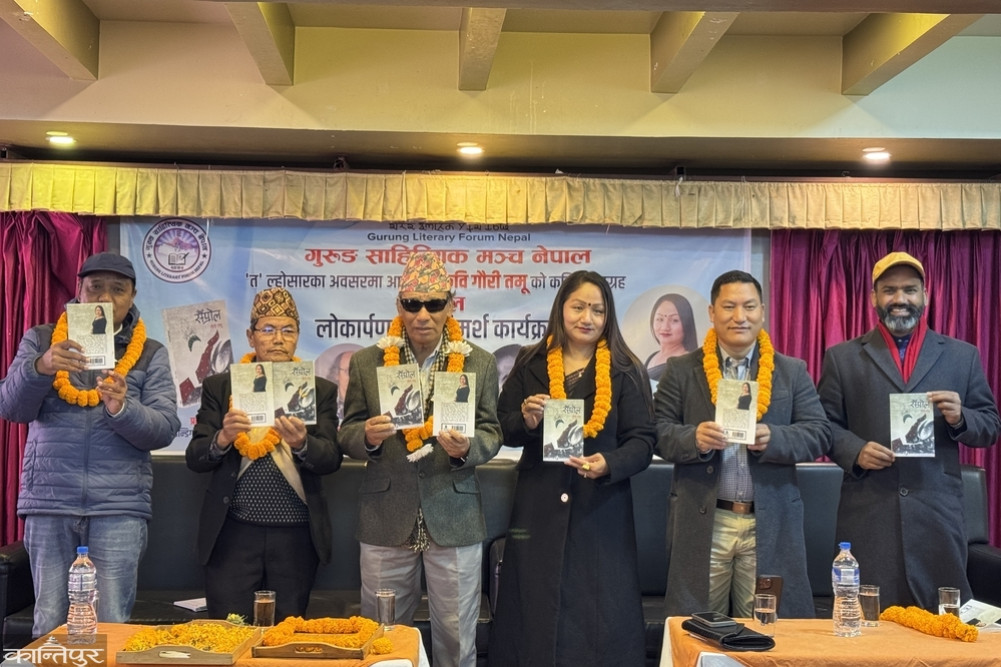
The collection of poems raises questions about how indigenous geography and culture are being attacked along with Tamu, and how the government has overthrown the way of life of indigenous peoples by creating laws against their naturalness.
We use Google Cloud Translation Services. Google requires we provide the following disclaimer relating to use of this service:
This service may contain translations powered by Google. Google disclaims all warranties related to the translations, expressed or implied, including any warranties of accuracy, reliability, and any implied warranties of merchantability, fitness for a particular purpose, and noninfringement.
Poet Gauri Tamu's latest poetry collection 'Saiprol' was launched in Pokhara on Saturday. At the launch and discussion program organized by Gurung Literary Forum Nepal, the speaker interpreted the poetry work as a powerful document of the myth, identity and existence of women of the Gurung community. The speaker said that the collection especially presents nature, environment and sources of indigenous knowledge in a simple but serious way.
While releasing the work, writer Sarujhakta said that Gauri's poems are written by Muktakakar. 'The voices written about racial consciousness and women are loud,' he said, 'Social anomalies have been addressed. A conscious poetic consciousness is in Gauri.' He said that Nepali literature is becoming prosperous when poets and writers who have brought racial consciousness create literature by speaking about racial images.
Writer Ganesh Poudel said that the poem was written based on the myth that 'Saimprol' is a woman's name and that despite the compelling situation of passing on knowledge from father to daughter, not son, the daughter was prevented from acquiring knowledge. He mentioned that Saimprol is portrayed as a rebellious female character and informed that the poetry collection includes short poems. He said that Gauri's poems are somewhat weak in terms of craft, but strong in terms of ideology. ‘This poetry collection is not going to do anything great in Nepali literature,’ he said, ‘Based on the mythical stories of the community, love and the anger of women being victims have been expressed.’ He said that the poetry collection highlights the problems of women who are connected to the environment.
Stating that civilization is a dialogue with nature, he said that the importance of poetry is connected to nature and is the simplest. ‘The truth of tribal consciousness is simplicity. Saiprol is not only the language of Gurung, but also of Nepali,’ he said, ‘This should be included in the Nepali dictionary. This is how the language prospers.’ He was of the opinion that the poetry collection is like a collage of myths about nature, environment, and the ancient source of knowledge of the community and is expressed in a simple way.
Discussing the work, writer Tirtha Gurung said that ‘Saiprol’ contains poems that are capable of making the reader think. ‘Poetry is not ordinary writing. This work contains a collection of short poems,' he said, 'After reading the poem, you have to be silent for a while. If you can become thoughtful after reading, that is the power of poetry.'
Poet Gauri Tamu said that in the religious scripture of the Tamu caste, 'Pyetan Lhutan', many interesting myths about the Tamu caste are found, and only a few of them have been meticulously raised in Saiprol. She said, 'In Saiprol, where did the Tamu (Gurungs) originate along with the existence of women? In which place? How did it happen? Where and who originated fire, marsha and zaand? How should the death rituals of the Tamu be performed after death?' Along with Tamu, questions have been meticulously explored in the collection of poems, she said, how tribal geography and culture are being attacked and how the government has made laws against the naturalness of the tribal people and overthrown their philosophy of life. "'Saiprol' is a question of the existence, dissatisfaction and anger of women," she said, "It is a concern for the Gurung community, which is falling into the clutches of patriarchy. It is a resistance to the questioning of Samprol's scholarship and ability because she is a woman." This is her second work. Earlier, she had released the free poetry collection 'Samain Darbani'.