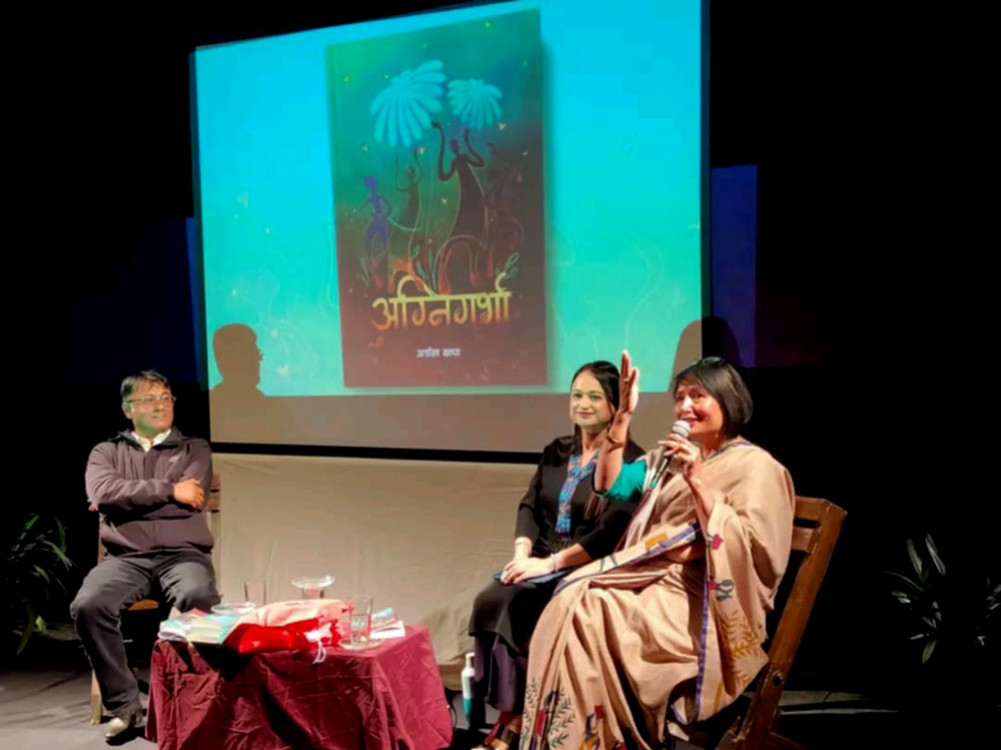
The novel 'Agnigarbha' is Archana Thapa's second novel. Her previous collection of short stories, 'Kathputala', has been published.
We use Google Cloud Translation Services. Google requires we provide the following disclaimer relating to use of this service:
This service may contain translations powered by Google. Google disclaims all warranties related to the translations, expressed or implied, including any warranties of accuracy, reliability, and any implied warranties of merchantability, fitness for a particular purpose, and noninfringement.
Mahesh Paudyal, associate professor and critic of the Central Department of English, has said that there should be a movement in the kitchen as well. Speaking at the launch of Archana Thapa's novel 'Agnigarbha' at Shilpi Theater on Saturday, associate professor Paudyal said that a kind of movement is needed to end gender discrimination.
She says that discrimination against women starts in the kitchen. Poudyal said that although there is a general trend of not allowing women to do kitchen work, there has been a change in recent times. He said, 'Even though the general trend is the same, we are starting to feel ashamed. It is necessary to turn this shame into a people's movement.'
Stating that the movement should not only be on the streets, but also in the kitchen, he further said, 'Raising children, feeding milk, washing clothes, and taking them to those who say magazines are 'great'. This is shameful. The work of breaking these things should start from those who work in the intellectual space.'
Similarly, journalist Aarti Chataut said that the theme of the novel is mainly focused around the kitchen. In addition, novelist Thapa, while clarifying the plot, has written that she is dedicated to her mother Anjana Sijapati Thapa, 'Those who write stories in fire, smoke, water, steam, and ashes... dedicated to those who save the spark of existence.' Journalist Chataut said that patriarchy is still strong today. 'Even though a revolutionary constitution was introduced in Nepal, that constitution has not accepted the share and lineage of women to this day. It says but, or else, or whatever,' she said.
Saying that patriarchy does not imagine women's public life, she says, 'The big question is whether those in power, those who run society, or intellectuals, whoever they are, have brought about any change in the attitude towards women.'
Writer Archana Thapa said that the way stories are told in the family, discrimination also increases in the same way. 'We cannot show respect to our family members. We tell stories like that. Children learn the way we behave. When we write or tell stories, we do not tell stories of 'healing'. We tell stories of discrimination in a way that makes them seem natural,' she said.
She also says that she is hopeful for Gen-G. 'Every generation has rebelled. That is why I think the new generation will not take steps to repeat discrimination. Everything we have been saying and doing may not be right, our strong daughters can challenge it,' she said.
The author says that it took her about 7 years to write the novel, even though she started writing it in 2075. Writer Thapa says about the time it took to write the novel, 'Although the plot remained the same from the beginning, the narrative style, subplots and characters kept changing.'
'Agnigarbha' is Thapa's second short story published by Akshar Creations Nepal. His previous collection of short stories 'Kathputala' has been published.