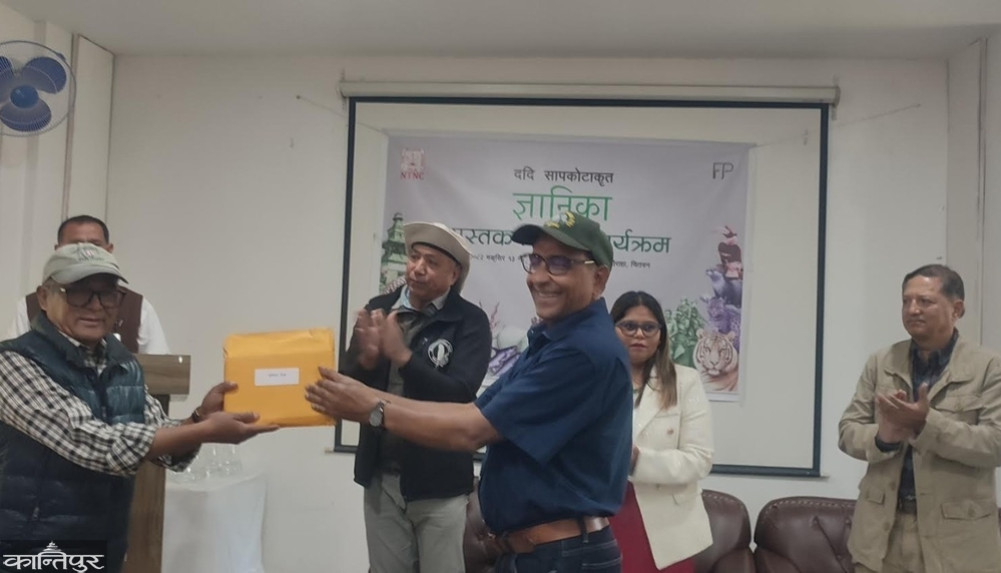
A discussion was held in Sauraha on the book 'Gyanika', which includes the experiences of 21 people working on issues including environment, wildlife, flora, tourism, and more.
We use Google Cloud Translation Services. Google requires we provide the following disclaimer relating to use of this service:
This service may contain translations powered by Google. Google disclaims all warranties related to the translations, expressed or implied, including any warranties of accuracy, reliability, and any implied warranties of merchantability, fitness for a particular purpose, and noninfringement.
A discussion on Dadi Sapkota's book 'Gyanika' was held in Sauraha on Saturday. Five characters from 'Gyanika' shared their views with the readers during the program.
Bishnu Lama, who has written about his long experience working as a wildlife technician in Sauraha, said that he learned to speak Nepali at the age of 14 and that although he had very little formal education, the knowledge he gained in the field has taught many people from home and abroad about wildlife rescue and other topics. Similarly, Gari Harkaman Lama said that he has worked as a wildlife technician for 43 years. Although he started his work with fear, he gained a lot of knowledge and experience from the field and discussed this in the book.
Babukrishna Karki believed that this book is like a 21-story temple because the experiences of 21 people have been included. Rama Mishra said that she is the youngest of the 21 characters in the book. 'There are few women in the conservation campaign. Such writing encourages those who are involved,' she said. She said that after she worked hard to study the very rare and little-known Malaha cat, many people have started to be interested and concerned about this animal.
Another character in the book, Rajendra Suwal, said that birds and other animals in Nepal are a subject of interest from the general public to high-ranking personalities. He said that including personalities involved in the protection and promotion of such animals in the book has encouraged conservation work. He said that it is also necessary to discuss the issue of linking conservation with economic gain.
'Gyanika', which includes the experiences and biographies of 21 people working on issues such as environment, wildlife, flora, tourism, etc., has been published by Fine Print. 'Now we have moved forward in the process of publishing a book that includes topics that can introduce Nepal to the international arena,' said Bhari.