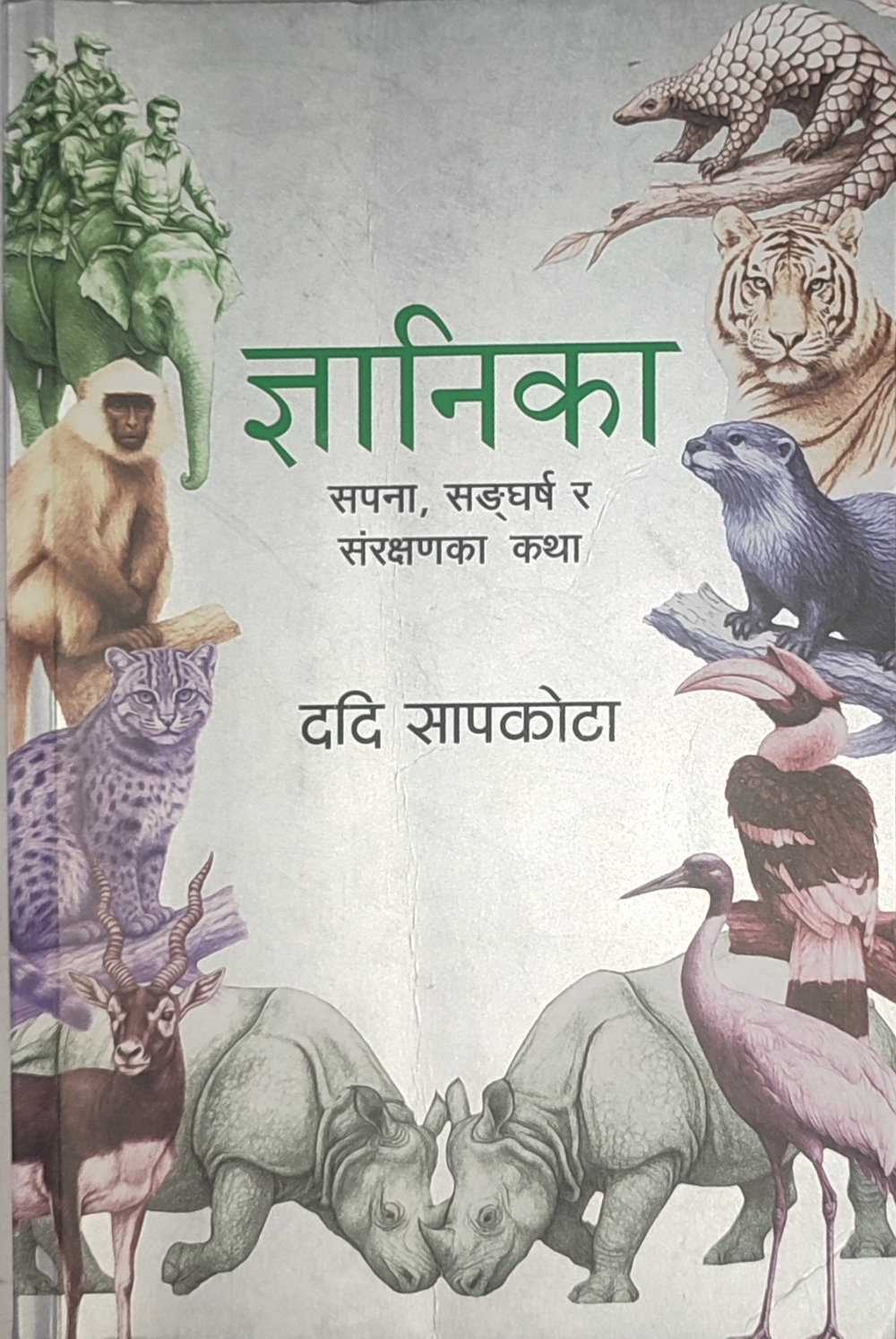
‘I am going today. What have you seen? Don’t look at me much anymore. I also feel like crying again.’ This is a psychological dialogue between a man and a group of monkeys. ‘Gyanika’ is a book that covers many such mysterious topics related to animals.
We use Google Cloud Translation Services. Google requires we provide the following disclaimer relating to use of this service:
This service may contain translations powered by Google. Google disclaims all warranties related to the translations, expressed or implied, including any warranties of accuracy, reliability, and any implied warranties of merchantability, fitness for a particular purpose, and noninfringement.
‘It’s like sending a couple on a honeymoon. You should create a fun, romantic environment, like sending them to a hotel with good service and amenities, for romance.’ Such an environment is necessary for pond fish. Since pond fish may not have sexual desire, it is necessary to create an atmosphere like a honeymoon spot, says fisheries expert Rajkapur Napit.
'Gyanika' is a book that covers not only the context of music and fish, but also many other mysterious topics related to animals.
'I am going today. What did you see? Don't look at me too much now. I also feel like crying again.' This is a psychological conversation between a man and a group of monkeys. When Mukesh Chalise was engaged in monkey research, when he was about to leave the Ramnagar forest in Chitwan after finishing his work, Chalise said this while addressing the monkeys gathered in front of him.
Chalise became very emotional at that time. What kind of strong relationship has developed between a man and a monkey who cannot speak? Almost tears fell at the farewell. In addition, the experiences of women engaged in research are even more unique. In a society where the general mentality is that women are weak, Tulsi Lakshmi Suwal's research on the lizard and Rama Mishra's account of the Malaha cat are included.
'I felt like the baby would fall out because it was so difficult for me. When I felt like it was going to be difficult, I asked how far the hospital was. But after resting, the pain decreased from the next day. Should I go to the hospital?' Researcher Rama Mishra is more worried about her research work than her life. Even when she was pregnant, she worked in the field far from home to study wildlife.
 Her physical condition was not conducive when she worked in Koshi Tappu, and the society is also a bit different. Women are rarely seen outside the house. She says, 'When it was so difficult, I used to forget that I was pregnant the next day after resting.' Not only in society, but there are also hardships she has faced in the forest. The book ‘Gyanika’ also describes the experiences of the then military officer working in the Bardiya National Park.
‘Nirajan Bir Bikram Shah tormented me for hours to allow me to hunt,’ Babukrishna Karki writes further, ‘Sorry, government, this is not possible.’ When Karki said no, did the then Crown Prince Nirajan’s desire or wish to hunt be fulfilled? You can read in the book. Not only this, the book also describes the views of the military leadership at that time on poaching.
Smugglers kill these rare animals for tiger skin, elephant tusks and rhinoceros horns. The army has been stationed in the park to protect them. Such organs recovered from smugglers, which are also called poaching, are stored for some time and then destroyed in a systematic manner.
Even if the animal dies, these organs are removed and preserved. There is a story about Bardiya in the book - 'Before the king's journey, Chief of Army Staff Prajwal Shamsher Jabra came. When he came, we had put on display the horns, elephant tusks, tiger and leopard skins recovered from poachers and smugglers.' He said, 'How good it is! Send me the tiger skins, I will decorate the office.'
Did a military officer named Karki fulfill this instruction given by the Chief of Army Staff, which was not in accordance with the rules, or what did he do? Its management has also been very clever. 'Gyanika' is Dadi Sapkota's sixth work. Sapkota, who started his book journey with 'Panchi Jagat', has written four out of six books about animals, plants, and the environment. 'Gyanika' is also a book mainly based on animals.
It includes the experiences of people who have researched environmental protection, rivers, snow, mountains, climate change and other small and large animals, who have also been involved in the protection and treatment of such animals, who have protected plants and herbs, who are involved in organic agriculture campaigns, and who are involved in pollution control. It also includes matters of Nepali traditional musical instruments and tourism.
The book has tried to shed light not only on the experiences of studious people, but also on the impact of their studies and interests on society. Sapkota has interviewed 21 people to prepare the book. The book is written in the direct statements of those who were interviewed. Two of the 21 are women. Their words fill 384 pages.
Some of these 21 people have opposing views. For example, tourism expert Ravi Jung Pandey believes that an airport should be built in Nijgadh. Another forest expert, Tej Bahadur Singh Mahat, writes in the same book, ‘The Commission is a Nijgadh affair’.
The book, in which military officer Babukrishna Karki is included to stop the royal family from hunting, also advocates hunting tourism. ‘Let’s increase the forest, increase the number of animals, protect the environment. If the increase is causing too much damage, let’s let hunting,’ Deepak Shumsher Jung Bahadur Rana has put forward his views in the book, saying that there is an opportunity for wildlife conservation and tourism through hunting. He has also given examples of Pakistan and Africa where rhinos are overpopulated in Africa and elephants are being killed by poachers who destroy crops.
Similarly, another wildlife expert, Rajendra Suwal, believes that wild boars entering crops should be killed on the spot with a good-caliber gun and that we should think about using their hooves, skin, and teeth. Suwal wrote that boar skin is used to clean binoculars and that even a small piece of boar skin is sold at a very high price in the international market.
Similarly, Rama Mishra, who did her PhD on the Malaha cat, said, ‘Farmers may think that it eats fish, it is our enemy.’ But it does not only eat fish. Rather, it is the farmer’s ally. It is an animal that eats a wide variety of foods. It eats all farm mice and birds.’ But fish expert Rajkapur Napit is of the opinion, ‘There is a fox-like creature called the water cat, which eats fish and kills them.’
In this way, those with opposing views and beliefs are included in one book. This may make the reader have to find more facts and basis to remove the confusion of what is right or wrong.’ The book also contains minor errors. Some articles have repeated sentences and paragraphs with the same meaning. Rahu fish is called Raghu. Similarly, rainbow trout is called Tilapia. While these are two different species of fish.
Similarly, it is said that the population of Chitwan has reached 1.6 million and there is a sentence that the voters are 800,000. While the population of Chitwan is around 700,000 and the voters are around 300,000. It also seems that if the book had been edited a little more tightly, it would not have reached 384 pages. Some articles feel like they are a little longer.
This book published by Fineprint is helpful in understanding the forests, environment, fauna and its conservation, and those involved in research. Mostly, those who have studied abroad and returned home and are engaged in research are included in the book. In addition, this book also includes people who have not even completed school education but have become skilled through experience and have even gone abroad to share their experiences in animal rescue.

