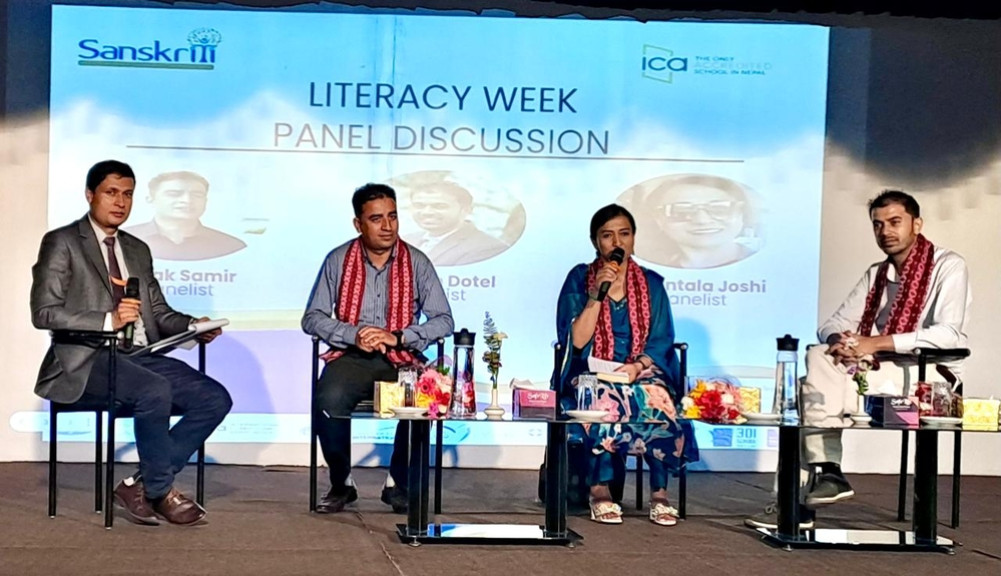
An in-depth analysis of the culture of reading in the interaction between writers and students and exchange of views on its balance in the digital age.
We use Google Cloud Translation Services. Google requires we provide the following disclaimer relating to use of this service:
This service may contain translations powered by Google. Google disclaims all warranties related to the translations, expressed or implied, including any warranties of accuracy, reliability, and any implied warranties of merchantability, fitness for a particular purpose, and noninfringement.
On the occasion of International Literacy Day-2025, Sanskriti International School has completed various programs with the slogan 'Promoting Literacy in the Digital Age'. Students, teachers and school administration participated enthusiastically in the interactive program organized by the school as part of the regular program of Literacy Week.
An interactive session was conducted in the special presence of school director Dipti Acharya, principal Timila Shrestha, co-principal Amit Mantri and representatives of the school administration and students. Vishwa Sigdel played the role of facilitator of the program.
Journalist and writer Deepak Samir, poet Shakuntala Joshi and book dealer and publisher Sudesh Dotel presented their views as special speakers. They analyzed the importance of reading culture, the opportunities and challenges of expanding literacy in the digital age and shared their experience with the students.
Journalist Deepak Samir told his experience that the books he read in his childhood guided him in life and said that the habit of reading books is weakening in today's generation and said that it should be balanced with digital technology. Even though there are many digital means of reading and acquiring knowledge now, he also narrated the joy of reading the pages of a book in physical form, the deep feeling that it gives, which cannot be found anywhere else.
Poet Shakuntala Joshi recounted her childhood experience of reading world literature books from her father's library in a remote mountain village. She emphasized the beauty of book study to the generation of this digital age, saying that books connected her with the world in that era when there was no media. She said that as much as it is easy for the current 'Generation Z' generation to get knowledge and information through digital technology, there is also a danger that people will be cut off from social relations due to its careless use.
Publisher Sudesh Dotel said that additional book reading will strengthen creativity and critical thinking and emphasized that the new generation should advance book culture in parallel with digital literacy. He said that in order to connect the new generation with the reading culture, they are running a campaign to connect the teachers and parents with the reading culture first. Also, according to an international survey about the reading culture, the United States was at the forefront of the annual Sardar book reading of more than 100 countries, and the fact that Nepal was not included in the list while India and Pakistan also said that our reading culture is far behind. During the
program, students asked speakers about literature, digital technology, the future of reading culture, book selection, ways to find time for reading, and how to instill enthusiasm for reading. During the question and answer session, when the students raised their questions, the speakers gave clear answers and also gave practical suggestions.
The school administration thanked everyone who contributed to make the program a success and informed that such programs will be carried out in a more effective manner in the future for the continuous promotion of reading culture.