We use Google Cloud Translation Services. Google requires we provide the following disclaimer relating to use of this service:
This service may contain translations powered by Google. Google disclaims all warranties related to the translations, expressed or implied, including any warranties of accuracy, reliability, and any implied warranties of merchantability, fitness for a particular purpose, and noninfringement.
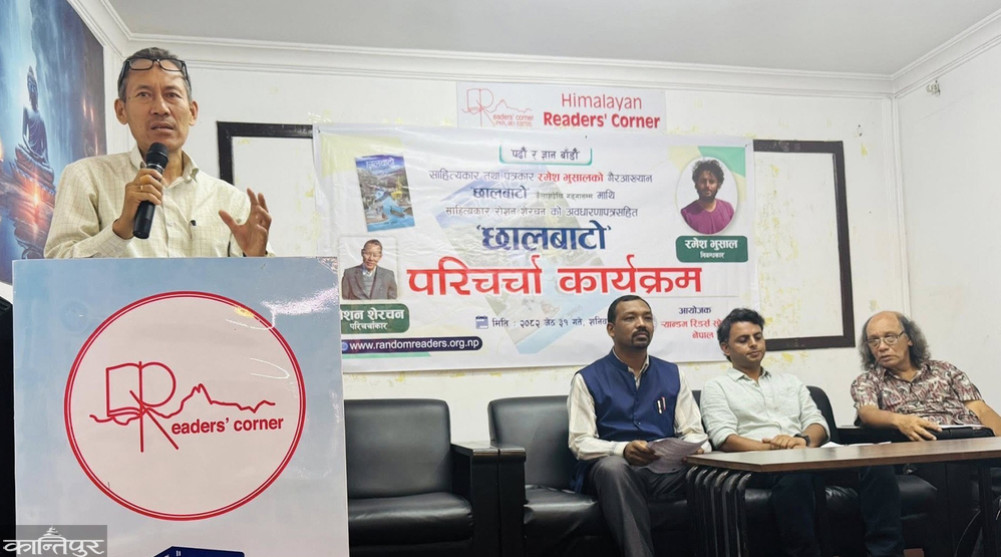
In Pokhara, the city through which the Seti Gandaki flows, the waves of Karnali were heard on Saturday - in Ramesh Bhusal's work 'Chalabato'.
Journalist and writer Bhusal's book 'Chalbato' has been organized by Random Readers Society.
The experience of a 45-day adventure journey from Mapcha Khamba, the origin of Karnali to the border of India, is covered in 'Chalbato'. When writer Bhusal spoke in the discussion program, his words also flowed like a river. He said, 'We live with the river, but there is no love in our behavior towards it. I want, after reading this book, we look at ourselves through the eyes of rivers, mountains and birds.' In his views there was an understanding of the relationship between nature and man.
'We find money to cut a mountain but we cannot connect the same mountain. This is a suicidal idea in the name of development,' he added. In Chalabato, he said that the relationship between the mountains and the river is depicted not only on the geographical, but also on the emotional level. Presenting a concept paper on the
work, writer Roshan Sherchan opined that the reader will get a taste of both physical and mental journey from the book. He said that the author has written the work by sociologically observing the estuary of Karnali, development priorities of Tibet, border security and coastal settlements. Stating that
is not only description, but also the feelings of the author have come in abundance, he said that it is mentioned that the original Karnali should be allowed to flow unhindered in the work. Narrating his reading experience that laughter and sympathy arise simultaneously while reading a book, Sherchan said that it is the author's power to generate laughter and sympathy at the same time. He is of the opinion that due to the facts in the book, Chalabato has become a sociological and natural science text of the river system, not limited to travelogues.
In Sherchan's eyes, the poor condition of water-dependent tribal women, the rapid development of Tibet and the unstructured expansion of Nepali border settlements are the stories that flowed in the 'Chalbato'. In his words, 'Chalbato' is not just a travelogue, it is an opening of sociological consciousness. He also recalled, 'It is requested in the work that the Karnali river should always flow. That request is a silent rebellion against today's development concept.'
Writer Sarubhakta considered Chalabato as a document of feeling. 'A work is not just a reflection of memory, it The reader should be able to travel with the writer,' he said, 'Chalbato has that ability.' He said that although
works are called non-narrative, the quality of the narrative and when the topic is deep, the format is secondary. 'There is no artificiality in the writing. He talks to the river, dwells in the slums and stands on the border asking questions,' Sarubhakta said, 'I want this book to make us think about nature and our relationship even once.'
Random Readers Society joint secretary Deepak Parajuli and book selection committee member Hasina Basnet presented their critical views on the work.