We use Google Cloud Translation Services. Google requires we provide the following disclaimer relating to use of this service:
This service may contain translations powered by Google. Google disclaims all warranties related to the translations, expressed or implied, including any warranties of accuracy, reliability, and any implied warranties of merchantability, fitness for a particular purpose, and noninfringement.
After 6 years, art connoisseurs got a chance to interview painter Hari Prasad Sharma again.
He was delighted to see the fascinating scenes of the merged history on the walls of the Nepal Art Council at Babarmahal. Together, we look at Newari culture, life, lifestyle, journeys and periods. Earlier, Hariprasad's solo exhibition was held at the Art Council in August 2076.
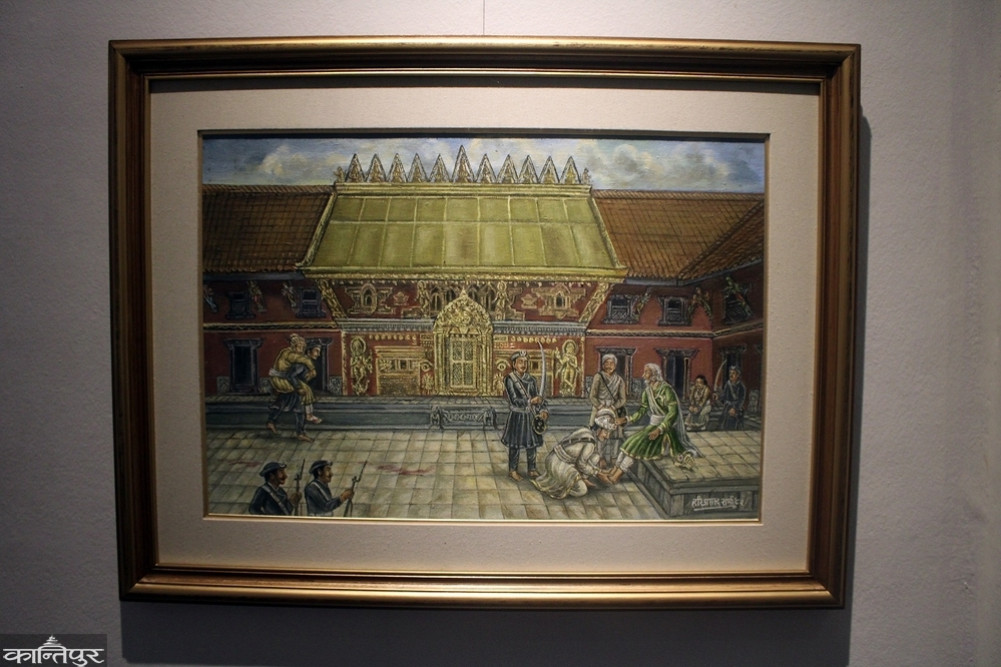
At that time, art lovers were fascinated by the rare paintings of artist Araniko. Influenced by the architecture of Nepal in ancient times, a king of China built 100 Kaligads. At that time, a 17-year-old youth who became famous by the name of Arani went to China with 80 Kaligad men armed with arms. Hariprasad brought the rare moment of bidding farewell to Balbahu alive on canvas.
6 years ago was 82 years old Hariprasad . Now reached 88 . The forces are decreasing . The hands that hold Kuchi are trembling . But his memory of history that has become blurred is just as sharp. Eyes are sharp . In the meantime, 15 new pictures were added from Hariprasad's Kuchi.
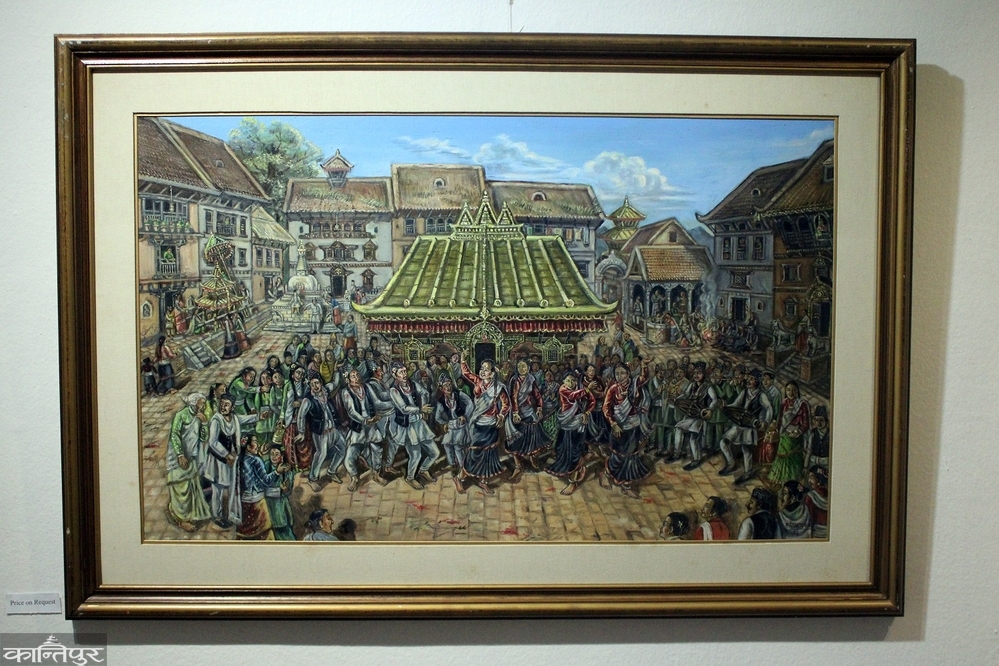
On November 1, 1826, Prithvi Narayan Shah won the kingdom of Bhaktapur. Before fighting at Bhaktapar, Prithvi Narayan had already won the battle at Kantipur and Lalitpur. The moment when Prithvi Narayan ended the Mallaka period by running on Mitba's knee after winning a three-day battle in Bhaktapur has survived in the picture of Hariprasad.
It was not easy to make that picture . His son Vishnu Sharma, who is constantly supporting Ba's painting journey, says, "The sketch of that painting in the main square of Bhaktapar could not be done sitting there. It was not possible to take the paper too. We used to come out and work noticing the father and son.'
In one picture, Prithvi Narayan Shah gives a gold and silver asarfi to a dancer after watching a Newari dance. This is a picture painted by Hariprasad after spending a lot of time. It took him 6 months to make the picture.
The book of Hariprasad's paintings is now being gifted by the President's office to foreign guests.
Hariprasad's paintings, how do you combine Newari lifestyle with history? For this he has to go back to his past . His childhood was spent in Lagantol, Kathmandu, where the Newari community dominated. Although he is the son of a Pandit, he is a Newar friend. Newari lifestyle and culture was imprinted on Hariprasad at an early age.
He got to know the Newari culture closely by speaking Newari, participating in the Newari Jatra. Markha Jatra from Batutol is still fresh in his memory. In his childhood, he used to watch that Jatra from the window. "In the cold of the month, the presence of sadhaks walking with a thousand streams of water on their naked bodies from clay pots, teams with accessories and Newar girls dressed in beautiful clothes and holding wax rose flowers in their hands made the Jatra more magnificent," said the narration commemorating the Jatra. The beauty of Rajamati can be found in his paintings.
An interview with the original process of making Newari liquor. Jatra in some, business in some, festival in some, In some, professions are clearly visible. During the picture exhibition, Hariprasad expressed his love for soil and art and said,
'I was born in Nepal, I grew up here, I call it here.'
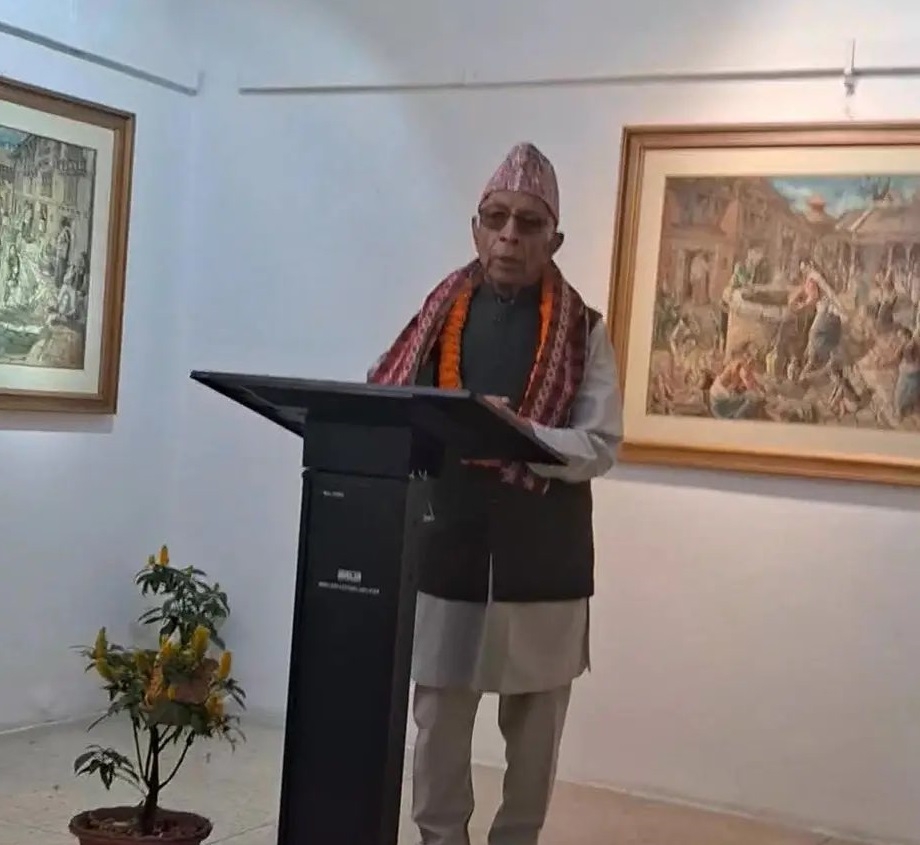
Satya Mohan said about Hariprasad's paintings, "His artistic sense and imagination are spectacular and admirable." Professor Abhi Subedi also expressed his words of appreciation, being impressed by his art, "No one seems to have painted such a deep and rare scene." Neither his master nor his contemporaries . His paintings seem famous.'
Hariprasad's son Vishnu is equally active in his painting journey. Vishnu is a professor of economics. He used to teach regular college. As he did not have enough time for his father, he gave up regular teaching .
In 1930, a 'thug' took Hariprasad's paintings and did not return them. After the death of Hariprasad's life partner in 052, he expressed his desire to paint again for peace of mind.
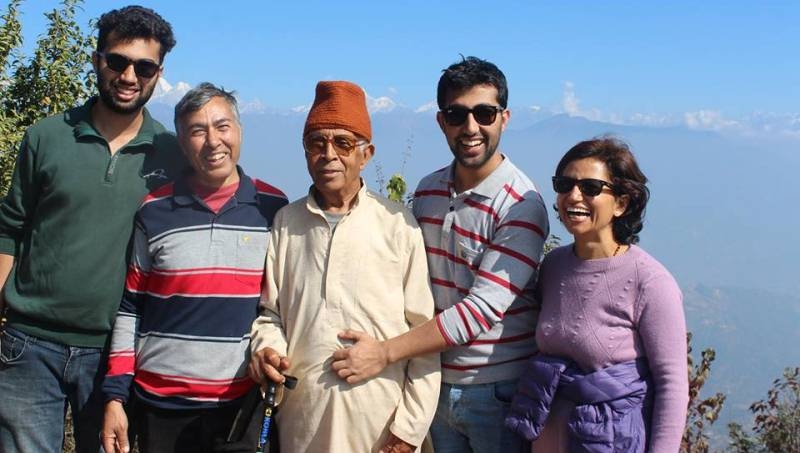
Vishnu was happy when his father decided to make a picture. After that, the pictures that my father made. I felt that it should not be allowed to go to waste,' says Vishnu. The son reflected on the fact that there is no record of the changes in the culture of Kathmandu in the span of 30 years. It was an old house, now it is a new one.
is not his record. The last generation will not be able to see it . You can work on it . I will help you," Vishnu dared Hariprasad. Then going to the old houses, walking the streets, taking photos of the people's life there, Reading became their routine. They studied extinct people.
Vishnu used to collect material and give vision to it. In this way, father and son's cooperation is still continuous. This exhibition is also the result of that collaboration.
After the current exhibition, Hariprasad is more happy. He said to his son, "Now I have received publicity." Everything has arrived. I am very happy to come here.'