On the second day of Nepal Literature Festival, debate on health, education, conflict literature, development, adventure tourism, technology, language
We use Google Cloud Translation Services. Google requires we provide the following disclaimer relating to use of this service:
This service may contain translations powered by Google. Google disclaims all warranties related to the translations, expressed or implied, including any warranties of accuracy, reliability, and any implied warranties of merchantability, fitness for a particular purpose, and noninfringement.
The crowd of foreign nationals at the airport, chaos on the streets, is Nepal going through extreme despair? Speaking at the 'Disappointment: Interpretation and Reality' session on Friday at the ongoing Nepal Literature Festival in Pokhara, the speaker said, 'There is not only despair in Nepal, there is also hope within despair.'
Congress General Minister Gagan Thapa, Co-Founder and Chief Executive Officer of Teach for Nepal Fellowship Swastika Shrestha and Political Scientist Jeevan Baniyan, Kantipur Daily Editor-in-Chief Umesh Chauhan met.
General Minister Thapa agreed to Chauhan's concern that the government is not trying to alleviate the frustration that is being seen now. Thapa admitted that the current weakness of the government is that it cannot do effective work to overcome frustration. He said that he will not be able to escape from the shortcomings of the government.
"While I don't see that, I also have questions, but it doesn't mean that I questioned here, I did it, because I am in a responsible position of running the government, whether or not I am involved, I should not run away from the weaknesses in it.
Shrestha said that there is hope in the midst of despair. I don't mean to say that there is no challenge. Again, hope does not mean blind hope. There is hope and despair in the community. There are also hopeful things. There are also difficulties. But what is our priority, whose responsibility is it," she said.
Political scientist Baniyan told that Nepal is not the only country where there is despair. However, he said that the points and elements of disappointment are the main ones. Nepal is not the only country where there is despair. What is the rate of a little disappointment? What are the factors? There may be a difference in that. In the case of Nepal, there are major reasons. The first thing is employment, the second is our politics, the same is shown by various studies," he said.
He told that the idea that Nepal is not able to do good work in any field is wrong. He said that the work being done in various fields is promising. Not if there is nothing. Now in health care, very well done . We are doing good work in IT, Hydro,' he said. On the second day of the
festival, debates were held on health, education, conflict literature, development, adventure tourism, technology, language. At the festival, journalist Yogesh Dhakal interacted with Health and Population Minister Pradeep Paudel, cardiologist Dr. Bhagwan Koirala and diabetes and hormone specialist Dr. Santosh Shakya in the session 'People's Access to Health Services'.
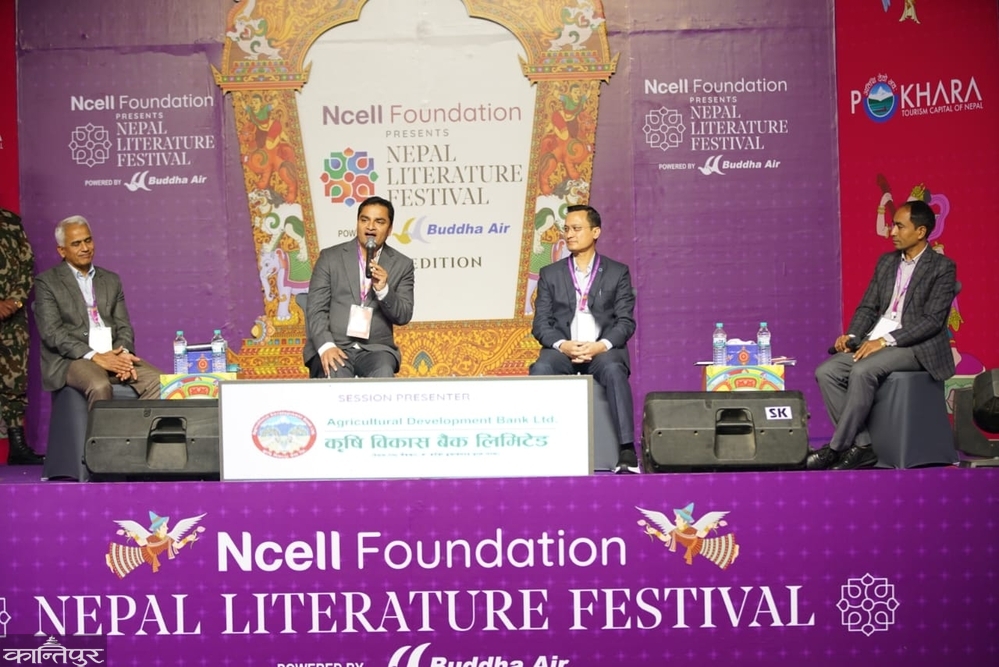
Dhakal asked Health Minister Poudel, "What did the Ministry of Health's laboratory do in 225 days for diagnosis?" Did you see that you should be cured by taking pain killers or surgery?'
Health Minister Paudel's answer was, 'Surgery should be done.' He claims that there has been some improvement in terms of service expansion. It takes some time to get the feeling. Surgery should be done in many places in terms of giving cetamol or surgery. It seems that we have to do surgery on the policy, managerial and investment side.'
Journalist Yogesh Dhakal interacted with actress Manisha Koirala and Mahendra P Lama in the session 'This is how Nepal-India relations are'. In the dialogue, Koirala said that the constitutional monarchy is the preserve of BP Koirala. "He has brought a policy of national reconciliation because Nepal needs a constitutional monarchy for stability," she said, "if the Congress had not abandoned his vision, our situation would not be like this now." Yes .' "Nepal is a huge success story in many ways and that's because of education," said Doyen. Every formula of success comes from education.'
'Hello Daxab!' Jagdishlal Vaidya and Dr. Journalist Dipendra Shrestha had a fight with Buddhi Bahadur Thapa. Suman Ghimire interacted with cute pilot Sanubabu Sunuwar, Go Bungee operator Meena Baral and mountaineer Jagan Timilsina in the 'Now Adventure Tourism' session.
Ganesh Khaniyan debated with war journalists Sangeeta Khadka, Naveen Vivas and Govindraj Bhattarai in the session 'Until Writing Conflict Literature'. Bhattarai said, "Conflicts will continue as long as human society exists, and the society becomes sophisticated with small and big conflicts." Journalist Deepak Pariyar asked, "What kind of development?" In the 'Whose development?' session, a discussion was held with Lakshmi Pandey, Chairperson of the National Federation of Rural Villages, Manjudevi Gurung, Deputy Head of Pokhara Metropolitan City, and Pragya Pradhan, Program Director of UN Habitat in Nepal. They thought that the budget should be made inclusive to adopt the concept of inclusive development.
In the 'Litch and the Art of Other Stories' session, Bhushita Vashishtha argued in a dialogue with Ranjan Adiga that the writer should be anarchic to show dimensions that society has not imagined. Yojana Thapa Magar interacted with content creators Dipesh Tripathi, Saroj Karki and Amrit Thapa in the session 'Alternative Voices in the Age of Technology'.
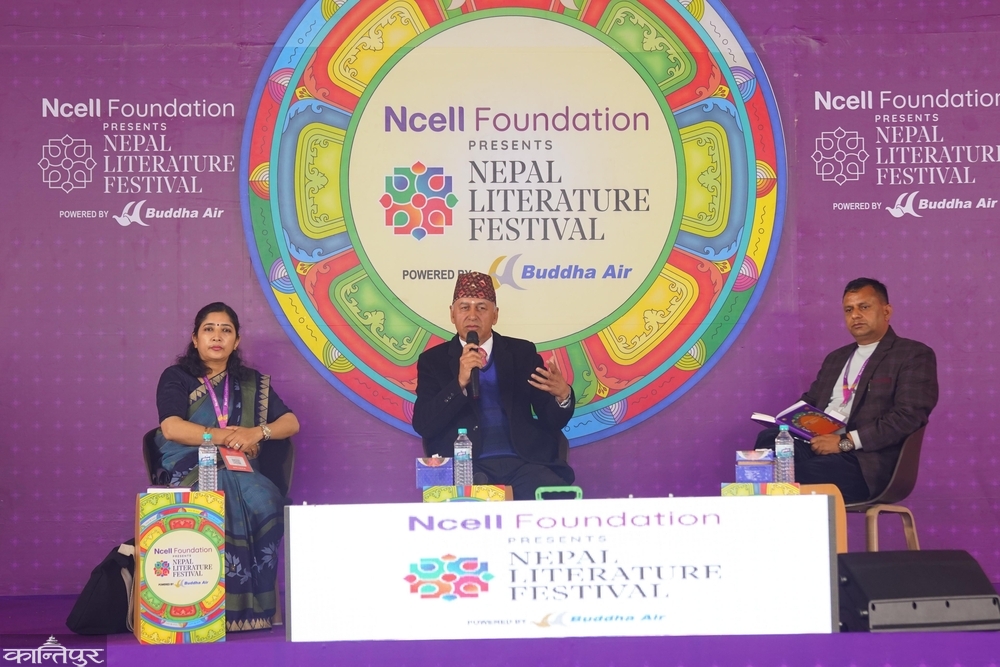
Reshamm Giri interacted with Diwakar Jaisi, Hasina Basnet in the 'Ghar: Prahta University' session . "Why the current mothers and fathers could not become idols for their own children?" Suraj Upadhyay interacted with Surendramansingh Bhandari, Teknarayan Poudel and Kaushalya Gurung in the session 'Reading Culture in Schools'. In that session, the speaker said, "Why doesn't the state that invests in a big view tower invest in a library?"

