Nar Bahadur represents those people of the diaspora who do not want to leave their 'roots' even in difficult circumstances. They talk about the 'country' even while 'outside the country'.
We use Google Cloud Translation Services. Google requires we provide the following disclaimer relating to use of this service:
This service may contain translations powered by Google. Google disclaims all warranties related to the translations, expressed or implied, including any warranties of accuracy, reliability, and any implied warranties of merchantability, fitness for a particular purpose, and noninfringement.
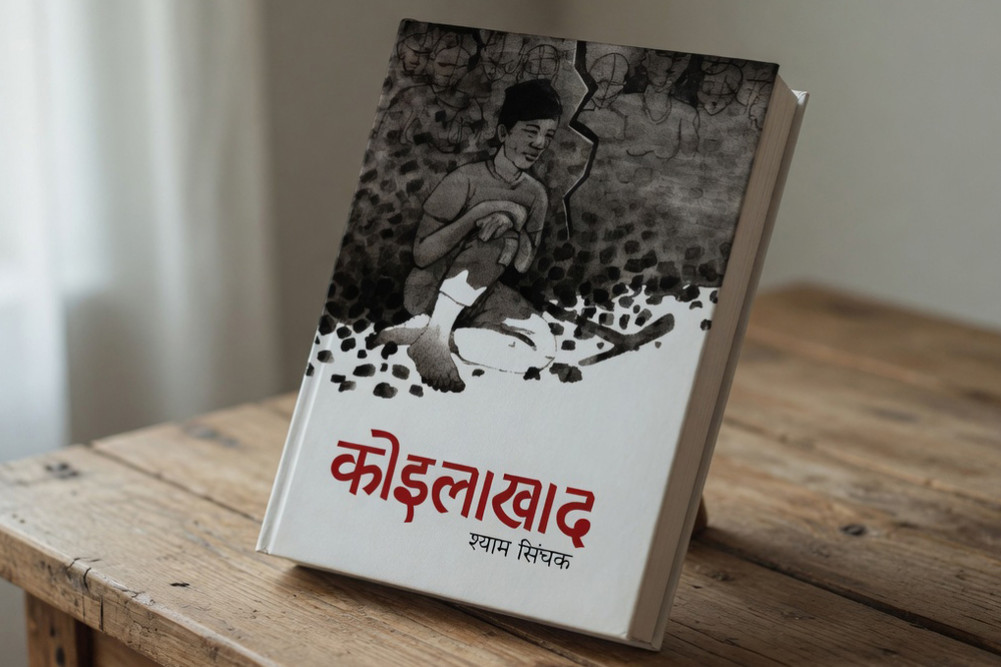
A novel is a new form of modern literature, where human emotions and the characters of the soul are revealed through words. In this context, novelist Shyam Singhak's new novel 'Koilakhad' fell into my hands. While reading this novel, the reader will not only feel like reading a book, but will also feel like listening to the deep sigh of a living civilization and human existence.
Let's look back at the history of world literature. When Maxim Gorky emerged in fiction, the stories of the pleasures of the palace and the luxuries of the prince gradually faded away. Gorky was the first to place the man at the center of literature, whose hands were lifted and whose foreheads were constantly dripping with sweat. I think writer Shyam Singhak is also very much influenced by Gorky's philosophy of 'social revolution'. He has given voice to the pain and rebellion of the working class, following in Gorky's footsteps. In Gorky's novels, the characters dream of rebellion along with the smoke rising from the chimneys of Russian factories. Shyam Singhak's characters are also daring to light the 'lamp' of justice within the pitch darkness of the coal mine. They are holding on to their lives and self-respect within the dark tunnel of the same coal mine.
Shyam Singhak's novel 'Koilakhad' is such a 'silent voice', which has become a strong document of Marxism and human labor.
Marxism in ‘Koilakhad’
Marx had said, ‘The workers of the world are one.’ The novel ‘Koilakhad’ is not just a story of a single place, but also a poignant story of the existence of people caught in the grip of industrialization and nature. Through the dialogues between Lochan, Nar Bahadur, Ruth and Sardarni, the novel has exposed the interesting human conflict between traditional beliefs and the struggle for survival. The strongest aspect of ‘Koilakhad’ is the intense portrayal of the unbreakable relationship between the characters who are connected to tribal identity and water, forest and land. In the book, a character asks, ‘Are we dependent on the forest or is the forest dependent on us?’ Such a question is not just a question, but also a serious issue of debate, where ecological and human relations are speaking loudly.
‘Koilakhad’ transcends geographical boundaries and embraces the common pain of the ‘proletariat’. Lochan, a young character who is driven away from a remote village in Nepal due to poverty, falls into the clutches of the same exploiting class when he reaches Meghalaya in India. This confirms that exploitation has no nationality and is the universal oppression of one class over another. The novel attempts to depict a historical period and economic constraints in Nepali society. Here, workers are forced to sell their ‘labor power’ abroad after not having access to the means of production (land, industry) at home. This migration is not a personal desire, but a result of class differences and unequal distribution of resources.
From a Marxist perspective, it can be said that the novel ‘Koilakhad’ is that black tunnel of capitalism, where the blood and sweat of the workers are used as ‘profit’. Shyam Singhak has put into words the faces of the proletariat disappearing in the coal dust and has also tried to provide class consciousness to the reader. In this way, after reading the novel ‘Koilakhad’, the theme of the novel forces the reader to think – is the industrialization and progress of the country, which is built on the mass grave of the workers in the name of development, justified in favor of humanity?
Marxism views society on the basis of ‘means of production’ and ‘class struggle’. The coal mine itself is a great Marxist image. The workers working in the coal mine (Lochan, Nar Bahadur) are the working class. The debate on rules and regulations between the characters Lochan and Nar Bahadur on page 41 of the novel ‘Koilakhad’ is actually a story about the relationship between ‘the state and the workers’. Marxism says – the rules of the state are always in the interest of the ruling class. Lochan's 'rules' are just a tool to control the workers. Lochan talks about the conflict between 'foreigners and locals'. Marxist philosophy explains this as 'divide and rule'. The capitalists fight the workers in the name of caste, religion and geography, so that they cannot unite against their common enemy (exploitation).
There is a theory in psychology that is consistent with this aspect, 'social identity theory'. That theory says that people naturally try to show their group (such as caste or geography) better than others. When the ruling class cleverly uses this human weakness, then the workers start seeing each other as enemies in the name of 'locals or foreigners'. As a result: their mutual harmony breaks down and instead of raising their voice against the real problem, i.e. exploitation, they get entangled in the fight over their own identity.
Whenever humanity is divided into ‘me and you’, that is when exploitation gets an easy chance to rule.
Love consciousness in ‘coal mine’
Love is such an indomitable and eternal force of creation, which has bound the entire universe in one formula. It is not just a word, but also the basis of human existence and the original hymn of creation. Love is that energy, which gives momentum and meaning to life.
The real nature of love is free and independent. It is such a natural experience of the human mind, which does not accept any artificial walls or social bonds. Love seeks freedom. It does not recognize caste, religion, class or any other boundary. Whenever love arises in the mind, that love has the courage to transcend the rigid rules or narrow boundaries set by society. Yes, this is how it is, the love story of Lochan Limbu and Ruth, the characters of the novel 'Koilakhad'. Lochan, a young man from Nepal who comes to Meghalaya to become a coal mine worker, falls in love with a woman from the Khasi community. Their love has written a new story in the novel, where it is not just a line that separates caste but also a window to understanding each other. In 'Koilakhad', the matriarchal customs and strict rules of tradition of the Khasi community give Lochan Limbu authority. And, his girlfriend Ruth, who is thus separated by tradition, easily rejects the ancestral property she will receive. She seems to be trying to prove such a love, where there is no question of being attached to any material object or inheritance. The self-respect of the Nepali Lochan, who was raised in the culture of Mundhum, and on the other hand, the determination of the Khasi woman Ruth, who puts love above property, have made the novel juicy. This taste is interesting to the reader - true love has the ability to defeat not only geography and the fading social norms, but also the most complex human emotion in the world, the greed for money.
Therefore, while reading 'Koilakhad', the reader is not only reading a tragic story, but also experiencing the loneliness of being forcibly bound in the artificial chains of tradition. And, he is also tasting the spiritual dedication of Ruth's selfless love, which is also a strong introduction to femininity.
In the novel 'Koilakhad', the situation of the character Ruth is more poignant. Ruth represents a caste where matriarchy is given importance. In this way, Ruth's life is also found to be in a state of being forced to run a family like a common Khasi woman and having to sacrifice her feminine desires. Ruth's life story is dying 'little by little' due to economic inequality. But, Ruth is in love with Lochan. Meghalaya's 'rat-hole mining' is a very dangerous place, where several workers lose their lives every year while mining coal by entering narrow tunnels of 3-4 feet.
The value of a Nepali worker's life working in the coal mines of Meghalaya is considered less than the value of the coal mined there. If a worker is buried in a coal mine, the owner is more worried about the cessation of coal production than the grief of the worker's death. I think that this 'humanistic theme' has become the main ideological basis of the novel Koilakhad.
Koilakhad and 'Diaspora'
Just as the chemical process of the birth of a diamond prevails in the black womb of coal, similarly, the story of the struggle and deprivation of the characters in the plot of 'Koilakhad' is also trying to dig out the light of human existence amidst the whirlpool. And, one face of that effort is the ‘diaspora’ emerging in the novel. The novel’s diaspora consciousness is telling the reader, ‘The Nepali diaspora living outside the country for jobs is not just a dream, it is also a class struggle, where workers must be forced to change both their geography and faith.’ In one part of the
novel, the reader can experience two streams of diaspora. Where one stream is saying, ‘We cannot change our blood and culture wherever we go’ (character Nar Bahadur). The other stream thinks, ‘We must immerse ourselves in the soil of wherever we go’ (character Lochan). This conflict between ‘stability’ and ‘mobility’ is the beauty of diaspora. Lochan and Nar Bahadur are in a coal mine, but in their logic, the ‘country’ (Nepal) is always alive. Therefore, here the diaspora says, ‘home’ is not just a geographical address, it is a ‘memory’. For the characters in the novel ‘Koilakhad’ of Meghalaya, Meghalaya (India) is their ‘workplace’ while Nepal is their ‘birthplace’.
Shyam Singhak’s ‘Koilakhad’ does not only tell the story of coal mine workers, it also expresses the turmoil of millions of diasporic Nepalis who have left their homeland and gone abroad, where they follow the rules of a foreign country with their bodies, but are searching for the fragrance of their own soil with their minds. The theme that the character Lochan thinks about in the novel is ‘most conflicts are the struggle between the language, culture and religion of the visitors and the locals’ – the basic formula of diasporic literature. The reason is that the ‘racism’ or cultural discrimination that Nepalis in exile face is the result of this struggle. When the locals do not accept the existence of the ‘migrant’ – that is the moment when the conflict begins. Isn’t it? The character Nar Bahadur represents those people of the diaspora, who do not want to leave their ‘roots’ even in difficult circumstances. Even though they are ‘outside the country’, they talk about the ‘country’. At one point, Nar Bahadur says, ‘Laws and religion and culture are different things.’ For Nar Bahadur, ‘laws’ are for the body, but ‘cultures’ are for the soul. Nar Bahadur is trying to say throughout the novel – a person can change his geography, but he cannot change his ancestral history and culture. Thus, Nar Bahadur is found talking about connecting with ‘roots’ throughout the novel. And, these things are the main motivators of ‘existentialism’.
In the diaspora, a person always remains ‘unknown’. No matter how many years they live in Meghalaya, India, characters like Lochan and Nar Bahadur are still called 'visitors', and the bitter side of this is the way the locals view 'visitors' and the 'identity crisis' they have to face.
The difference in language and culture prevents people from becoming 'humans'. People even become enemies of each other in the name of artificial language or culture. In the novel 'Koilakhad', the characters have also experienced diaspora. And, they have dreamed of returning to their country, but it is very difficult to return. The reason is that there is the heat of the fire and the shadow of some beloved human relationships that have grown abroad. Although Nepalis living abroad easily follow the traffic rules and tax systems of foreign countries, but when celebrating Dashain-Tihar or performing family worship at home, every Nepali who has gone abroad remembers his own country. Isn't that right, dear reader? Similarly, things depict the mental pain of diasporic life. The dear reader will definitely feel this while reading the novel ‘Koilakhad’.
The depiction of the middle-class society in ‘Koilakhad’ is highly commendable. Reading the real state of that society definitely evokes a feeling of pain and struggle. However, as a reader, it is difficult to accept the reality presented in the novel. However, the author has woven the essence of the Nepali community as well as other communities into the story with complete beauty. Even though I find some weaknesses in the novel at some places, I would like to say that the author has left no stone unturned to portray it realistically.
While reading the novel, the reader will definitely remember the ‘coal mine’ of Meghalaya and the ‘lovely’ scene of the Nepali young man Lochan and the Indian Khasi young woman Ruth against their caste or, let’s say, caste-religion. And, this is the success of a skilled novelist.
‘Koilakhad’ is not just a novel, but a living document of the sweat, struggle and dreams of the working class. The way the author has put the psychological conflict and social conditions of the characters into words, forces the reader to think seriously.
The language of the novel is simple and poignant, which easily reaches the reader’s mind even with serious topics. It has exposed the willpower of a person to survive and struggle even amidst the class discrimination and deprivation in our society. ‘Koilakhad’ is a readable work of contemporary Nepali literature, which will succeed in leaving a deep impression on the reader’s heart for a long time.
‘Koilakhad’ is the story of those lost in the dark tunnel of life, who are seeking a place in the reader’s consciousness through the words of Shyam Singhak. Dear reader! Have you read ‘Koilakhad’? After completing the reading journey of ‘Koilakhad’, which character or scene has made the most impression on you? Is it just a novel or an unresolved aspect of your life? Do tell me!