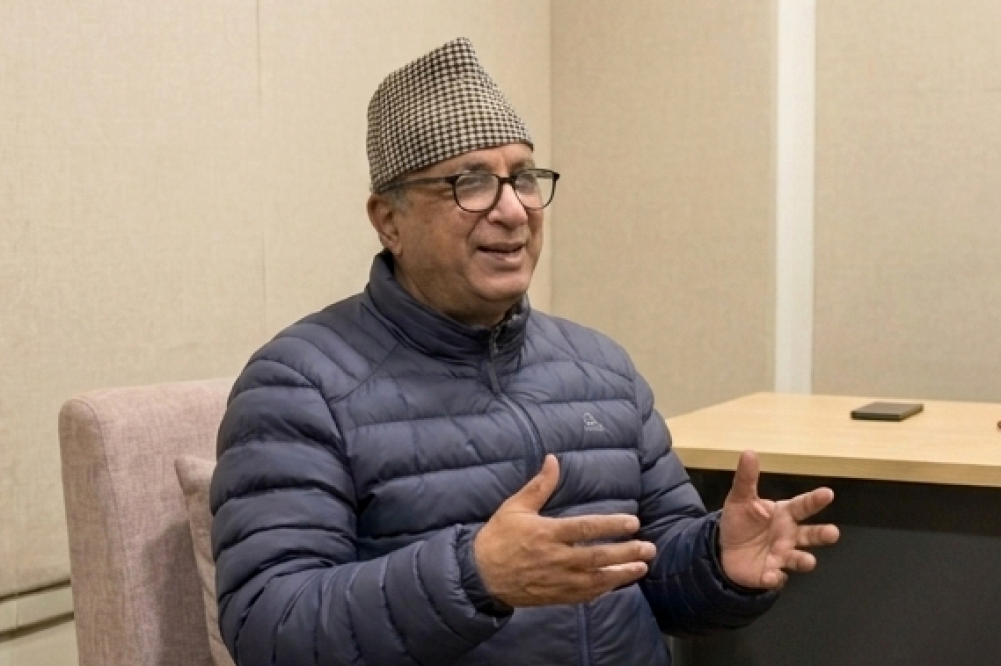
In an interview with Kantipur, Giri said that frustration with criticism has increased due to a lack of critical discernment and honesty, imbalance of ideas, and narrow-minded thinking.
We use Google Cloud Translation Services. Google requires we provide the following disclaimer relating to use of this service:
This service may contain translations powered by Google. Google disclaims all warranties related to the translations, expressed or implied, including any warranties of accuracy, reliability, and any implied warranties of merchantability, fitness for a particular purpose, and noninfringement.
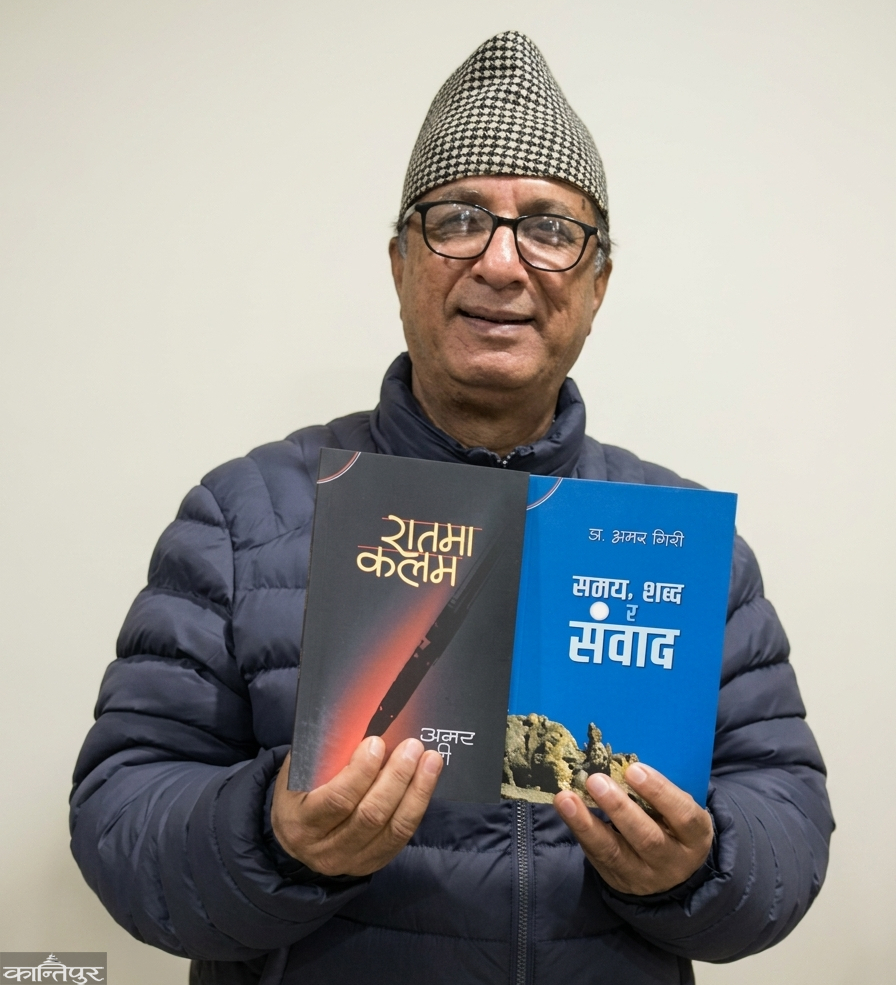
Amar Giri, who holds a PhD in progressive poetry, is writing his latest collection of books - 'Time, Words and Conversation' (essay) and 'Night Pen' (poem). Giri, who writes poetry, criticism, essays and political columns, is also a former academician of Nepal Academy of Sciences. Active in the progressive cultural movement for five decades, his essays, three criticism works, and six poetry collections have been published. Kantipur's Phanindra Sangam spoke to him about the new book: In the context of globalization, marketism and consumerism making a forcible entry into poetry, is poetry resisting or surrendering to the market? We have both. Poetry has resisted globalization, marketism and consumerism, and has also been influenced by its values. We are in a time when the logic and influence of the market and consumerism are strong everywhere. The market and consumerism prioritize content that is easily digestible and provides entertainment. This is a time when knowledge and beauty have been displaced from entertainment. Poetry is art, a source of beauty. There is a difference between beauty and entertainment. Poetry has been made market-friendly. Making poetry market-friendly means turning it into a means of entertainment. Entertainment is related to the consumerist trend of easy consumption, quick enjoyment, fun, time-passing, and not having to be serious.
Beauty is related to deep feeling, expansion of sensations, spiritual sophistication, imagination, truth, pain, encounter with complexities and contradictions, conflict and questioning, self-reflection, transformation of life and the world. Poetry has been made market-friendly through the objectification of feelings, the conglomeration of ideas, demonstration and simplification, abandonment of depth, criticism of social and aesthetic roles, etc. Poetry has also resisted this. This is why poetry is alive and will remain alive even in the midst of the world of the market and consumerism.
You have quoted thinkers from Christopher Caudwell to Adorno and Baudrillard to show your disappointment with poetry. Was the poetry that disappointed them artistically weak or ideologically hollow? Has the poetry being written now been able to reverse that disappointment and create any ideological hope?
I have mentioned the views of Theodor Adorno, Christopher Caudwell, Octavio Paz, etc. on poetry in my essays. They find deep disappointment in poetry. But this is a disappointment within hope. The disappointment is related to the consumerist culture created by capitalism, the situation created by the World War, the commodification of art, the fragmentation of language and meaning, the decline in human values, etc. Their disappointment is not related to the weak craftsmanship or ideological hollowness of poetry.
After the Holocaust, Adorno felt that writing poetry was barbaric. He believed that beauty, sensitivity, and language had lost their moral foundation after the horrific inhuman violence. His frustration is also linked to capitalism and the culture industry. He says that art has been transformed into an object because of these. His frustration is also related to the objectification of art. But he also said that poetry should increase its ability to express human suffering.
Cadwell's frustration is related to the fact that poetry is moving away from collective life in bourgeois society. Poetry loses its meaning when it is cut off from collective life and passion. The reasons for his frustration were that poetry was limited to purely personal experiences, was cut off from social reality, and the artistic value of poetry was declining. He believed that poetry was in crisis because of capitalism. He also said that poetry should resist this situation.
Paz's despair is related to the disruption of the continuity of history due to the modern era, the increasing loneliness, the uncertainty and decay of meaning, and the damage caused to the collective and spiritual life of people by the development of technology. Despite expressing despair towards poetry, they also had a deep belief in the power and future of poetry. The views they expressed many years ago seem more serious and compelling today. Struggling with today's situation, poetry has artistically recreated life and the world. Their despair should be understood in a relative way. This situation has also had an impact on Nepali poetry. Its analysis and evaluation will be done in the coming days.
There is a debate on postmodernist concepts such as 'death of the writer' and 'death of the critic'. You say that the ideological basis of criticism is not postmodernism. But in practice, Nepali criticism seems to be 'dead'. Is this an ideological crisis or the intellectual bankruptcy of the critics themselves?
Many writers say that Nepali criticism is dead. Their opinion is expressed as a disappointment towards the current Nepali criticism. It is related to the role that criticism has not been able to fulfill, not to postmodernism. I have discussed this issue in one of my essays. The postmodernist notion of ‘the end of criticism’ or ‘the death of criticism’ is linked to notions such as the end of the grand narrative, the plurality of meanings, the death of the author, the instability of language, etc. Postmodernism does not accept the assumptions and paradigms of traditional criticism.
Postmodernism is still active and can also be observed in criticism. The dissatisfaction with the current criticism is born due to its weaknesses. This dissatisfaction has reached the level of saying that criticism is dead . Dissatisfaction and disappointment with criticism, which has become weak due to the syllabic tendency found in many critics, lack of critical conscience and honesty, imbalance of thoughts and feelings, lack of seriousness towards paradigms and methods, poor reading, divided and narrow thinking, indifference towards the responsibility of the critic, etc., have increased .
You claim that literature without thought is not possible . But why is there intolerance towards different ideas even in the progressive stream ? Isn't this ideological narrowness ?
Literature has never been free from thought and ideology, and it is not even today . This is not my opinion, it is reality . Some say that literature should have thought, not ideology . Such a statement is also not realistic . Thought and ideology are not synonymous with each other . Both of these remain in literature . Creative thought and ideology are not absolute . This is reflected in both the content and form of literature . Even in the progressive stream, intolerance towards different ideas is found . This cannot be considered appropriate . Ideological disagreement, criticism and intolerance are different things . There should be disagreement, not intolerance towards different ideas . This trend is also present in the non-progressive stream . Reading and evaluation are also affected . What we need is not intolerance but dialogue- dialogue free from prejudice, narrow-mindedness and intolerance .
It is often accused- ideology makes literature a 'pamphlet' . As a Marxist thinker and poet, how is the balance between art and theory maintained in your work ? Are you not afraid that theory will ruin the beauty of poetry ?
Ideology does not make literature a pamphlet . Ideology in literature is embedded in the specific nature of literature. Ideology, which is mixed with life experience, sensation, imagination, etc., is expressed through themes, language style, characters, social context, etc. Marxism does not consider literature to be synonymous with ideology. Some say this. This is only a misinterpretation of Marxist literary theory. Creators who are aware of the nature of art are clear about the relationship between art and thought. The beauty of their poetry is not oppressed by theory. You can experience this in my poems.
But it is necessary to pay attention to ideological prejudice and narrowness here. If viewed in a prejudiced, narrow and superficial way, even good works may seem weak and oppressed by ideas. Our literary and cultural environment is not that good.
'Society' comes as a main link in your writing. In today's post-modern and consumerist times, people are becoming more self-centered. In which direction does the pen of a Marxist poet have the power to lead society?
As mentioned here, people are becoming more self-centered in post-modern and consumerist times. The role of literature is important at such times. However, some streams of literature are themselves affected by this. It seems that those streams have done more to support it than to oppose it. There is also a view that gives importance to the social and aesthetic role of literature. There is also literature being written in accordance with this. It is a critic of the dark side of post-modern and consumerist society. I am serious and aware of this issue in my creations. Literature contributes to changing society. Literature has an important contribution to the transformation and progress of human society. I do not think this is a topic that needs to be discussed.
Except for art lovers, no one denies this role of literature. The idea that literature changes society is not a matter of intellectual luxury. Change in society comes from the contribution that literature makes to the spiritual refinement and expansion of consciousness of man. Nepali literature has a significant contribution to the change of Nepali society. Literature does this through cognitive, ideological, educational and aesthetic functions.
Complaints are heard about the increasing 'institutional politics' (also called factionalism) and opportunism among writers. Are today's writers focusing more on the 'power circle' than on creativity?
Such a trend seems to have developed. This is not a good thing. Writers should avoid factionalism, narrow-mindedness and opportunism. Writers can engage in politics. This cannot be considered inappropriate. Narrow-mindedness, factionalism and opportunism are different. The creator should give importance to creation rather than following the power center.
The new generation accuses politics of being distorted, but writers themselves are divided in party loyalty and are also seen to be becoming 'spokespersons'. Where has the intellectual responsibility of the writer been lost?
It is true that distortion and inconsistency have increased in politics, but it is also true that it has been exaggerated by some. Such a trend does not match reality. It has both light and dark sides. We should look at everything in a balanced way. The new generation should also do the same. A writer may be under the responsibility of a political party, but his role as a creator should be the same as that of a creator. Being associated with a party does not mean losing critical discernment. A creator should be able to play a role with critical discernment even while remaining committed to the party. The tendency to become a spokesperson for wrong things should be avoided.
What is the originality of Nepali progressive literature amidst the intense pressure of globalization and market-oriented culture?
Critically looking at both of these is an important aspect of progressive literature. Progressive literature is the most critical of both of these in Nepali literature. Standing against the commercialization of culture, criticizing the market-oriented approach to literature, opposing individualism and consumerism, opposing the commodification of literature and humans, giving importance to the spirit of patriotism and its originality, and standing in favor of the social and aesthetic role of literature are the notable features of progressive literature. Progressive literature has been fulfilling its critical role even amidst the intense pressure of globalization and market-oriented culture.
Marxism talks about class bias. Amidst the changing political landscape and cultural divergence of Nepal, is Nepali literature accurately representing the voices of the marginalized and working class?
Progressive literature, in whatever form it has expressed the voice of the marginalized community, has accurately represented that voice. Progressive literature has expressed the voice of the marginalized community including women, Dalits, indigenous peoples, Madhesis, and others, in the economic, political, social, and cultural context of the country. The problem of the marginalized community is not only cultural, but also economic and political. This problem should be viewed in conjunction with the class problem. Their problems can be solved only through structural change.
What is the difference between a poet's thoughts coming in an essay or article and coming in a poem? Have you resorted to essays and ideological writing to say things that you could not say in poetry?
Poetry and essays have their own genre nature. Essays are based on thought, logic, and analysis. Poetry is perceptual, sensory, symbolic, figurative, and imaginative. These differ from each other due to differences in form, purpose, and style of expression. I say through poetry what needs to be said through poetry, I say through essay what needs to be said through essay. It is not even possible to say through poetry what can be said through essay. This is an important reason for essays and conceptual writing.