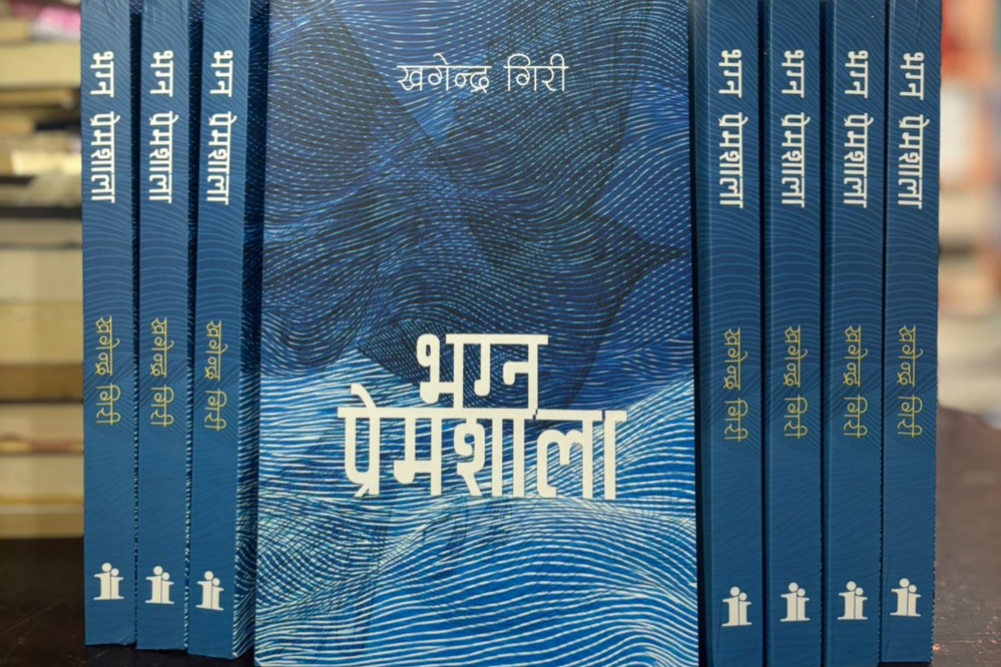
There are many sub-stories connected to the story. Each story has a different presentation style. As the name of the story collection suggests, love is present in each story, but they are broken and shattered. Nowhere does it appear whole and spotless.
We use Google Cloud Translation Services. Google requires we provide the following disclaimer relating to use of this service:
This service may contain translations powered by Google. Google disclaims all warranties related to the translations, expressed or implied, including any warranties of accuracy, reliability, and any implied warranties of merchantability, fitness for a particular purpose, and noninfringement.
‘Bhagn Premshala’ is Khagendra Giri’s first collection of stories. His collection of stories, which has made journalism his profession and identity, seems to have succeeded in leaving a separate wave in Nepali fiction. After reading the nine stories in this work, it seems that the story is not just a depiction of reality and there is no way to shrink within the frame of the definition that a story should be like this. The stories in this work, which are spread over a relatively long dimension, are different from traditional stories. They are innovative and experimental. These stories have established journalist Khagendra Giri as a great storyteller of contemporary Nepali fiction. The content used in
stories is not ordinary, they are mysterious. The way in which those mysteries are unveiled in the story shatters our traditional thinking and perceptions. The characters here seem mysterious. The events occur in a mysterious way. The scenes come mysteriously. Such mysteries not only make the story exciting, but they also immerse the reader in deep thought. Various elements play a role in making the story of this work powerful and effective, and the most effective aspect is the character development and character portrayal. Here, the character is presented so vividly that the reader feels that the character is here. He is with me.
The character of the story 'Chiso', who came from Saptari district and has been working as a fish cutter for seven years, says, 'Every day when I come to the shop, the shopkeeper asks, what's up? Have you had tea? That's all the sweet talk he does throughout the day. Hearing this, I feel like I can spend another day in this city. Otherwise, this is a city of corpses. Otherwise, in the city where I have spent so many years, why doesn't anyone say a sweet word to me? Doesn't he look at me with love? Why doesn't anyone recognize me? Why doesn't anyone see me even when I am walking on the surface of this earth?' The expression makes us sensitive to the reality and existence of the earthlings. The presence of the character 'I' has been very effective in this story to show the urban mentality and the insensitivity of people.
Similarly, the character of the story titled 'Hagangauda', Anand, who is a renowned media person in the city and the number one editor considered by everyone, says, "I want to give up this deceitful avatar. Now I want to be the same old me. But, I forgot that old me. I forgot myself. While acting, while doing drama. When I lied, I was no longer me. The lie was true, the reality was false. Even when I searched for myself, I could not find myself, Richa! I could not be myself. I have lost myself.'
In some stories, the lack of language according to the characters and the situation where the narrator dominates the expression of the story seem to make it unnatural, while in some cases, the subject is made complicated in the name of experiment. This statement has also destroyed the so-called ideals created by people today. It shows how hollow and pretentious the things that society has idealized, what it considers prestige and honor are. All the characters in the story are important for their own roles. But comparatively speaking, the male character seems to be more lively and effective in the story than the female character. All the characters in the story as a whole and their unusual lives and mysterious characters have succeeded in showing today's people, society and trends in a subtle way.
Another important aspect found in the stories of the presented collection is the contemplation of death. In some way or another, the context of death has come into the story. Death has touched us from close quarters. There are references to dead bodies and murder. Especially in literature, the contemplation of death comes in the form of philosophical, psychological and anachronistic thoughts. In the philosophical sense, death is not seen only as a biological event, it is considered as an achievement of rebirth, but looking at the references to death used in these stories, that does not come across, but rather, as anachronism says, ‘If life is meaningless, why do people continue to live?’ The thoughts seem to dominate the characters in these stories.
In the story ‘Nirmukt Stri’, Kalpana’s mother has died and a woman has died by hanging herself from a tree. In the story ‘Velvet’, Velvet has been in prison for a long time on charges of murder. In the story ‘Kima Paratha’, an ex-combatant is excited to die and kill and references to death have come. Similarly, the story ‘Chiso’ also has references to death and murder. This The character of the story, Kavita, is responsible for the disposal of the corpse and in the end she kills her own father. In the story 'Hapsilo', the character of a person like Hapsilo who eats the heart and liver is also symbolically presented, and in the story 'Hagnagauda', the situation of women and men who have achieved position, prestige, and wealth in life is shown to have reached the point of committing suicide.
In this way, these stories show that people live with the possibility of death at every moment and people's thoughts are mostly focused on the subject of death. People are either afraid of dying or someone will kill them, or they are thinking about what will happen even if they die or if they can kill them, or they are worried about whether a loved one or family member will die, and overall, every person thinks about death the most in life. It can be felt while reading these stories.
Mainly in stories like Makhamal, Kima Paratha, Chiso, Khukuri, Hapsilo, Hagnagauda, murder, suicide and References to death have revolved around the content of the story. Sometimes these stories have historical contexts of war tragedy and murder, while sometimes there is a story of a young man who returns after serving a prison sentence for murder. Sometimes there is a morgue setting and the scene of a person becoming calm only after the body is made is described, while sometimes the heartbreaking events of people who were cut and killed due to war, conspiracy and injustice in different periods of history are presented as a plot. And sometimes the psychology and dialogue of the characters who are going to commit suicide are presented. In this way, most of the stories in this work express thoughts of death.
The stories are long in terms of dimension. Like a long story and like a short novel. They are also broad in terms of subject matter. These stories are not confined to a single event and character. Therefore, after reading each story, one feels the completeness achieved after reading a novel. The subject matter of the story is the same. Even though it is visible, there are many truths that it reveals. Some truths cannot be seen with the naked eye. Some truths are seen with the mind, some voices are heard with the eyes, and some realities are understood with the ears. Reading these stories, one gets a sense of this kind of contradiction. The story is diverse in terms of content. The
The story has subtly presented the anomalous and dark sides of human society rather than the social, cultural, and environmental aspects. The story of Nirmbhut Stree is a story that shows the various phases of women's lives living in a patriarchal society. This story, which shows through imagination that women are not made by themselves, they are created by social thinking and circumstances, presents various events in life and the female psychology formed by the impact of those events. The Velvet Story is the story of a young man who has been in prison for a long time on charges of murder. After the death of his father, he was imprisoned for the murder of his uncle, who was the breadwinner of his family. He does not want to be released from prison. The city outside the prison seems even more strange and unsafe.
The uncertain future of Kammal, who sees the city as a prison of walls, and his psychology are presented in this story. The helplessness of a man with an invisible, therefore unarmed physical disability is presented. The story depicts the Samakhya's expression 'No matter how difficult the questions were, he would smile brightly, show his teeth, hold his head with his strong hand and sit down as if he were dead. There was nothing he could do. He had to endure it. He could easily endure it. Because, it is not that difficult for a person who has endured misfortune once to endure it again. And misfortune was always in his lot' presents the main essence of this story.
Similarly, Kima Paratha is a symbolic story. It is a story of hunger. Hunger for food, hunger for money, hunger for war. These hungers were illusions, there was no satisfaction. It is a story of a character surrounded by such irony. In this story, which especially refers to the Maoist war and its absurd aspects, politics is satirized by raising the serious question of what is politics for. It is amazing in terms of cold use and characterization. There are two characters in the story, a young man and a young woman. From the outside, they are straightforward, simple and dutiful, but from the inside, they are unusual.
This story, written with the character I as the narrator, presents the context of love and sex symbolically and through imagination. Smile Please! is a story that presents social psychology and individual psychology. Here, not only the psychology of the character named Shubhechki is shown, but also the insensitive tendency of people who enjoy pomp and show. Similarly, Khukuri The story contains references to tragic events in history. In this story, which is an interview with the dead, the truth and reality in history may have been covered up, so the issues of wars and murders in history are expressed through the story by asking the dead themselves.
Hapsilo Katha is a wonderful story written using free imagination. This story, which seems like a magical reality, symbolically shows human cruelty. This story, written in the psychological style of a twelve-year-old girl's song, is used in the presentation of the subject, characters and the names of the characters, events, etc. By presenting unusual themes in general, the many complex roles and situations that a woman has to play in life are symbolically shown, while the Hagangauda Katha shows the disparity between the life of today's civilized and prosperous high-ranking people from the outside and the life they experience from the inside.
Although stories are generally written by making an event or aspect of the life of a single character as the plot, these stories are structurally separate. There are . Here, the sequence of the plot and the gaps, i.e. gaps, are left . For example, the twenty-year gap in the life of Makhamal, the time gap between the lives of Kalpana and the gaps between the lives of Mainvar and Anand, the story seems empty . The storyteller has entrusted the reader with the task of completing the possible things that could happen in the gap between the lives of these characters .
Suppose the storyteller claims that after I have told some references, I have to understand others myself, otherwise how can there be empathy and sympathy with the characters in the story ? There is no flat description of the events or scenes in the story, they are shown in hints . Although it seems that the storyteller has tried to present the plot in as few words as possible, the story has become relatively long because, the lives of the characters present here are so complex and mysterious that it is difficult to understand them .
The list of characters kept in the last section of the work is also a new experiment in this work. Bisaunyudgar also seems helpful in understanding the context of the storyteller's writing and the composition of the story. Here, the storyteller says, 'A gloomy hope that the truth can be understood even by creating a false world and telling lies'. While reading these stories, is this just a fantasy? Is the world created by the story a false world? Even though the question arises, the reader cannot accept these stories as false and ends up accepting them as true.
Similarly, in another confession made by the storyteller in this context, 'The boundless joy of hiding one's head in the false world one has created, even for a moment', he has immersed not only himself but also the reader in these stories. There are references in some stories that one should read with bated breath, like watching a thriller movie. After reading these stories, one can understand the reality that truth is not only seen in the light and history is not made only by writing with a pen. सकिन्छ ।
कथामा अनेकौँ उपकथाहरू जोडिएका छन् । प्रत्येक कथाको प्रस्तुतिशैली फरक छ । कथासङ्ग्रको नामले भनेजस्तै प्रेम त प्रत्येक कथामा छन् तर ती भग्न छन् भत्किएका छन् । कतै सग्लो र दागरहित देखिँदैन । प्रेमशाला त कथाको परिवेशमा जताततै छ तर ती प्रेमशालामा प्रेम पाइँदैन । यो आजको यथार्थ हो । यी कथाहरू हाम्रै परिवेशका पात्रलाई उभ्याएर लेखिएका भए पनि ती अलि नयाँ लाग्छन् । यसअघिका कथामा कतै पनि नभेटिएका जस्ता बिराना अनि हाम्रै वरिपरि भएर पनि हामीले नचिनेका अपरिचतजस्ता ।
त्यसैले यी कथाहरूले अनावरण हुन बाँकी रहेका मानवीय जीवनका कयौँ पाटोहरूको उद्घाटन गरेका छन् । केही कथामा अतियथार्थवाद र प्रतीकवादको व्यापक प्रयोग गरिएकाले सामान्य पाठकलाई कथा दुरुह लाग्ने सम्भावना भए पनि कथाको भाषा र शैलीले भने सम्मोहित बनाउँछ । कतिपय कथाहरूमा पात्रअनुसारको भाषाको अभाव र समाख्याताको अभिव्यक्तिमा कथाकार हावी भएको स्थितिले अस्वाभाविक बनाएको देखिन्छ भने कतै प्रयोगका नाममा विषयलाई क्लिष्ट बनाइनु यी कथाहरूमा पाइने कमजोर पक्ष हुन् ।
अन्त्यमा, 'यहाँको हावामै दुःखको बहाव छ । उकुसमुकुस छ, ओसिलो पन छ, चिसोपन छ । बाबु पेसेवर जँड्याहाँजस्तो छ, आमा स्थायी मानसिक रोगी । तरुनी छोरी मुर्दाघरमा काम गर्छे । मजस्तो पुछारको केटोसँग झ्याम्मिन खोज्छे । केही न केही गडबडी छ पक्का । म विश्वस्त हुन्छु ' (पृ.१०७) भनेर कथाको पात्रले आफ्नो परिवेशप्रति जुन किसिमको अनुभूति व्यक्त गरेको छ, ठीक यही अनुभूति यस कृतिका कथाहरू पढिरहँदा पाठकले अनुभूत गर्न पुग्छन् । यो समाजमा केही त गडबडी छ । मान्छेको सोच र उसको जीवनशैलीमा केही अन्तर्विरोध र विरोधाभास छन् भन्ने कुराको बोध गराउन सक्नु यस सङ्ग्रहका कथाहरूको विशेषता हो ।
यी कथाहरू पढ्नु केवल कथा पढ्ने काम मात्र थिएन । मेरो लागि यो अज्ञात विषयतर्फको यात्रा थियो । आफूले नभोगेका, नदेखेका र अनुमानसमेत पनि नगरेका कुराहरूसँगको सादृश्य अनुभूत गर्नु थियो । मलाई यी कथा पढिसकेपछि के लाग्यो भने शताब्दीयौँअघि प्लेटोले भनेजस्तै ईश्वरले यो वास्तविक संसारको निर्माण गरेजस्तै साहित्यकारले सृजनाका माध्यमबाट कल्पनिक संसारको निर्माण गर्न सक्छन् र जीवन र जगत्का अविदित सत्यहरूलाई उजागर गरिदिन सक्छन् भन्ने कुरालाई यी कथाहरूले चरितार्थ गरेका छन् ।