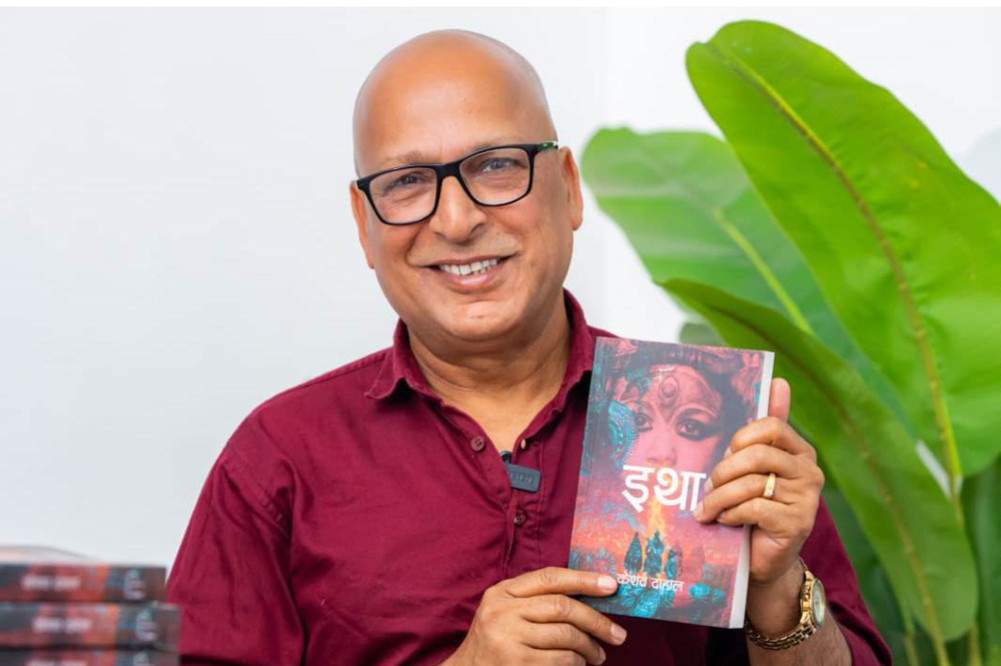
In a book-talk, storyteller Keshav Dahal said, ”Itha begins towards the end of the Malla period, wanders back to the past and reaches the Kirat period. In this way, this is a story from the time of Buddha.”
We use Google Cloud Translation Services. Google requires we provide the following disclaimer relating to use of this service:
This service may contain translations powered by Google. Google disclaims all warranties related to the translations, expressed or implied, including any warranties of accuracy, reliability, and any implied warranties of merchantability, fitness for a particular purpose, and noninfringement.
Storyteller Keshav Dahal 's elusive, supernatural and historical novel 'Itha' says - there is not only history in history, there is not only story in story . The rhythm of time is the combination of history and story . That is, time is Itha . Through the dusty letters of history before history, the author writes the biographies of Kumari Vasudha, Nayantara and Sairandri, and travels through the dark cave of the story of human sacrifice . '
Itha' has - the fragrance of legend and story . The adventurous journey of Nayantara and the Lichchhavi, which began in the Vaishali era about 2400 years ago, reaches Manjupattan (Kashtamandap), where they defeat the Saumars and lay the foundation of the new kingdom of Koligram . Focusing on ‘Itha’, Deepak Sapkota’s book-talk with Keshav Dahal for ‘Koseli’: How did the idea of writing the novel ‘Itha’ come about? What is its main inspiration? How did you connect the historicity of the Lichchhavi journey from Vaishali to Manjupattan to the story?
I like to create a window to civilization and trace the path walked by our ancestors through it. For me, Itha is the window to memory that traces our past. From where many mythological, mythical and fictional characters are seen and their stories are found.
Those characters who remain anonymous within our history, myths and stories are my inspiration for writing Itha.
I wanted to touch that period of our civilization, from where time has taken a new path. For this, I was not satisfied with just knowing history, nor with just telling a story. That's why I thought of writing this. Because if we want to know any time, knowing history is not enough, we must also know the story, and knowing the story is not enough, we must also know history. If we leave history and story alone, both are incomplete.
So, by combining that incompleteness of history and story, I tried to complete a period of our civilization. For this, I made the facts of history the seed and the imagination the rain— then this grew. What happened, history gave me direction and the story found its own way.
What time and context of our history does this reveal?
Itha begins towards the end of the Malla period and winds its way back to the past and reaches the Kirat period. In this way, this is the story of the time of Buddha. When there were 16 Mahajanapadas in India and the Kirat kingdom was in the valley. Which I have called Saumar after the words of Iman Singh Chamjong.
At that time, King Bimbisara of Magadha was captured by his son Ajatshatru and took over the rule. At that time, Pramati was the king in Vaishali. At that time, the last Kirat king ruled in the valley. At that time, Lord Buddha was alive.
In this way, Itha is a story of a Sandhi period, which not only narrates the upheavals of India, but also tells the story of the entry of the Lichchhavi into the valley. Such a story, from where we were entering a new civilization . But here the meaning of Sandhikala is not just political change, but also the transformation of civilization .
You have extended the story that started with the ancient republic of Vaishali to Manjupattan (Kathmandu Valley). What role has Vaishali's cultural heritage played in 'Itha' ?
Looking now, there is neither Vaishali nor Manjupattan . But if we look deeply at our civilization today, we find the color, taste and fragrance of Vaishali and Manjupattan in its every particle . The influence of the plains Aryans and the hill Kirats in our daily life, religion, deeds, judicial system and social system is distinguishable . The state system, openness and knowledge culture of Vaishali have awakened the spirit of Itha .
And, the simplicity of Manjupattan has enhanced the beauty of Itha.
If we look at the character of Nayantara, the main character of Itha, Vaishali plants the seed of freedom in her, which blooms and blossoms in the valley. Therefore, in ‘Itha’, Vaishali is not just a geography, it is civilization and is a life stream, similarly Manjupattan is a natural life stream.
In the novel, when the two streams of emotion of Vaishali and Manjupattan are united through Nayantara, then a new grammar of our civilization is born. In this way, for the novel, Vaishali is not only the capital of the Vajji Mahajanapada, but also the origin of the conscious civilization that the story wants to tell. And yes, the beginning-sound of time.
To shape our civilization, a bridge was needed to connect the awakened vibration of Vaishali and the mysterious simplicity of Manjupattan. In Ithama, I have tried to build that bridge and Vaishali and Manjupattan stand as strong pillars of that bridge.
Why did you create female characters as a man? While creating female characters, did you not have the question or dilemma of how to do justice to them?
I wanted to do justice to our ancient mothers, who are unknown in history. The history we read always seems like a list of kings, emperors, generals and teachers. They are Chakravarti. They are wise. They are mysterious. Which history presents with flowers.
But neither women are found in that list of names, nor the spirit and pace of civilization. Through Itha, I wanted to add some names to the pile of names, who are as brave as kings but also more prudent, determined and magnificent than them . And they are women .
For that, I created Nayantara . Thus, I completed half of the history created by the patriarchy by adding the names of Nayantara .
As far as the question of justice being done to female characters, there is a part of a woman within every man and a part of a man within every woman . While creating the female characters of Itha, I tried to awaken the woman within me, who was inseparable with me as a mother, grandmother, daughter, sister, wife and lover .
When women within me are inseparable, what can I do to tell their stories ? It was not a difficult task for me .
The novel's heroine, Nayantara, has told a story of courage. While creating this character, which female figures from history did you include in Nayantara? Or, what is the essence of Nayantara?
Nayantara is not a single character, she is a confluence of many women. There is a shadow of our mythological and mythical characters Ahilya, Draupadi, Sita, Tara and Mandodari in her, because my mother had painted an indelible picture of those mythological women in me. Who, despite living a difficult life, seemed internally free and bright.
Similarly, in Nayantara, I have added the beauty and self-respect of Amrapali, as well as the weight and dignity of Madhavi.
But I must say, for me Nayantara is more than a character - an echo of suppressed female voices. Which history did not write. Where only the external beauty of women was seen, not the intelligence, energy and spiritual beauty.
For me, Nayantara is the alternative heroine of our history. The history that I wanted to tell my daughter and other daughters of her generation. Through 'Nayantara', I wanted to restore that, where women are not just victims, but also drivers and decision-makers of history.
Sairendri's rebellious nature and internal struggle are the main strength of the novel. What dimension of women's rebellion are you trying to present through this character?
 I have not created any new dimension of rebellion in this. Rather, I have only shown the rebellion of women through Sairendri, which has been inside women for centuries.
If we look closely, Sairendri's rebellion is very conscious, gentle and spiritual . Because, first of all, she fights not with society, but with her own silence . And, she expresses the feelings of rebellion through music and dance . For her, love is also rebellion and so is sex .
And, the way Sairendri goes into sannyas in the latter half of her life, that too is her rebellion—a rebellion against authority, power and attachment . I think, of course, Sairendri had dilemmas and in some respects, she seems to be tormented by moral dilemmas . But when she reaches the level of self-acceptance, she is free from the dilemma and becomes firm .
Because of being Sairendri in the story, the main character Nayantara has become so firm and decisive .
Kumari Vasudha's mixed story of humility, courage and self-determination has given depth to the novel. How did you link 'female self-respect' with Eastern philosophy while developing this character?
As you asked, I don't know much about Eastern philosophy. But I do know that our civilization's ethos is different from that of the West. For us, life is neither just the gross form of material matter as the strict materialists say, nor is it the pure creation of God as the strict spiritualists say.
Eastern philosophy focuses on the realization of life, self-discovery and liberation. The ideas that we can see in traditions like Hinduism, Buddhism and Jainism. The sources of which are the Vedas, Puranas, Gita, Upanishads, Tripitaka etc. And the essence is, to realize one's own power, to know the soul. In Eastern philosophy, "power" is considered the basic energy of creation. Which has many sources, such as the five elements. Sometimes I think that all the forms of the gods and goddesses we worship are sources of power, which are one with us in many names and characters.
From this context, the characters in Itha not only have a physical journey, they also have a mental journey along with them - that is, a journey of self-reflection, a journey of self-realization.
Perhaps Eastern philosophy is the balanced and inseparable flow of knowledge of our civilization, which is why the tendency to realize oneself can be seen in the characters in Itha. The proclamation of self-existence and freedom in the novel is an attempt to recognize the power within oneself. Which is represented by the main characters of Itha, Nayantara, Sairendri and Vasudha. Like
, the flame of courage and consciousness can be seen in Nayantara. Sairendri is the mistress of inspiration. Vasudha has the energy of self-esteem, which we can also consider as a symbol of fire, air and earth.
From this perspective, women are the source of power and that power is revealed in Itha. I think that Eastern philosophy is the knowledge system that nourishes our Eastern civilization. It is within us, so when we write the narrative of our civilization, it comes out as an inseparable part without realizing it.
What is the main element in ‘Itha’ that brings to life the socio-political environment of that time (the Kirat-Lichchhavi treaty period 2400 years ago)? Doesn’t the historicity of Kathmandu be overshadowed by making the historical event of the victory over Saumar and the establishment of Koligram a story?
I must clarify that Itha is not history writing, but a narrative. Even if historical characters appear in it, they appear in a narrative character. In this sense, I have tried my best to ensure that Itha does not become a historical document and remains free from history.
That is why while writing this, I have not taken history as a reference material, I have only remembered it for the plot. I would like to tell my readers, if you want to know the history of that time, Itha will not help you much. But if you want to know the human side, mind, emotions and dignity of that time, Itha can be helpful.
The victory of the Lichchhavi over Saumar and the establishment of Koligram mentioned here are also just a part of the narrative . In Itha, I did not try to prove the history of that time, but rather tried to experience the story .
Therefore, the records, myths, legends obtained while writing this—I presented all of these not as facts, but as characters in the story .
I do not know how much justice my novel does to the historicity of the victory of the Lichchhavi over Saumar and the establishment of Koligram, but it has done justice to my story, the characters in the story, and the entire Itha . But to understand that link of justice, it must be taken in the spirit and language of the narrative .
Because I say again, Itha is a narrative, not history .
Did you combine history and story in ‘Itha’ because the story disappears in history and history disappears in the story ?
कहिलेकाहीँ मलाई लाग्छ इतिहास फगत तथ्यहरूको कंकाल हो, जसलाई प्राण दिन्छ कथाले । लाग्छ, इतिहासबिनाको कथा जरा नभएको रूख हो, कथा बिनाको इतिहास फूल नभएको बोट ।
‘इथा’ मा मैले यी दुईलाई मिलाएर एउटा जीवित बगैँचा बनाउन खोजेको हुँ ।
सोचौँ त, यदि आउने पुस्तालाई सुनाउन हामीले कथा छोडेर इतिहास मात्र लेख्यौँ भने त्यो कति रूखो र सुक्खा हुन्छ होला । त्यस्तै यदि हामीले सन्तानहरूलाई सुनाउन इतिहास छोडेर फगत कथा मात्र लेख्यौँ भने त्यो कति धेरै बेघर हुन्छ होला ।
‘इथा’ मा मैले इतिहास र कथाको विवाह गराइदिएको छु र घरबार बसाउने प्रयत्न गरेको छु ।
किनभने, हामी कुनै पनि समयलाई जान्न चाहन्छौँ भने, त्यो समयको इतिहास पनि जान्नुपर्छ र कथा पनि । इतिहासले सत्य दिन्छ, कथाले त्यसमा भावना, संवेदना र अनुभूति थप्छ । जब यी दुई मिल्छन्, तब मात्र समयको कथाले पूर्ण आकार पाउँछ ।
तर म सचेतनतापूर्वक भन्छु, इथामा उल्लेखित इतिहास र कथाको सन्तुलन गणितीय होइन, काव्यात्मक हो । यो लेखिरहँदा भयो के भने, इतिहासले मलाई कथाको सीमाना दियो र कथा त्यो सीमाभित्र स्वतन्त्र उड्यो ।
अतः इथामा यदि कतै तथ्यहरू तोडमोड भएका छन् भने पनि, त्यो मैले जानेर गरेको होइन, बरु मेरो कथाले लिएको स्वतन्त्र उडानमा त्यो आफै भएको हो ।
प्राचीन काठमाडौं सहर (मञ्जुपट्टन) को संस्कृति, धार्मिक, सामाजिक र दैनिक जीवनलाई उपन्यासमा चित्रण गर्दा कुन कथाको मार्ग समाउनुभयो ? इतिहास र कथाको दोसाँधमा बसेर ‘इथा’ लाई सन्तुलित गर्न तपाईंले कस्तो जुक्ति लगाउनुभयो ?
जब तपाईं काठमाडौंका पुराना गल्लीहरू चहार्नुहुन्छ, तपाईं पुग्नुहुन्छ उतै जहाँबाट हामीले आधुनिक सभ्यताको प्वाँख हालेका थियौँ । ती गल्ली, ती ढुंगेधारा, जात्रा, पर्व, पुराना घर, मन्दिर, टुंडाललाई तपाईंले नियाल्नुभयो भने, त्यहाँ इतिहास जीवन्त भएर बाघचाल खेलिरहेको भेट्नुहुन्छ ।
त्यसैले इथामा मञ्जुपट्टनको मैले जुन चित्र कोरेको छु, त्यो यही काठमाडौं भित्र आज पनि जीवित भेटिने मञ्जुपट्टनको धुमिल चित्र हो ।
यसैगरी, हामीसँग पुराना कथा, किंवदन्ती, पुराणहरू पनि छन्, जसले हामीलाई विगत चिह्याउन सहयोग गर्छन् । हाम्रो औपचारिक इतिहासमै पनि उपत्यकामा गोपालवंश, महिषपालवंश र किरातवंशका अनेक घटनावली पढ्न पाइन्छ, जसले त्यो समयको काव्यात्मक चित्र बनाउन सहयोग गर्छन् ।
परिणाम, मैले इतिहास कथा र किंम्बदन्तीले दिएका यी र यस्तै रूपरेखामा कथाको रङ भरेर मञ्जुपट्टनको सांस्कृतिक, धार्मिक, सामाजिक जीवनलाई चित्रण गर्न खोजेको हुँ । जहाँ इतिहासले मलाई ढाँचा दियो, कथाले त्यसमा प्राण भर्यो ।
त्यसो त एक लेखकका रूपमा मञ्जुपट्टन मेरो लागि केवल सहर होइन, इतिहास चिह्याउने प्रकाशपुञ्ज हो । जसको उज्यालोमा बसेर मैले उपत्यकाका दरबार र सिंहासनहरू मात्र हेरिन, सभ्यताको जीवनधारालाई समेत हेर्ने प्रयत्न गरेँ । मेरा लागि इथामा मञ्जुपट्टन मात्र देखिँदैन, महसुस पनि हुन्छ ।
‘इथा’ मा वैशालीबाट सुरु भएको पात्रहरूको उकालो यात्राले हाम्रो उपत्यकाको सांस्कृतिक रूपान्तरणलाई प्रभावित पार्छ । त्यो समयको उपत्यकाको संस्कृतिमा लिच्छवीको आगमनले क्रान्ति नै ल्यायो भन्ने तपाईंको व्याख्या हो ?
एउटा प्रकृतिपूजक, सरल र एकान्त मञ्जुपट्टनमा जब लिच्छवीहरूको प्रवेश भयो, त्यसपछि यसको सारा जीवन पद्धति फेरियो । धर्म, कर्म, पूजा–पाठ, तन्त्रसाधना र ढाँचा फेरियो । राजकाजको विधि फेरियो । दरबार बनाउने शैली फेरियो । महिलाको भूमिका फेरियो ।
यहाँको भाषा फेरियो । यहाँका गीत, संगीत र नाट्यशैलीहरू फेरिए ।
त्यसपछि उपत्यका मैदानी आर्य सभ्यतासँग जोडियो । यो राम्रो भयो कि नराम्रो भयो, सायद यो राजनीतिक प्रश्न होला । तर फेरिएको भने पक्का हो । जसले गर्दा सौमरहरू यहाँबाट विस्थापित भए र नयाँ सभ्यताले आकार लिन प्रारम्भ गर्यो ।
सायद लिच्छवीहरूको आगमन हाम्रो सभ्यताको एक ऐतिहासिक कुइँनेटो थियो ।
‘इथा’ लेखिसकेपछि तपाईं आफैंलाई नै शानदार लागेको र सबैभन्दा बढी प्रभावित पार्ने विषय के रह्यो— वैशालीको इतिहास ? सौमरहरूको प्राचीन सभ्यता ? कि नयनतारा–सैरेन्द्री–कुमारी वसुधा जस्ता पात्रहरूको स्वतन्त्र यात्रा ?
लेखकको रूपमा मलाई सबैभन्दा मनपर्ने कुरा हो स्वतन्त्रता । त्यसैले इथाका तीन पात्रहरू नयनतारा–सैरेन्द्री–कुमारी वसुधाको स्वतन्त्रताको खोज, त्यसका लागि उनीहरूले देखाउने धैर्य, साहस र अविचलित दृष्टि मलाई सबैभन्दा प्रिय लाग्ने कुरा हो ।
उपन्यासमा नयनताराले जुन साहसका साथ आफ्नो स्वतन्त्रतालाई जोगाउन निर्णयहरू गर्छे, त्यो मेरालागि सुखद छ । जस्तो कि, नयनताराले नृत्य प्रतियोगितामा भाग लिने साहस गर्नु, राजा प्रमातीसँग विवाह गर्नु र पछि उसैलाई त्याग गर्नु, आफ्नो स्वतन्त्रताका लागि दरबार, रानीको पद, आफ्नो श्रृंगारलाई त्याग्नु र त्यसमा अडिग रहनु एक लेखकका रूपमा स्वयं मलाई रोमाञ्चित गर्ने कुरा हुन् ।
पछि आफ्नै पति राजा जेतेदास्तीलाई अपदस्थ गर्ने निर्णय गर्न सक्नुले नयनताराको निर्णय क्षमता अद्भुत देखिन्छ । मलाई लाग्छ, नयनताराको वैशालीदेखि उपत्यकासम्मको यात्रा हावा झैँ बहने उसका सपनाहरूको स्वतन्त्रताको खोज हो, जो सम्झिँदा म गद्गद् हुन्छु ।
लेखन र पठनका तपाईंका अनुभवहरू के छन् ? तपाईंको भाषा, पात्र निर्माण, कल्पनाको स्रोत र लेखनशैलीलाई प्रभावित गर्ने मुख्य कुरा के हुन् जस्तो लाग्छ ?

मान्छेका लेख्ने र पढ्ने आफ्नै सीमा, छनोट र शैलीहरू हुन्छन्, जसलाई प्रभावित गर्छन् उसका निजी सोच, सृजनात्मकता, उसले गरेको अध्ययन, उसको परिवेश र स्कुलले ।
प्रारम्भिक कालमा मैले नेपालीसँगै रसियन, बंगाली, भारतीय र चिनियाँ साहित्य धेरै पढेँ । परिणाम, मलाई लियो टोल्स्टोय, फ्योदर दोस्तोएभ्स्की, अन्तोन चेखोभ, मिखायल सोलोखोभ, अलेक्जेन्डर पुष्किन, निकोलाइ आस्त्रोभस्की, मक्सिम गोर्की, लुसुन आदि प्रिय लागे ।
सरल लेखनका लागि मुन्सी प्रेमचन्द र व्यापकताका लागि रवीन्द्रनाथ टेगोर मलाई मन परे । निकै पछि, मैले गाब्रिएल गार्सिया मार्केज, अर्नेस्ट हेमिङ्वे, जर्ज अर्वेल, फ्रान्ज काफ्का, झाँ पाल सात्र्र आदि पढेँ । मार्केज पात्रहरूलाई एउटै जीवन्त प्रवाहमा मिसाउँछन्, त्यो अद्भुत लाग्छ । टोल्स्टोयको क्यानभास ठूलो हुन्छ र त्यसभित्र उनी भूगोल, समाज, राजनीति र मानव जीवनलाई गजबसँग समेट्छन् ।
दोस्तोएभ्स्की पढ्दा मलाई नैतिक प्रश्न र अस्तित्वको व्यापक सौन्दर्यबोध हुन्छ । काफ्काको अस्तित्ववादी प्रवाह मलाई मनपर्छ । मलाई हाम्रा कविवर लक्ष्मीप्रसाद देवकोटाको शब्द छनोट बेजोड लाग्छ । सायद मेरो लेखनमा मैले थाहै नपाई यिनीहरू मिसमास भएर आउँछन् ।
कहिलेकाहीँ सोच्छु, मेरा आख्यानमा आउने धेरै पात्रहरू र उनीहरूको नैतिक द्विविधाका लागि मभित्र महाभारतको प्रभाव पो छ कि । मेरो लेखनभित्र भावनात्मक गहिराइ र दृश्यात्मकता कतै छ भने, त्यो लियो टोल्स्टोयको पो प्रभाव हो कि ।
एउटा पुस्तक छ निकोलाइ ओस्त्रोभस्कीको हाउ द स्टिल वाज टेम्पर्र्ड जसको नायक पावेल कोर्चागिन मलाई औधी मन पर्छ । सायद, मेरा नायकहरूमा कतै त्यसको पनी प्रभाव पो छ कि ।
मलाई मैले पढेका नेपाली उपन्यासमा मदनमणि दीक्षितको माधवी उत्कृट लाग्छ । सायद त्यसैको प्रभावले हुनुपर्छ मेरा उपन्यासहरू मोक्षभूमि र इथाका नारी पात्रहरूले कहिलेकाहीँ मलाई माधवीको झल्को दिन्छन् ।
यसैगरी, कथा र इतिहासलाई जोड्ने, बुझ्ने र विनिर्माण गर्ने मैले जुन कोसिस गरेको छु, यसमा मेरा गुरु हुन् आचार्य चतुरसेन । र मेरालागि वैशालीकी नगरवधू एक अनुपम स्रोत पुस्तिका हो ।
आजको पुस्ता ३० सेकेन्डको भिडियोमा भाव खोज्छ; गीत समेत हामीलाई ट्रेन्डिङ भएको ५–१० सेकेन्ड मात्रै याद हुन्छ । यो ‘रिल्सको गति’ मा ‘इथा’ को पुरानो कथा असान्दर्भिक होला कि भन्ने डर लाग्दैन ? कतै ‘स्क्रोल संस्कृति’ ले तपाईंको कथालाई पनि स्क्रोल त गर्दैन ?
‘इथा’ ती मानिसका लागि हो, जो अझै पनि शब्दभित्र जीवन, सौन्दर्य र अर्थ खोज्छन्, अथवा समय दिएर शब्दहरूको परख गर्छन् र त्यसभित्र निहित भावमा लहराउँछन् ।
अहिले हेर्दा समयको गति तीव्र देखिन्छ नै, तर मानवीय अनुभूति समयको गतिझैँ तीव्र हुँदैन, बरु यो गहिरो हुन्छ । यो सत्य हो कि संसार तीव्र बन्दै छ, तर यसको अर्थ यो होइन कि भावनाको वेग पनि तीव्र बनोस् ।
जहाँसम्म स्क्रोल संस्कृतिको कुरा छ, कतिपय कुरा पर्खिएर हेर्नुपर्छ अनि मात्र मिठो लाग्छ । छोटो र छिटो हेर्ने बानीले धेरै कुरा छुट्छन् ।
जस्तो, हिमाल हेर्ने हो भने, एक मिनेटमा हेर्न सकिँदैन । साहित्य र होहल्लामा यही फरक छ कि, हल्लाखल्ला सुन्न धेरै समय लाग्दैन, तर जब हामी हल्लाभन्दा पर गएर समयको लीलालाई बोध गर्न चाहन्छौँ, तब छिटो हेरेर कसरी सबैकुरा देखिन्छ ?
मानौँ कि हामी कुनै पेन्टिङ हेर्दै छौँ, त्यसलाई एक झल्कोमा पनि हेर्न सकिन्छ र लामो समय दिएर पनि हेर्न सकिन्छ । चित्र मात्र हेर्ने कि त्यहाँ निहित रङहरूको संयोजन र त्यसले निर्माण गरेको जादु पनि हेर्ने ?
स्क्रोल गरेर छिटो–छिटो अगाडि बढ्दै जाने हो भने, मान्छेले हेर्नुपर्ने धेरै कुरा छुट्दै जान्छन् । यदि हामी सतही, घटनामा रमाउने र लहडी नै बन्ने हो भने, रिल्सले पुग्छ । तर जीवन–सौन्दर्यको बोध गर्ने हो भने, समय त लाग्छ ।
भनिन्छ, साहित्यका पुस्तक (खासगरी आख्यान) बजारको रुचिअनुसार लेखिनुपर्छ, तब मात्रै धेरै बिक्छन् । तपाईं के सोच्नुहुन्छ ? आजको आख्यान बजारमाथि तपाईंको टिप्पणी के छ ?
मलाई हाम्रो साहित्यको बजार उत्साहजनक छ भन्ने लाग्छ । यद्यपि, साहित्य बजारका लागि होइन, समयलाई न्याय गर्न लेखिनुपर्छ । अवश्य नै बजार आवश्यक छ, तर निर्णायक तत्व बजार हुनुहुँदैन । मलाई लाग्छ, लेखकले बजारलाई के आवश्यक छ त्यो लेख्ने होइन, लेखक स्वयंलाई के लेख्न मन लागेको छ त्यो लेख्ने हो ।