'I do not represent any current trend in Nepali poetry. I represent the consciousness expressed by my senses.'
We use Google Cloud Translation Services. Google requires we provide the following disclaimer relating to use of this service:
This service may contain translations powered by Google. Google disclaims all warranties related to the translations, expressed or implied, including any warranties of accuracy, reliability, and any implied warranties of merchantability, fitness for a particular purpose, and noninfringement.
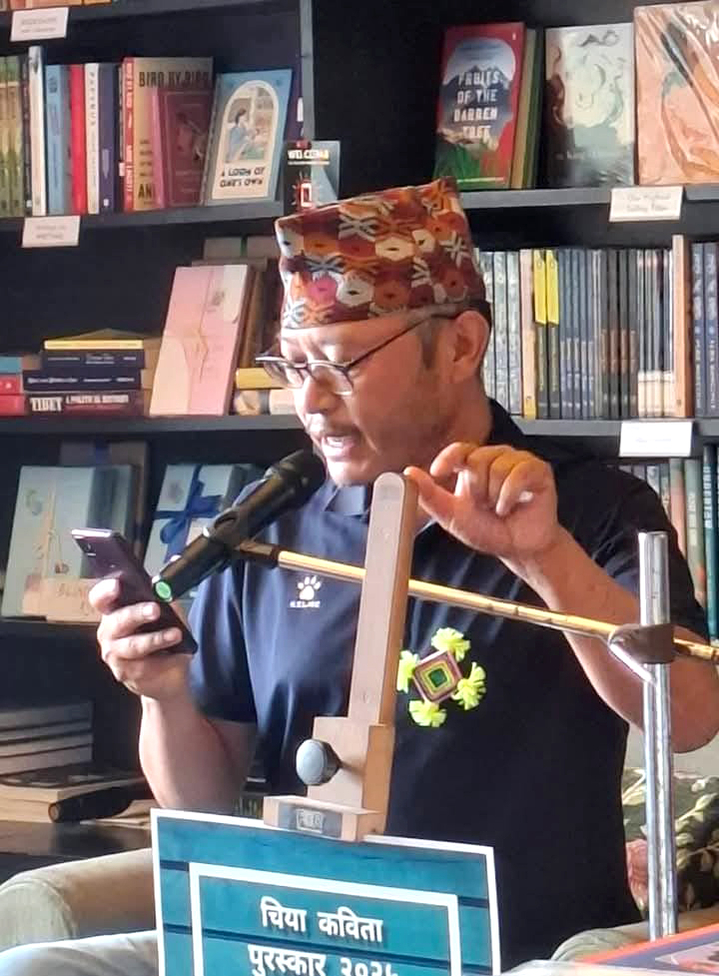
Poet Hangyug Ajat 's new poetry book 'Hangyug Ajatka Kavitaharu' has been published. Since the fifties, he has embraced the path of experimental poetry writing with racial connotations. And, he used cultural myths in poetic imagery. In fact, he is the initiator of the 'Creative Anarchy' movement along with poets Rajan Mukarung and Upendra Subba. Ajat, who is practicing poetry in Ilam, spends most of his time in the countryside, only occasionally venturing into beautiful poetry. His previous books include 'Karangko Khust' and 'Hong Kong'. On the occasion of World Poetry Day, Deepak Sapkota conducted a poetry interview with him:
You, who spend most of your time in the countryside and only occasionally venturing into poetry, have started calling you an endangered and rare poet, but now you are in the city. Thank you for the poem book ‘Hangyug Ajatka Kavitaharu’. Didn’t the feeling of ‘staying in the village and getting lost’ play a role in the release of this book?
Hey, you tested my instincts in the first question, thank you. But, without further ado, what I want to say is that in the commentary produced by the center, I am an endangered and rare poet. Because I did not want to get caught in the sweet swamp of Kathmandu-centric literary programs. Not only that, I also did not want to get caught up in the circles of any political party. By saying this, I do not mean that I do not have any political consciousness. In any case, the book ‘Hangyug Ajatka Kavitaharu’ was created more by the loving request of my long-time beloved soul, Mount Everest climber Junita Subba (whom I have not met to this day) than by the feeling of ‘staying in the village and getting lost’. Also, after the publication of this book, he and I are also thinking of establishing a meditation center, library, awards and trust as a symbol of spiritual love, and creating a culture of reading, writing and service in a practical way. Rajesh Mishraji is also involved with us to make our dream a reality, he is also highly respected and thanked.
In the 1950s, Rajan Mukarung, Upendra Subba and you together gave impetus to experimental poetry writing with racial connotations. At that time, your ‘creative anarchy’ movement was very famous in the literary circles of the city. Now, there is no trace of that movement, nor are you organized. In fact, for what purpose and goal did you start that movement? Where did it reach and disappear? Aren’t you anarchists now?
Like other literatures in the world, Nepali literature is also dynamic. Just as the leading writers before us opened up new horizons in Nepali literature through various movements, we too tried to write about the lives and worlds of citizens marginalized by the state through the campaign of creative anarchy. This campaign brought a new awakening to the entire Nepali literature in the form of cultural writing. That is why our campaign in the fifties not only gained fame, but also established the latest values and norms in literature by breaking traditional rigid beliefs. Based on the culture and philosophy of Railimbu, which is a place in the Far East, we said in literature, 'any writer can be honest only when he can properly portray his society' and 'the spark of consciousness can awaken everyone'.
Nepali society is a society made up of different castes, cultures, languages, histories and philosophies of life. Just as the national bird, the falcon, is beautiful because it is colorful, Nepali society is also beautiful because of its diversity. However, when the state and the ruling class are ignoring this diversity in our society, we have the idea of racial consciousness or racial unconsciousness. This idea has developed and reached its peak, reaching the level of ‘identityism’, and the racial consciousness has almost reached the level of ‘separatism’. Various cultural writings are coming up in the entire Nepali literature. Our aim is to achieve a common and advanced identity, there is no doubt about it. The answer to the question of whether we are anarchic or have become a monarchy should be safe with Rajan Mukarung and Upendra Subba.
Which of the leading poets had the most influence on you in writing early poetry? Tell us about your contemporaries and even the poets of the later generation, who are writing well?
I think Gopal Prasad Rimal's 'Aama', Bhupi Sherchan's 'Shahidharupri' and Bairagi Kaila's 'Mateko Mancheko Bhastha' had a great impact on my school life. I wanted to write like them, I wanted to be like them. I used to dream that my poems would also be read in the curriculum by school and college students. I am also influenced by my contemporaries and the poets of the later generations. None of us can be absolute and lonely Jupiter. We are all influenced by our surroundings without realizing it. I like the poems of the poet Sundar Kurup, who is writing poetry in the village. I also like the poems of the poet Samdarshi Kaila, who is writing poetry in the inaccessible heights of the mind. I feel like the poet brothers of Ilam, Tika Chhetri, Sugam Khatri and Darshan Ghimire are also my contemporary poets. Because they are writing at the same time as me.
What is your answer to those who say that Nepali poetry has not progressed beyond Devkota, Rimal, Bhupi Sherchan, and Bairagi Kainla?
I feel like it has progressed. The poems of Shravan Mukarung and Bhupal Rai are vivid examples of this. Going beyond bourgeois and progressive writing, they have made the cultural writing base powerful in poetry, due to which the entire Nepali literature has gained popularity. Looking at today's Nepali poetry as a whole, it is not limited to any particular class, region or community.
Critics say - poems of harsh and soft lines are written in the creation of poetry. Which line do you think you represent? Why?
I do not represent any current trend in popular Nepali poetry. I represent the consciousness expressed by my senses. On the surface, poetry appears to be written in harsh and soft tones. This is a general principle. However, I think it is necessary to look at poetry from many angles, poetry cannot be completed in harsh and soft tones, it cannot be done. ‘What is time?’ It is just like saying day and night. What is the matter of harsh and soft tones? What did the critic say about the feminist trend? The feminist trend is also moving forward through urban feminism and rural feminism. Urban feminism also reaches elite feminism and squatter feminism. Squatter feminism again ends in fake and real. I humbly request the syndicate of so-called critics who generalize and weaken the issues raised by Teso and the poem and do not go into the depth of the subject, ‘Please don’t do that, be serious, man’.
What is your own analysis of your poetic creation?
Wow...! A writer like me, a narcissist, cannot analyze his own poetic creation. And I am not a narcissist either. However, I am completely satisfied with my poetic creation. Whatever I write, good or bad, I feel like expressing myself in a timely manner. No regrets! Fully satisfied!
In recent years, there has been a demand for inclusiveness in Nepali literature – as if literature must have such a purpose, as if it should represent the specific issues of a class or community. Is this good work being done?
In a situation where only the lives and worlds of the elite and elite class have been written, the awareness that the lives and worlds of not only the neglected and marginalized classes and communities but also the lives and worlds of the castes, genders and regions ignored by the state should be written came very late in Nepali literature. Due to the practice of the state systematically adorning only writers from one class and community in decisive positions, poets and writers from other classes and communities have been marginalized. To put it more bluntly, it seems almost impossible for the academic class to reach the academic bodies of the state unless they are agents of a political party.
It is because of such an anomaly that the wind of the Gen-G movement has blown up recently. Thank goodness! Kamaladi's roof and windows have been saved. If the new government can reverse the process of reaching Nepal Pragya Pratishthan, the state will get truly independent academics. It is wrong to make political appointments in the name of inclusiveness. Whether the Rashtriya Swayamsevak Sangh government will break the tradition of serving leaders to become scholars or not remains to be seen.
Now let's briefly discuss this reels era and the longevity of literature. The competition to become a 'celebrity' is intense among junior to senior poets who are immersed in the 'scroll culture'. They always want to hear - Aha, hat, kada ayo, aho, kyabat, ghajjab and very good...! Is the quality of literature written by our poets okay?
It would be good if someone read someone's creation and 'appreciation'. However, I think a creator must be aware of what he is writing. Especially new creators need encouragement. In this sense, it would be okay.
During the Creative Anarchy Movement, your poems were written more for power than for power, that 'power' of poetry is still the same . In fact, the changing times, memory and human feelings are strong in your poems . Has the current digital viral era made feelings deeper or superficial ? If likes and views start determining literary value, where will literature go ?
No, I think my poems are like 'amoeba' . It has no form, no color, no taste . It exists, but it keeps changing shape within itself, it has sex with itself and from one becomes two, from two to three . And in a way, there are millions . Nowadays, I am looking at poetry from this perspective . Going viral, getting maximum likes and views definitely does not determine literary value as you said, but it makes it even more like the diaper of capitalism's 'use and throw' .
Sometimes people may even enjoy being in diapers . Look at the ongoing war between America and Iran in the Middle East, how many expensive missiles are America and Israel spending to destroy Iran's cheap drones? More and more poets are being produced, probably inspired by likes and views on social media. I am a connoisseur of all kinds of poems. I am even more of a fan of Mamata Laila's short poems. The responsibility of writing seriously now belongs to the new generation, we are just witnesses now!

