Nepali women's seven-decade journey to parliament shows that parliament is not just a men's 'club'
We use Google Cloud Translation Services. Google requires we provide the following disclaimer relating to use of this service:
This service may contain translations powered by Google. Google disclaims all warranties related to the translations, expressed or implied, including any warranties of accuracy, reliability, and any implied warranties of merchantability, fitness for a particular purpose, and noninfringement.
2015 Falgun 7. It was not just a number in time and mathematics, it was a day that became a strong witness to historical coincidence. Falgun 7 never allowed the record that seven women left in the letters of history to be erased. That day, the first ‘general election’ was held in Nepal. The election had added a different enthusiasm to the people in the midst of the cold winter. That enthusiasm was even more intense among women.
The first time that seven women from across the country stepped foot on the field of the first ‘general election’ was a message of new change. Indeed, the presence of those seven women among 4.246 million voters was just like a drop in the ocean. But, where was that drop? It was a trumpet of transformation.
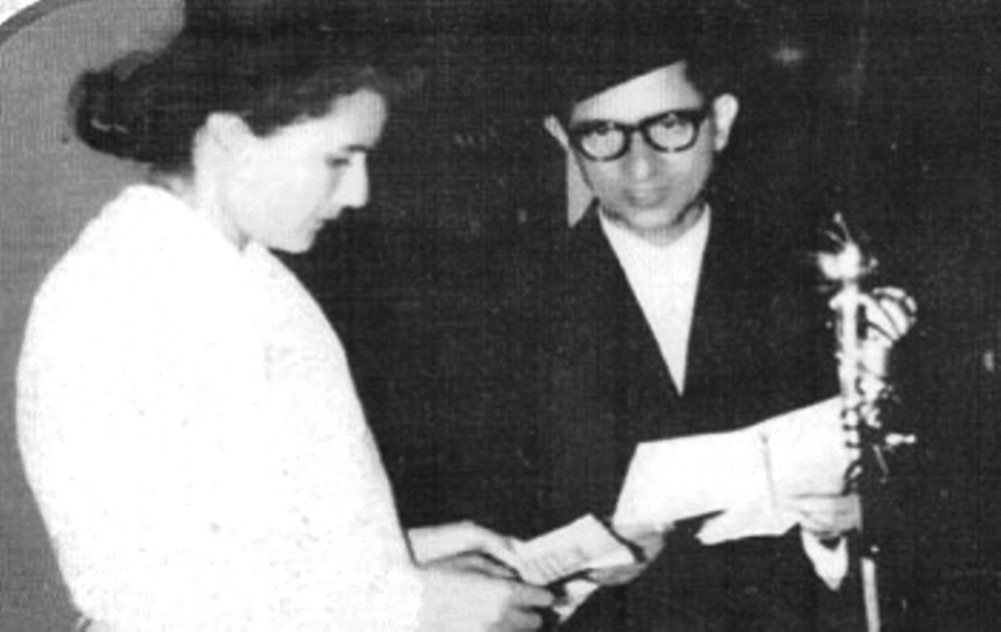
One of the seven standing in the field opened the ‘closed door for women’ forever. And, she changed the traditional face of Nepali politics. She was Dwarika Devi Thakurani, the Nepali Congress candidate from Dandeldhura (Constituency No. 66). Thakurani, who was elected by receiving 3,903 votes, also began the 'parliamentary life' of Nepali women as soon as she entered the parliament.
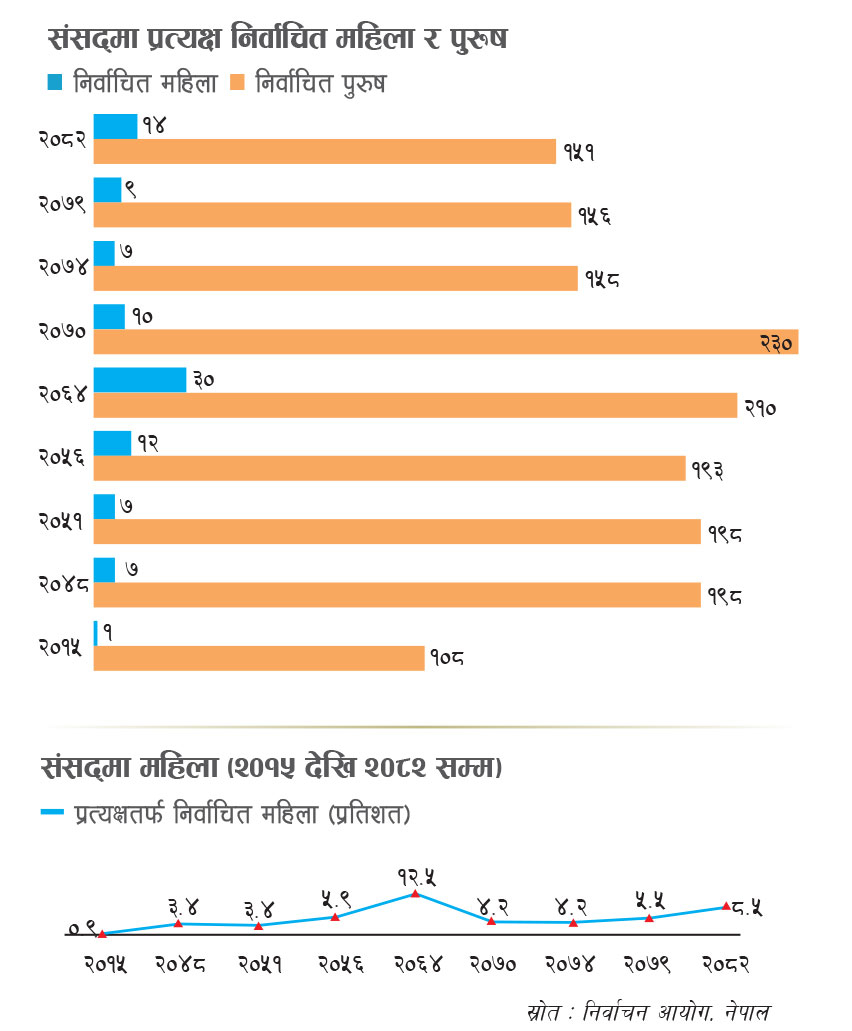
The parliamentary journey of Nepali women, which started with seven candidates and one victory in the 2015 general election, has reached 14 directly elected seats by 2082 BS. New documents were written in the political journey of women. However, the question remains – has the power of women been reduced within the constitutional constraint of 33 percent? Thakurani is the first elected woman MP. However, a decade before she reached the parliament, Nepali women had already understood the value of 'vote' on the streets. In 2004, the 'Nepal Mahila Sangh' was established in Kathmandu under the chairmanship of Mangala Devi Singh. That organization put forward two demands - education and suffrage.
In Nepal, women's presence was confined within the confines of the home. In that dark society where permission had to be sought even to step out of the courtyard, saying 'I also vote' was a huge rebellion in itself. At that time, women's diminished freedom found an outlet due to the rebellious steps of Mangala Devi Singh, Sahana Pradhan, and Sanomaya Gorkhali. They submitted a memorandum to the then Prime Minister Mohan Shumsher. The government tried to suppress it, but women were not swayed.
Finally, the Prime Minister announced, 'All citizens who have reached the age of 21 by 2005 Baisakh 1 will be able to vote.' The first practical test of this was in Bhadra 2010. In the then Kathmandu Municipality elections, Sadhana Pradhan ran for the post of ward chairperson and was elected. Pradhan's victory was not only hers, but also over the long-standing oppression and humiliation faced by Nepali women.
It was the first time in Nepal's political history that a woman was elected to any position. Researcher Shivahari Gyawali considers that moment to be 'the first step in the creation of women's physical presence and space in the state structure'. After that, women's political journey did not stop. Instead, new documents were drawn one after another.
Thakurani's victory in the 2015 general election was another celebration for women. Thakurani also became Nepal's first woman minister. She assumed the responsibility of Deputy Minister of Health and Autonomous Governance in BP Koirala's cabinet on 2016 Jestha 13. At the same time, Kamal Rana also became the Vice President of the Upper House, the Mahasabha. That was another leap in the political journey of women.
The curtain of the Panchayat and the ‘decoration’ of the elite
In 2017, the then King Mahendra Bir Bikram Shah implemented the Panchayat system by carrying out a ‘coup’ on democracy. After the ruling power came into the hands of the king, democracy was massacred. The rights that women had gradually gained also came back into the hands of the ruler. According to ‘Women’s Participation in Parliament (2015–2074)’ prepared by the Federal Parliament Secretariat, a total of 21 women reached the National Panchayat during the three decades from 2019 to 2043. All of them were the king’s choice. Later, in the 2043 election, out of 73 candidates, only three women, Sharada Malla, Chanda Shah and Laxmi Singh, were elected.
Although women have been present in the meantime, researcher Gyawali points out that it is not fair. ‘During the Panchayat period, women who reached parliament were mostly from hill tribes, supposedly from high caste and elite families – Bhadra Kumari Ghale, Saraswati Rais,’ says Gyawali, ‘The presence of Dalit women was zero, Madhesi and tribal women were also in name only. That was ‘representation’, but not of ordinary Nepali women, but only of a certain upper class ‘decoration’.’
5 percent ‘ceiling’ and entry of Madhesh
The people’s movement of 046 BS ended the Panchayat system. Multi-party democracy was restored. The people used to hear – change has come. But was that really change for women? In the 048 BS elections, the number of voters suddenly rose above 11 million. This was an increase of 163 percent compared to 015 BS. The voting rate increased from 42 percent to 65 percent. Out of 1,345 total candidates, 81 were women.
In 2015, the National Women's Commission was established. That institution conducted a gender audit of the constitution and duly took forward the issue of one-third participation. According to former MP Pandey, it was an important milestone. 'It helped establish women's representation as a right,' she says. It was a significant increase compared to the Panchayat period. But, the result? A total of 8 women were elected. In the 2011 elections, Uma Adhikari from Parbat-2, Tham Maya Thapa from Myagdi-1, Meena Pandey from Sarlahi-2, Maiya Devi Shrestha from Gorkha-2, Leela Koirala from Dhanusha-2, Bidya Devi Bhandari from Kathmandu-1, Sahana Pradhan from Kathmandu-4 and Shailaja Acharya from Morang-5 were elected.
Former MP Binda Pandey recalls the 2047 interim constitution as the reason for the high number of female candidates at that time. ‘The 2047 constitution had taken a progressive step to make at least 5 percent of women candidates mandatory,’ says Pandey, ‘but the parties considered this minimum limit to be the maximum. No one showed the will to give tickets to more women than that.’
The situation did not change in 2051 either. On the contrary, the attendance was even thinner. There were only 86 women candidates in the election competition. However, only 7 were elected. ‘The question of women’s participation in parliament kept coming up again and again. However, the parties kept pushing back the question of representation, citing political instability,’ says Pandey.
However, in 2056, new signs of change were seen. In the general elections held in two phases in Baisakh and Jestha, 12 women succeeded in becoming MPs. At that time, the number of female candidates was 143. In that election, Madhesi women entered the parliament for the first time. They were Chitralekha Yadav and Renukumari Yadav.
It was not just a personal achievement, it was also a social message – in Nepali politics, there are voices from not only the hills and Kathmandu, but also from Madhesh. However, researcher JB Bishwakarma says, ‘Even during that period, the influence of women around the leadership and from the upper class was greater. The presence of Dalit and marginalized women was only in name.’
The National Women’s Commission was established in 2058 BS. That organization conducted a gender audit of the constitution and duly took forward the issue of one-third participation. According to former MP Pandey, it was an important milestone. ‘That helped establish women’s representation as a right,’ she says.
064: The ‘golden age’ of inclusion
It was the people’s movement of 062/63 that brought women to the center of politics. And that proved to be a ‘golden age’ of inclusion for women. The subsequent Madhesh movement played an important role in taking the issue of inclusion to a new height in Nepali politics. According to researcher Bishwakarma, those movements established the issue of inclusion as a ‘rise’.
On 16 Jestha 2063, the parliament, which was re-established after the people’s movement, unanimously passed a historic resolution – at least 33 percent women’s participation in all state bodies. There were 57 women in the re-established House of Representatives and the interim legislature of 063 BS. But more important than that was the entry of Dalits into parliament. Bishwakarma says, ‘It made the Nepali Parliament a true ‘common home’ for the first time in terms of geography, ethnicity and class.’ Bishwakarma calls the first Constituent Assembly election of 2064 ‘the time of the most colorful and active participation’. Out of 368 female candidates, 30 won directly. A total of 197 women entered parliament through proportional representation and nomination. Notably, 7 Dalits were successful in winning the election through direct elections. ‘At that time, the participation of women and Dalits was not only in numbers but also with an agenda,’ says Bishwakarma. The second Constituent Assembly election of 2070 BS set a ‘record’. 78.34 percent of the vote was cast in that election. That is the highest voter turnout in Nepal’s electoral history. That election reflected the people’s faith and enthusiasm for democracy. However, the presence of women was not encouraging. Only 10 women won directly from the elections. Although the number of female candidates was 667, the winning rate was very low. The representation of women was three times less than in the first Constituent Assembly.
The second Constituent Assembly election in 2070 set a ‘record’. 78.34 percent of the vote was cast in that election. That was the highest voter turnout in Nepal’s electoral history. That election reflected the people’s faith and enthusiasm for democracy. However, the presence of women was not encouraging.
As Pandey said, the number of women candidates in parliament directly started decreasing with the election. In the first House of Representatives election under the federal system in 2074, a total of 7 women were elected directly. While only 156 out of 1,899 candidates in that election were women. The Constitution of Nepal was promulgated on 2072 Asoj 3. Article 84 of the Constitution provided that: In the Federal Parliament, at least one-third of the total number of members elected by each political party should be women. There was a gap in that provision. The parties made a way for that gap. The 2072 constitution made 33 percent female participation mandatory. However, the parties used it as a means to impose the ‘proportional’ system. The parties were seen as ‘regressive’ in fielding women candidates directly. Pandey says, ‘The parties were stingy in giving tickets to women directly in the 2074 and 2079 elections. Only proportional representation was used to reach 33 percent.’ She argues that even though women were ready to contest the elections, the parties created a narrative that they were ‘not ready’.
The 2079 House of Representatives election was held on Mangsir 4. The total number of voters reached 17.988 million. There was an increase of about 17 percent compared to the previous election. The voting rate was 61.41 percent. In that election, 240 women candidates were in the fray. However, only 9 were elected.
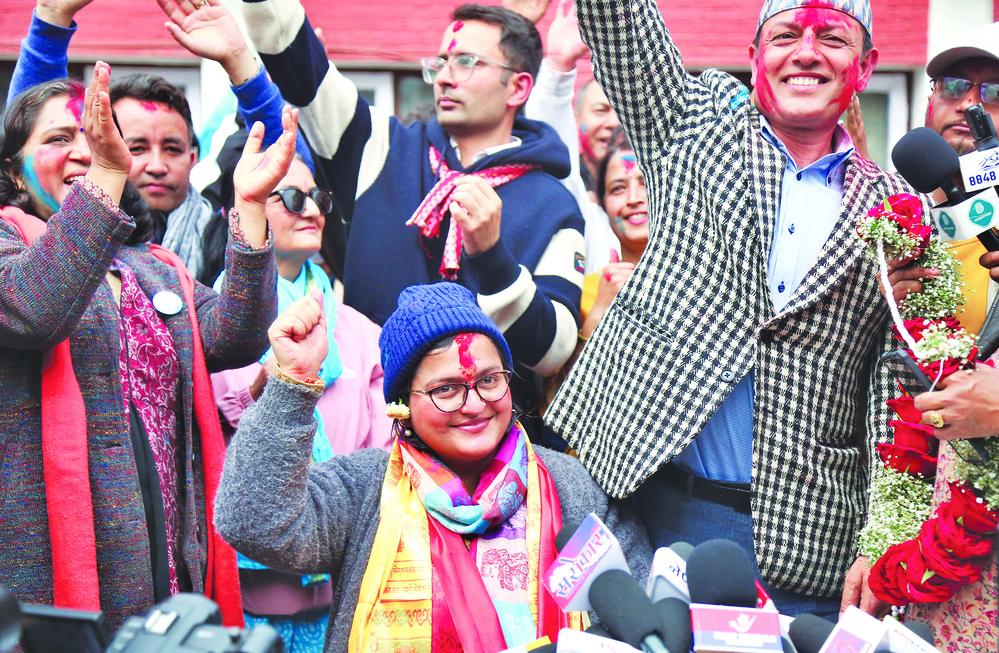
The number of women elected directly seems to have increased compared to 2074. Similarly, in the recently concluded election 2082, the number of women elected directly has reached 14. However, this is not encouraging. Out of 3,406 candidates elected directly in this election, 388 (about 11 percent) were women. Among the major parties, the Rashtriya Swayamsevak Sangh (RSS) gave tickets to 16, the UML and the NCP to 12 each, and the Congress to 11 women.
Out of 14 women elected directly, 13 are from the Rashtriya Swayamsevak Sangh (RSS) and one is from the Congress. Indira Rana Magar, Tosima Karki, Sobita Gautam, Nisha Dangi, Ranju Neupane, Rubina Acharya, Bina Gurung, Komal Gyawali, Asha Jha, Nitima Bhandari Karki, Asika Tamang, Gauri Kumari and Pushpa Kumari Chaudhary won from the Rashtriya Swayamsevak Sangh (RSS). Vasana Thapa was elected from Dailekh-1 from the Nepali Congress.
The number of female candidates in direct elections from 2015 to 2082 BS is increasing, but the number of those elected is decreasing. Why? Former MP Pandey feels that, ‘Parties do not field candidates in areas where women can win, but in difficult areas.’ And, later, they conclude that ‘women cannot win’, which is a product of the situation they themselves have created.’
However, she claims that women are not weak. Looking at the parliamentary record of 2074-079, 45 percent of the speakers who spoke during zero hour and 52 percent of those who proposed amendments to the bill were women. ‘This confirms that women are not in parliament just for ‘headcounting’,’ says Binda, ‘they have reached out to formulate meaningful policies.’ The problem is not in the ability of women, but in the willpower of the parties.’
‘Inclusive governance is good governance’
In 2080, the Election Commission submitted the ‘Integrated Election Bill’ to the government. It includes an important point that one-third of women candidates should be mandatory in direct elections from ward chairmen to the federal level.
If this proposal becomes law, Pandey argues that it could prove to be a ‘game changer’ in Nepal’s electoral history. Under the current system, parties can reach 33 percent from the proportional list even without direct candidacy. The new proposal closes this ‘escape route’.
According to researcher Vishwakarma, inclusive representation is not just a moral demand, but a practical necessity of good governance. ‘Until all communities are represented in every component of the state, service delivery cannot be fair,’ he says.
Many women have not yet been able to fit through the door that Dwarika Devi opened seven decades ago. Policy interventions and social transformation are necessary for that. However, this seven-decade journey of Nepali women to parliament has made one thing clear – parliament is not just a ‘club’ for men.