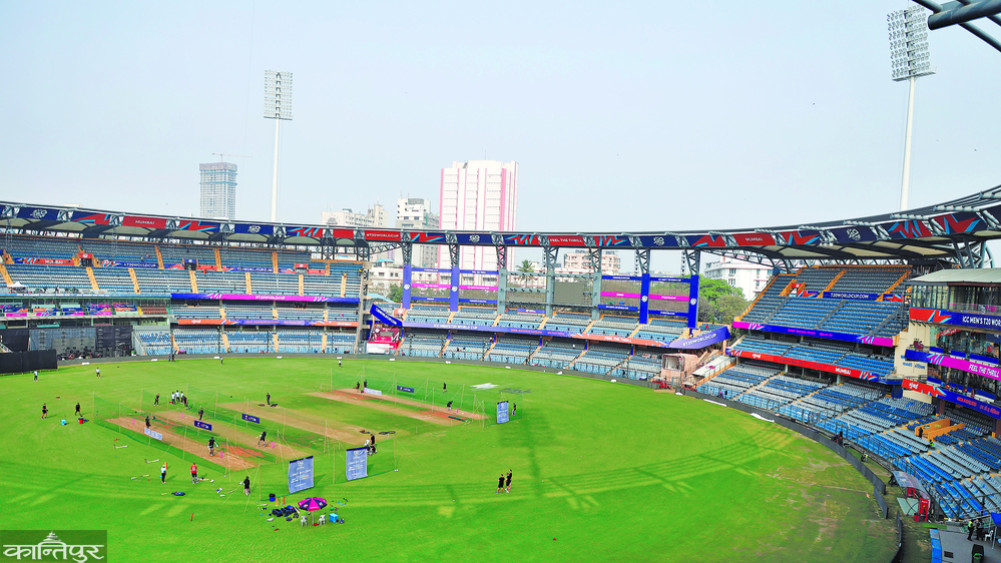
The biggest feature of the Wankhede Stadium, where Nepal will play all four group stage matches, is its pitch made of red clay. Red clay pitches are not available in other cricket stadiums in India. The ball bounces well here, which gives the batter and the bowler both the seam and swing, as the stadium is close to the sea.
We use Google Cloud Translation Services. Google requires we provide the following disclaimer relating to use of this service:
This service may contain translations powered by Google. Google disclaims all warranties related to the translations, expressed or implied, including any warranties of accuracy, reliability, and any implied warranties of merchantability, fitness for a particular purpose, and noninfringement.
Marine Drive and Church Gate. It is said that it is attached to it, Wankhede Stadium. Hearing these three names, a hint of Mumbai comes to mind. Mumbai is the home of cricket, this is Wankhede Stadium. First of all, why was this stadium built? How did it get its name? Its story is exciting. There are many such controversies related to sports in history, which have inspired the construction of new stadiums. The story of Wankhede Stadium is almost the same.
What happened? In the 1970s, there was a dispute between the Cricket Club of India and the Mumbai Cricket Association. The Cricket Club owned the Brabon Stadium and there was a dispute over the distribution of tickets for the matches held there. In such a situation, the association decided, why not build its own stadium? The president of the association was Sheshrao Wankhede. The stadium was built in about a year and its identity was established, with the surname of that president.
It had recently celebrated its 50th anniversary with pomp and show. Where is India? This is one of the most famous stadiums in the world. It is in Wankhede that India won the ODI World Cup in 2011. This is also where Sachin Tendulkar played his last international match. It is also the home ground of the Indian Premier League (IPL) team Mumbai Indians. Many memorable matches have been held here. Now the question is, why is Wankhede Stadium being talked about now?
Now Nepal will also be connected to Wankhede Stadium. This time's Twenty20 World Cup has started from Saturday. In one of its opening matches, India and America are facing each other at Wankhede. All Nepal's matches will be held here. For Nepali cricket, this is an opportunity to connect with a great 'heritage' of the game. Traditionally, Wankhede Stadium is a 'batting paradise'. Many runs are scored here, and many runs must be scored to win.
Wankhede Stadium is special for many reasons. To play well here, you need to understand it well. It was rebuilt for the 2011 ODI World Cup. The biggest feature of Wankhede Stadium is its red clay pitch. Red clay pitches are not available in other cricket stadiums in India. This is why Wankhede Stadium has a very enjoyable 'bounce'. The batter must be good, and you can play with equal fun on this bounce.
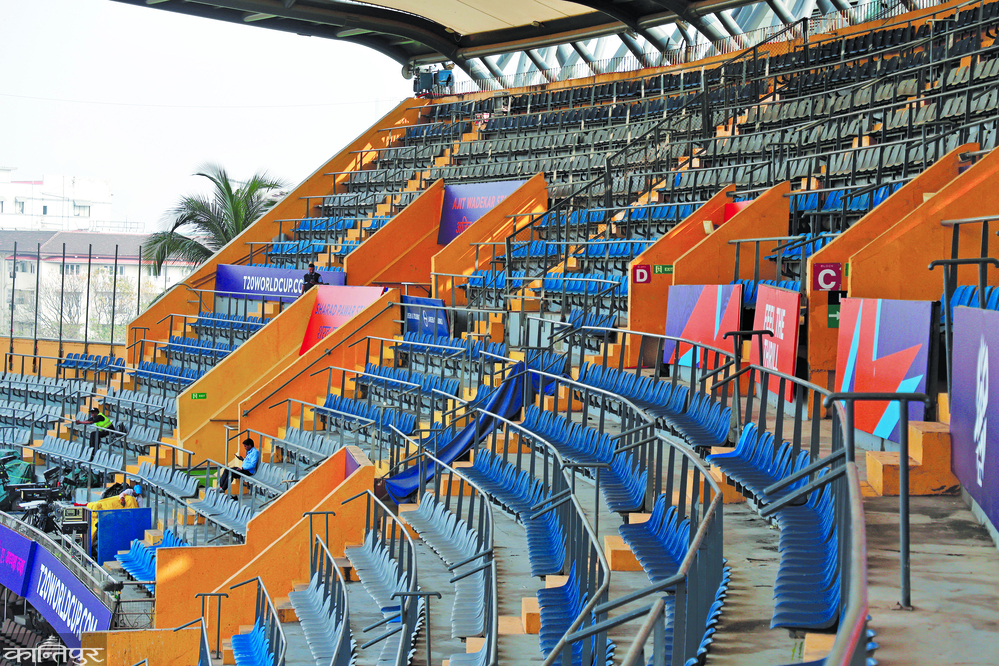
The ball comes to the batter better. There are a total of eight pitches in Wankhede Stadium. The outfield at Wankhede is not only big, the boundaries are also small. In this way, 200 runs at a time are common in Twenty20 cricket. Having said this, it is not right to say that everything is only for the batter. The bowler must be good, and swing is also available. As the game progresses, the spinner can also be helpful. Since the stadium is close to the sea, both seam and swing are available in the evening.
The wind blowing from the nearby Arabian Sea also plays a role in the game. The wind usually blows at a fast pace in the evening. Therefore, it is helpful for fast bowlers. This wind again slows down after 8 pm. After that, the humidity increases. But Wankhede Stadium is not a favorite place for bowlers. The strong effect of frost can also be seen in Wankhede Stadium. Often, during the second innings, the ball can become wet due to frost and this can bother the bowlers. Fielding can also be difficult.
Therefore, the Wankhede Stadium is the place where it is easy to chase the target. Usually, the decision to bowl first is made after winning the toss and the team chasing the target has won more, at Wankhede Stadium. Therefore, the toss is often considered one of the decisive factors here. In this way, the matches played only during the day, the matches played during the day and night, and the matches played only at night are different in some way. Accordingly, the team has to decide the strategy.
Coincidentally, Nepal will play four matches at Wankhede Stadium. The time is also different in three different times. The first two matches against England and Italy will start at 3:15 pm. The match against West Indies is at 11:15 am. The last match against Scotland will be at 7:15 pm. So the fun is here. It will be interesting to see how the Nepali team will take these three different time matches. The team structure will largely depend on this.
Specifically, cricket is a very technical game. It doesn't happen like this, just going straight to the field and playing. This has made the game a little more complicated. In another sense, it has also made cricket more exciting. With all these different features at the Wankhede Stadium, the excitement of the game that Nepal will bring will be different when it plays the Twenty20 World Cup. Let's believe, the Nepali team will adapt this diversity to its liking and score runs with gusto.