Although the parties made numerous commitments on issues such as Digital Nepal, Digital Democracy, Digital Revolution, Digital Learning, Digital Telemedicine, Digital Payment, Digital Service Delivery, and Digital Address System, none of them were seen to have done any work on these after the election.
We use Google Cloud Translation Services. Google requires we provide the following disclaimer relating to use of this service:
This service may contain translations powered by Google. Google disclaims all warranties related to the translations, expressed or implied, including any warranties of accuracy, reliability, and any implied warranties of merchantability, fitness for a particular purpose, and noninfringement.
These are the points included in their manifestos (pledges or resolutions) by the major parties that have somehow reached the government in the last four years and left the parliament after the Gen-G movement. Some of the parties that made such promises and commitments have consistently led the government, while others have seen the face of the government with a bang.
In the 2079 BS elections, most political parties had placed Digital Nepal, advanced information technology, electronic service delivery, and youth-targeted startups at the center of their manifestos. The parties, which are busy writing their manifestos for the upcoming House of Representatives elections, seemed to be trying to attract voters with emotional and ambitious things rather than reality in the previous elections.
Although the parties made many commitments on the issues of Digital Nepal, Digital Democracy, Digital Revolution, Digital Learning, Digital Telemedicine, Digital Payment, Digital Service Delivery, and Digital Address System, none of them were seen to have done anything about them after the elections.
With the availability of digital infrastructure and archives along with instant fact-checking, the challenge of refreshing their manifestos and being accountable for the promises they made in previous elections in the upcoming elections may become uncomfortable for the parties. The parties were also not seen to have taken a stand on the development of the 'digital public infrastructure' required for such digital transformation or to have taken any initiative after coming to power. Under the Digital Public Infrastructure (DPE), a data exchange platform has not yet been created in Nepal, and significant work has not been done in expanding connectivity and data centers.
According to the latest data from the Nepal Telecommunication Authority, fixed broadband subscriptions have reached only 50 percent across the country. Although the government has said that it will establish data centers in all seven provinces, experts have criticized it for not even upgrading the primary data center in Singha Durbar and the secondary data center in Hetauda.
The CPN-UML, which came to power with the support of the Nepali Congress in Asad 2081, had included the slogan ‘Twenty Guarantee: Five Years – UML Will Do It!’ in its manifesto. The party, which contested the election alone on the issues of nationalism, constitutional stability, and distribution-based economic governance, had put forward a policy of taking diplomatic initiatives to protect and return the land according to the Nepali map, which includes Limpiyadhura, Lipulekh, and Kalapani, making the local level a center for service delivery, and strengthening the provinces as facilitators of development.
Although the UML had announced a plan to increase Nepal's gross domestic product to 100 trillion rupees within 5 years and raise the minimum monthly wage to 25,000 rupees, it could not fulfill any of its promises when the party chairman was the prime minister. Since last July, the government has increased the minimum wage of workers to 19,550 rupees.
UML had promised to expand 5G services across the country in information technology with slogans like 'No Line, Service Online', 'Hunger: No Anchor', '5G Communication: Miracle in IT', to establish Nepal's own satellite in Earth's orbit and become self-reliant in information and communication, to provide government services at home through mobile apps, and to start digital education by linking schools with information technology infrastructure. Although online services have gradually improved, the government's focus or priority has not been seen in this regard. The UML-led government has not done anything significant in terms of building public digital infrastructure, upgrading the existing online system, or improving cyber security.
There was no preparation for 5G, and the government did not even show the will to pursue a policy when Nepal Telecom, which had granted trial permission, did not submit the trial report for four years. In the education sector, UML had promised to make the country fully literate within two years and provide technical education to all municipalities.
From 2081 Shrawan to 2082 Bhadra, when the government was toppled by the Gen-G movement, the Nepali Congress, which was in a coalition government with the UML and before that, the Pushpa Kamal Dahal-led government, had talked about a knowledge-based economy in the previous elections and explained the software sector as a new source of economic growth. Amid the confusion between the previous parliament restoration and dissolution, the Congress, which went to the elections in alliance with the then CPN (Maoist Center), had made political stability, good governance and economic development the main issues.
‘The Nepali Congress government will implement an integrated social security package of programs from womb to mourning through the national identity smart card in the next five years,’ the manifesto said. ‘Within five years, we will provide free medical services to citizens under 3 years of age and above 73 years of age, and we will increase the average life expectancy to 73 years. All women will be provided with free quality sanitary pads.’
The Congress manifesto mentioned making Nepal a middle-income country within five years and developing based on citizens’ freedom, extending the term of the House of Representatives to a full 5-year term, and not allowing the parliament to be obstructed under any pretext.
Similarly, the Congress plan also mentioned issues such as providing security to the state at every stage of the citizen’s life cycle through an integrated social security package, and making education up to grade 12 free. In the education sector, the Congress had committed to making education up to grade 12 free, providing high-speed internet to 80 percent of community schools within the next 5 years, and providing 40 percent technical education at the secondary level.
On 10th of December 2079, the then party of Pushpa Kamal Dahal ‘Prachanda’, who was appointed Prime Minister for the third time with the support of the CPN-UML, the National Independence Party, the RPP, the JSP, the Janmat Party, the Civil Liberties Party, and three independent MPs, the Maoist Center, had promised to establish information knowledge parks and startup business centers in all 7 provinces in its election manifesto. The Maoists had promised to strengthen the government cloud and data centers, and make science, technology, engineering and mathematics (STEM) education mandatory from the secondary level.
However, even when party chairman Dahal was the prime minister for a total of 1 year and 6 months, the Maoists did not fulfill even small promises like knowledge parks and startup business centers. The Maoists' promises to implement a directly elected executive presidential system that would receive a total of 51 percent of the vote, to form a high-level commission to investigate the assets of all high-ranking officials since 2047, and to work on good governance and information technology by completely digitalizing all government agencies within 5 years remained unfulfilled.
Nepali Communist Party (then Maoist Center) leader Barshaman Pun said that due to being a coalition government, everything could not be carried forward according to his party's plan and thinking as stated in the manifesto and that there were some limitations. According to him, efforts were made to work as per the commitment in the field of good governance and some positive results have been seen.
‘Our election document in 2079 was mainly based on the theme of good governance, social justice and prosperity,’ he said, ‘In the context of good governance, we tried to make constitutional bodies effective and adopt zero tolerance towards corruption. In the meantime, we started the work of opening old and major corruption files. In the context of social justice, we brought youths who went abroad for employment under the ambit of the Social Security Fund.’
The National Independent Party (NISP), which emerged as a new party in 2079, had started a new debate on ‘digital democracy’ and direct public participation through technology. Pun said that they had only been in government for a short time and that being a coalition government, in some cases they could not function as mentioned in the party manifesto.
The National Independent Party (NISP), which emerged as a new party in 2079, had started a new debate on ‘digital democracy’ and direct public participation through technology. The RSP had considered issues such as making three years of primary education compulsory and providing nurses in schools, and legalizing cryptocurrency mining for earning foreign currency as its vision.
‘Digital currency mining will be legalized within the country and so that Nepali citizens cannot purchase it,’ the pledge letter said, ‘The necessary modern digital address system, post box operation, postal code, etc. will be managed by giving priority to the post office.’ The RSP had also promised to arrange for a directly elected Prime Minister and Chief Minister for good governance, implement time cards in government offices, and provide compensation for those who delay.
Although this party talks about ‘right to recall’ and ‘right to reject’, these issues are legally complex. Although the new commitment such as providing a one-year ‘on arrival visa’ to foreign workers in the information technology sector called digital nomads was included in the party’s ‘pledge letter’, the RSP got more involved in issues outside the manifesto.
RSP leader Sobita Gautam said that even though the issues were established, they did not have the necessary number to pass them because they were in the opposition most of the time. ‘Although our party was in government for a short time, that period was not sufficient in terms of lawmaking and implementation,’ she said. ‘Due to the number of seats in parliament, we were limited to raising issues rather than taking them to a decisive point.’
Gautam recalled that in her personal manifesto, she had put an agenda to start ‘part-time jobs’ for the youth, and mentioned that the government had started a system of minimum daily payment, and the door to ‘part-time jobs’ had opened for the youth. ‘The drinking water problem in Kathmandu-2 was very complicated, I had mentioned in the pledge to provide full facilitation to solve it,’ she said, ‘Now, work has started by tendering for mapping and network expansion of Melamchi drinking water.’
Janata Samajwadi Party (JSP) and Loktantrik Samajwadi Party (LOSP) had also prioritized the issues of technology and youth self-employment. JSP had pledged to provide federalism with 10 geographical and one non-geographic (Dalit) provinces, a smart agricultural system and a digital land revenue/survey system, and free higher education for the poor and needy when it came to power.
The Maoists had promised to provide direct employment to 1 million youth and form a National Employment Authority. Rastriya Prajatantra Party had also pledged to create a high-level mechanism for digital transformation and startups. RPP had made promises such as zero tax on software exports and encouraging digital payments, developing smart cities and smart villages in all 7 provinces, and legalizing marijuana cultivation for medical purposes.
There was a competition between the parties in terms of numbers in employment and youth-targeted programs. While the Congress claimed to create 1.25 million new jobs in 5 years, the UML had set an ambitious goal of creating 500,000 jobs annually and increasing per capita income to 300,000 rupees. The Maoists had promised to provide direct employment to 1 million youth and form a National Employment Authority. The JSP had set an exaggerated goal of increasing per capita income to 5,000 dollars in 5 years.
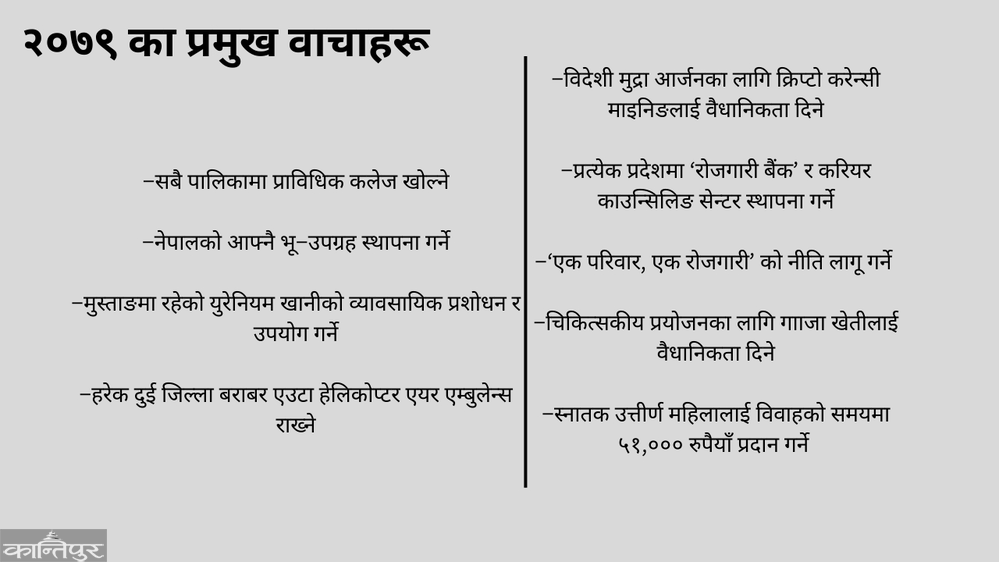
The Rashtriya Swayamsevak Sangh (RSS) had promised to establish employment banks, career counseling centers, and training centers in each province. The RPP had said that it would mobilize 1 million volunteers annually and significantly reduce the number of people going for foreign employment in 5 years. The LOSP had promised to give 51,000 rupees to women who have passed graduation and are financially weak at the time of marriage.
Traditionally, the manifestos of some parties have been criticized for being too airy and full of gossip, and for not reading them properly by those contesting elections. The recent manifestos seem to be starting to look a bit different. For the 2079 elections, some parties tried to make their manifestos not just political documents but also attractive, clean and modern in terms of design and presentation.
The UML used illustrations and sketches in the manifesto, while the Maoists used infographics. Pictures of air ambulances for health and tractors and drones for agriculture were used. The UML used illustrations and sketches in the manifesto, while the Maoists used infographics. Pictures of air ambulances for health and tractors and drones for agriculture were used.
It seems that some manifestos have even started to correct overly ambitious plans. For example, when the CPN (UML) fought the 2074 elections together with the then CPN (Maoist Center), it announced that the per capita income of citizens would reach 5,000 US dollars within 5 years, but the 2079 manifesto mentions adjusting it to 2,400 US dollars.
This time too, while some candidates are announcing outrageous plans like ‘making the road to Vaikuntha a national pride project’ or ‘making all Nepalis millionaires within 5 years’, the major political parties have not yet made their manifestos public.
In previous manifestos, the parties that had plans ranging from abolishing the provincial structure, making a directly elected president or prime minister, to extending the term of the House of Representatives to a full term, what kind of announcements will they make this time in the new situation? That curiosity seems strong.
With the availability of digital infrastructure and archives along with instant fact-checking, it seems that the challenge of giving newness to their manifestos in this election and being accountable for the promises they made in the previous elections may become uncomfortable for the parties.