When analyzing the manifestos issued by the major parties of 2074, the UML-NCP-Maoist Center, the Congress, the Rastriya Prajatantra Party, and the Federal Socialist Forum, it is clear that in practice, very few of the issues written in them were implemented.
We use Google Cloud Translation Services. Google requires we provide the following disclaimer relating to use of this service:
This service may contain translations powered by Google. Google disclaims all warranties related to the translations, expressed or implied, including any warranties of accuracy, reliability, and any implied warranties of merchantability, fitness for a particular purpose, and noninfringement.
During the 2074 BS Constituent Assembly elections, the main political parties prepared manifestos in competition with each other, asking, ‘Whose slogans are better than whose?’ In practice, the issues written in those manifestos were rarely implemented.
The manifestos of the parties often put forward ambitious plans and programs, which has led to challenges in implementation. Those who became candidates in the 2074 elections also contested the 2079 elections. The main parties also prepared and made public their manifestos in the 2079 elections.
The manifesto became limited to just a 'letter'. Political analysts say—now we need a vision statement, not a manifesto. However, the voters did not ask the candidates who became candidates again in the 2079 elections how many programs mentioned in the manifestos issued in 2074 were implemented. In fact, the programs included in the manifestos prepared by the main parties that contested the 2074 elections—the Congress, the Communist Party of Nepal (after the merger of the UML and the Maoist Center), the Rastriya Prajatantra Party (RPP), and the Federal Socialist Forum—were rarely implemented. The Communist Party of Nepal had issued a common manifesto in 2074.
Some of the points mentioned in the manifestos of these four parties seem to be similar. Political analysts argue that the manifestos of the parties are limited to paper.
Political scientist Krishna Pokharel comments that the manifesto is like tying a cat to a shrine for the parties. ‘Releasing a manifesto during an election is like tying a cat to a shrine,’ he says. ‘In democratic countries, the party that wins the election, how much work did it do as promised? It is seen in the next election,’ he says. ‘The winner tells the voters that I fulfilled this election promise, this is the practice of a responsible democratic country.’
In such countries, only those things that can be fulfilled are included in the election promise. ‘Those who win the election and form the government focus on fulfilling the promise so that voters can question them if they fail to fulfill the election promise,’ he says. However, Pokharel says that in Nepal, the custom of writing manifestos is to get the people’s votes by including certain things in the manifesto.
‘General voters do not look at the manifesto, it seems to be made just to show educated voters,’ he says, ‘Has anyone asked the candidates who will come to their respective constituencies in the upcoming elections what promises they fulfilled in the manifesto in the 2079 elections? Has anyone been able to ask them so far?’
He suggests that if they can ask questions now, they should include only those things that the candidates will fulfill in the election promises in the future, saying ‘the election can be lost because of this manifesto.’ Social security, information and technology, agriculture, tourism, and development infrastructure are mostly mentioned in the party manifestos.
Some parties have mentioned that the construction of the Kathmandu-Terai/Madhesh fast track (fast track) will be completed in four years, some in five years. However, in the eight years since the construction began, only 45 percent progress has been made. Although the parties committed to ‘fast construction’ in the 2074 manifesto, the Congress, UML, the then Maoist Center, and the Madhesh Party kept coming to power in turn, but failed to fulfill their election promises.
Political analyst Tulnarayan Sah says that a group that constantly monitors and warns about the issues mentioned in the party manifesto has not developed in Nepali society. ‘Organization, ethnic base, face, proximity to power – this is what people vote on the basis of,’ he said. ‘The culture of voting by reading the manifesto and forming an opinion has not been established in Nepali society.’
Therefore, he said, whatever is written in the manifesto will not have much meaning in the election. He argues that there is a practice of questioning candidates based on their work. ‘Candidates who win elections are questioned based on issues of local concern,’ he said. ‘Again, the party’s election manifesto is prepared from the center, and it contains matters of theoretical and long-term importance.’ He says that when a party is used to win elections and an individualistic style is adopted when going to government, the manifesto does not have much importance.
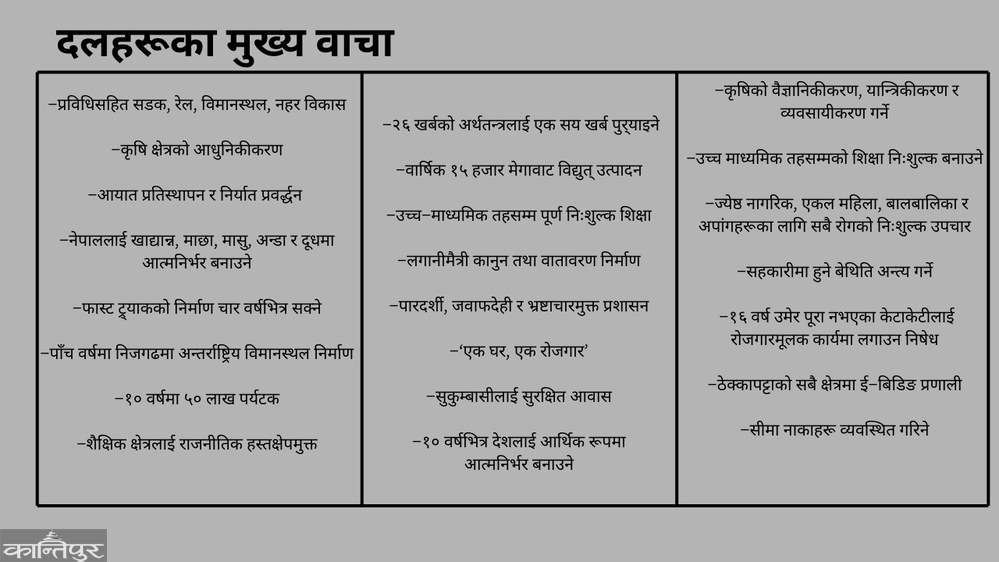
‘This is what has been seen in the elections of 30/35 years,’ he said, ‘The culture of putting the manifesto into policies and programs when going to government, and implementing it, has not developed at all. The new generation is considering the old parties as failures. Now, only what can be done should be included in the manifesto,' he said, 'The issues included in the manifesto should be implemented after winning the election and coming to power.'
Although various parties have presented the basis for making the country prosperous in their manifestos, they have forgotten all those promises after coming to power. Due to this, the real expectations, issues and development work of the people are overlooked.
Although slogans to lead the country towards economic prosperity are included in the manifesto, they are not included in the policies, programs and budget after coming to power. Analysts believe that only during elections, past manifestos are reviewed, amended and made public, making them timely.
Political analyst Geja Sharma Wagle comments that Nepal's political parties have made manifestos just 'letters' for trading dreams. ‘The vision of political parties should be included in the manifesto,’ he says, ‘that has not been done, which is why the manifesto is not implemented.’
He said that the general public does not vote based on the ideals, principles, contributions and manifestos of political parties. ‘People vote based on who the candidate is, their face and the political management they do,’ he said. However, he suggests that now is the time to vote based on the manifesto.
‘Whatever a political party can do, that should be in the vision,’ Wagle says, ‘it is done after announcing the manifesto, but now we need to bring a vision paper and work according to that.’ He understands that parties bring manifestos only for formality. ‘Whether a political party is in power or in opposition, it should work for five years based on the vision paper,’ he says, ‘Those who go to government should implement it, those who are in opposition should question it, so voters should vote only by looking at the party’s vision paper.’
Whether the voters win or lose the election or come to power or not, have the issues mentioned in the vision paper been implemented? He says that we should not stop asking questions about those issues. ‘Only if this happens will a political party and the candidates from that party become accountable to the people,’ he said.

