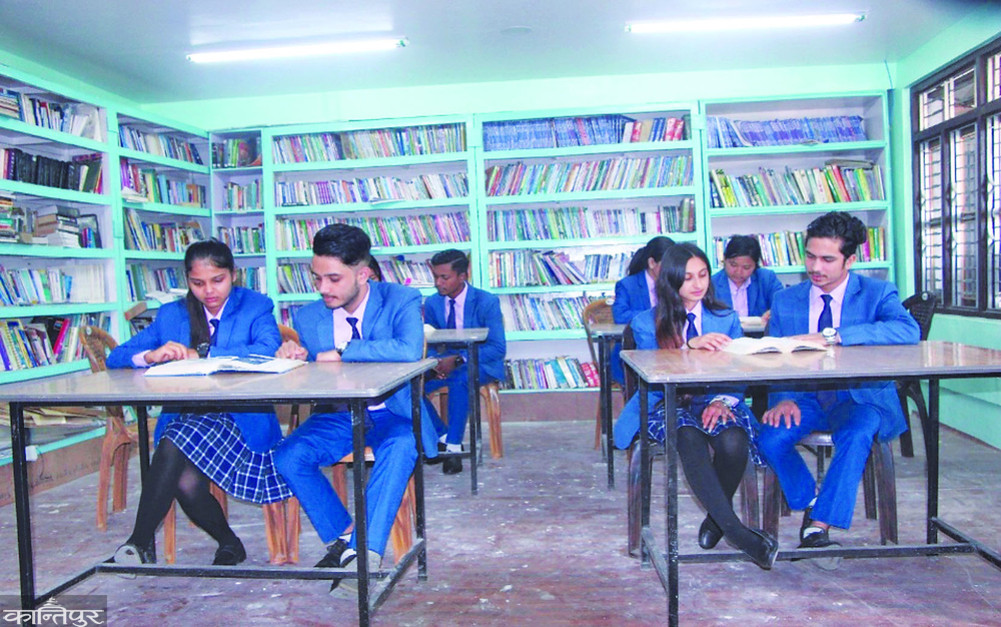
In the results of SEE 2079 and 2080, this school was honored by the Education Development Directorate, Gandaki Province, Education Development and Coordination Unit, Kaski, and District Coordination Committee, Kaski, for being the best in Pokhara Metropolitan City and Kaski District.
We use Google Cloud Translation Services. Google requires we provide the following disclaimer relating to use of this service:
This service may contain translations powered by Google. Google disclaims all warranties related to the translations, expressed or implied, including any warranties of accuracy, reliability, and any implied warranties of merchantability, fitness for a particular purpose, and noninfringement.
Gyanman Dangol, a teacher from Bhaktapur, came to Pokhara in 2003 as a representative of the then government to open a school based on Gandhian education. He wanted to run a school around the Vindhyavasini Temple in Pokhara. But the locals did not allow another school to be established because there was a Sanskrit language school opened during the time of Devshamsher.
Despite wandering around Pokhara for a year, Dangol could not find a place to set up a school. After suffering from tuberculosis, he set off for Kathmandu.
Pandit Muktinath Sharma met Dangol who was returning from Batulechaur, located in the northern part of Pokhara. After Dangol complained that he could not find a place to open a school, Sharma, who had studied from Banaras, promised to find a place with the aim of getting Pokhara's quota of schools back.
In the first week of Bhadra, 2004, Muktinath Sharma received training in education and was appointed to run the school in Pokhara. Sharma from Batulechaur established the Vindhyavasini Aadhar School on 12 Bhadra, 2004, as the founding principal, with 23 students.
Pandit Muktiram Sharma was the same revolutionary warrior who rebelled against untouchability by doing the work of plowing, which was forbidden to Brahmins, in 2001. He led Pokhara in the 2007 anti-Rana movement, due to which he had to leave the responsibility of the principal on 17 Jestha 2007 and enter India.
In November 2009, the school moved to public land that was the ruins of the palace of Siddhi Narayan Shah, the last king of Kaski, the fourth king of the kingdom. Education was started in a 65-foot-long thatched hut. The school started Nimavi in 2018, Mavi in 2021, and the former Higher Mavi in 2058. English medium education began in 2066. This school, which has become a learning center for good school practices, has now received a challenge - visit Vindhyavasini Mavi to see the school.
In 2079, Vindhyavasini Mavi came first in the country in the school performance test conducted by the Educational Quality Assurance Center under the Ministry of Education, Science and Technology after 6 years. In 2080, the Government of Nepal's Education and Human Resource Development Center, Sanothimi, Bhaktapur, ranked first in Gandaki Province and second in Nepal.
In the results of SEE 2079 and 2080, this school was awarded the best in Pokhara Metropolitan City and Kaski District by the Education Development Directorate, Gandaki Province, Education Development and Coordination Unit, Kaski, and District Coordination Committee, Kaski.
It has become first in Pokhara Metropolitan City based on the pass percentage in the 2081 Grade 8 Basic Level Examination. This school was the best in Kaski District in the results of SEE 2079. In SEE 2081, Sahaj Ghimire of this school scored 4 GPA.
It was ranked among the top 3 community schools across the country in the use of technology and received the ICT Award last year. In 2081 alone, principals, teachers, and school management committee officials from 259 schools across the country visited Bindhyabasini Secondary School to learn about the school's good practice.
The school has made a slogan, 'Discipline and dedication for quality education'. The school holds parent-teacher conferences at the class and grade level. Speakers are invited to organize motivational programs for students and parents. The school has posted separate codes of conduct (in Nepali and English) for students, parents, teachers, and staff in the schoolyard.
The code of conduct, which lists the responsibilities that parents must fulfill, is delivered to the students' homes. Extracurricular activities, information and communication technology, discipline, and grade-level in-charges are assigned.
The school sends a team of teachers to the students' homes once a year. Parents are asked separately about how much time the child spends studying at home, what are the facilities for studying, what problems the parents have, whether the child studies attentively or not, the family's financial situation, and the child's company. Principal Krishna Prasad Acharya says that the truth cannot be understood by asking only the students.
The school has 97 teachers and staff. 1,497 students are studying from early childhood development to grade 12. Management and science subjects are taught in grades 11 and 12. The school has been teaching in English since 2066. Computer science is taught from grade 4.
Sandeep Thapa, chairman of the management committee, believes that dutiful teachers, staff, dignified and disciplined students, and responsible parents are the factors of the school's success. 'The system of rewards and punishments, code of conduct, and procedures have made teachers and staff responsible. We have prohibited politics within the school,' he says.
Principal Acharya says that the dedication and honesty of teachers towards their profession, discipline of students, and proactivity of parents play an important role in the success of the school. Results are analyzed in every exam. Weak students are counseled by the in-charge of the relevant level.
Extra classes and memory enhancement training are provided. ‘The class teacher calls the parents to consult on what the students need to improve,’ said Principal Acharya, ‘Parents and students are made committed to improving their studies.’ The school has established a sister relationship with North London Collegiate School in South Korea.
With special attention to increasing the learning achievement of mathematics, ‘Mission Mathematics’ has been implemented since last year, and ‘Abacus’ mathematics has been conducted from grades 2 to 5 and an additional mathematics class has been continuously conducted from 4 to 9. The school has 18 scholarship revolving funds.
The classrooms have been equipped with multimedia projectors, smart boards, e-libraries, a math laboratory with a smart TV, and a computer laboratory with a smart board. The school cooks and feeds the children of the early childhood development program itself.