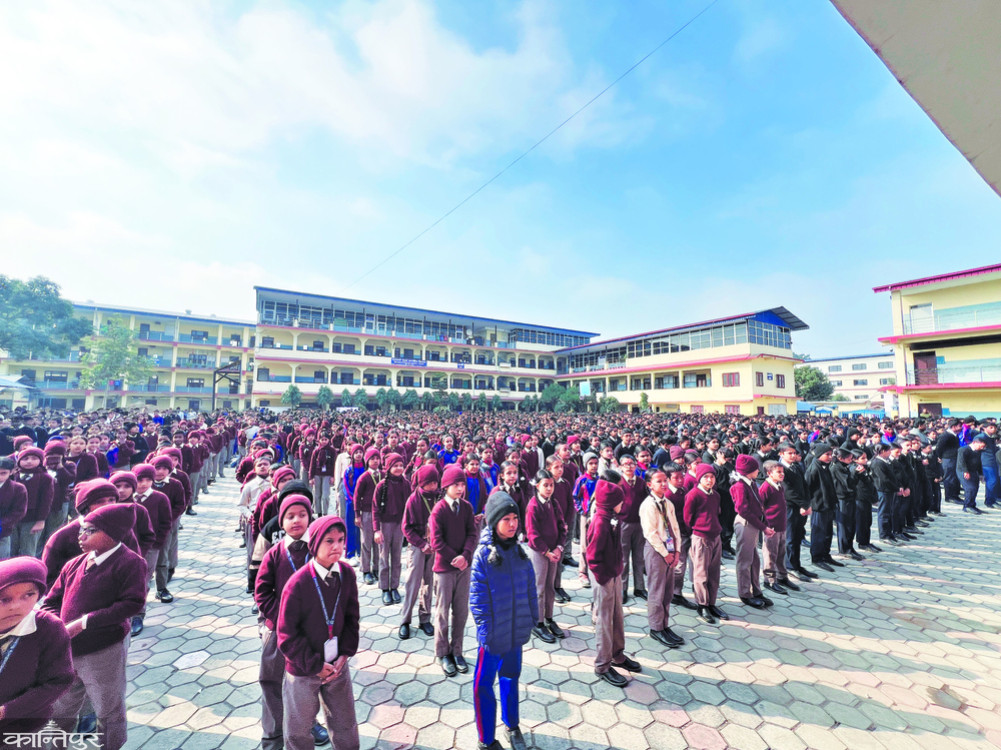
Narayani Mavi, which opened for older students who come to study at night to study on their own time, has taken a big leap forward in its six decades of establishment. It has transformed into a school where students are selected for quality results rather than going to study on their own time.
We use Google Cloud Translation Services. Google requires we provide the following disclaimer relating to use of this service:
This service may contain translations powered by Google. Google disclaims all warranties related to the translations, expressed or implied, including any warranties of accuracy, reliability, and any implied warranties of merchantability, fitness for a particular purpose, and noninfringement.
It was about time for the bell to ring for the start of class when Aditya Poudel entered the office of principal Ram Sharan Duwadi with a friend. It was Aditya's birthday, a student in grade 8 at Narayani Model Secondary School in Bharatpur.
Poudel, who went to the principal's office and said, "It's my birthday," received good wishes. He also deposited some cash in the school fund. "We wish students on their birthdays in a normal way to reduce unnecessary expenses on birthdays and other celebrations, and we have collected cash support from them as much as they can and put it in the fund," said Principal Duwadi.
Duwadi says that the 'Birthday and Happiness Fund' established last year aims to support the school's educational activities.
"Such students and education-friendly programs, from small to large, have contributed to the fact that many choose Narayani Model Secondary School in Chitwan for secondary school studies," he says. Although it falls within Chitwan district, Mrigasthali village on the Barbang River in Ichchakamana Rural Municipality-3 is located in a mountainous gorge, about 60 kilometers northeast of the district headquarters Bharatpur.
Shailesh Poudel, from this village, which is located two and a half kilometers south of Kuringhat on the Prithvi Highway, is currently studying MBBS at Pokhara Manipal Medical College. It has been three and a half years since he started studying MBBS. But Shailesh had already left the village and completed his class 12 studies in Bharatpur. After studying class 7 in the village, he studied at Narayani Secondary School until 12.
‘I had heard that Narayani Secondary School provides good education, that although it is not as expensive as private schools, the education is better than private schools. My parents had also heard the same. After studying 12, they said that their son would study medicine. That is why we chose Narayani Secondary School because it would be suitable,’ said Shailesh’s father Shiva Poudel. The Poudel family’s choice was right. Shailesh entered the school on a scholarship to study MBBS.
Narayani Secondary School did not reach this far. It started slowly. In the middle, there was a fear that the journey would be interrupted. But the school has emerged as a model school due to the hard work of parents, students and teachers who were responsible for raising the declining results. This school, which had reached zero in the SLC examination of 2038 BS, became the first in the district within 20 years.
Narayani Secondary School was born as a night school. After 2013 BS, with the eradication of malaria, settlements began to expand in Chitwan. Schools also started opening. Narayani Secondary School was opened with the aim of giving an opportunity to employees who had not passed grade 10 but were working at lower levels in government offices to pass grade 9 and 10 and pass SLC. Those who could not complete their studies also joined it.
When the school started teaching as a night school on 6 Jestha 2020, the school did not have its own land and building. Its founding chairman was Indra Prasad Poudel and the principal was Prem Kumar Shrestha. Former principal Purna Prasad Dawadi recalls that the school could not give the expected results because of the number of students who came to study after working during the day, and were tired while studying.
When 54 people gave their SLC exams in 2038, no one passed. Then concerns began about the future of the school. From 2041, the school started operating from 10 am to 4 pm. He says that a collective effort has been started to take the school forward systematically since 2049.
In the 2057 SLC, this school became the first in Chitwan to pass the community level. The then Hetauda Regional Education Directorate under the Education Department declared Narayani Secondary School a model school in 2070 on the basis of the SLC results exceeding 90 percent for five consecutive years, the teacher-student ratio was adequate, the classrooms were adequate, and the use of information technology in teaching was fulfilled.
A year before that, the school had started teaching in English medium. ‘Not liking the education in government schools, the locals started choosing private boarding schools to educate their children. We also made a plan to teach English. We called on the parents to cooperate,’ said Tek Bahadur Thapa, the former principal of the school and current chairman of the school management committee.
‘Even though there are no government posts to arrange sufficient teachers, parents are ready to help cover the cost of private resources,’ Thapa said, ‘Narayani Secondary School has become a model because we have fulfilled the promise we made to parents that if you help, we will give excellent results.’
The school, which offers education from early childhood development to grade 12, has 3,334 students. There are 132 teachers and 21 staff. There are three blocks - Annapurna, Dhaulagiri, Machhapuchhre, and Sagarmatha. An additional block, Kanchenjunga, is under construction. The school has also been doing well in sports, said Principal Ram Sharan Duwadi. ‘We pay special attention to how to help students in their studies,’ he said. The class teacher meets the parents once a month. The suggestions given by the parents are submitted by the class teacher to the school administration.
Duwadi said that the school has achieved results of about 97 percent in grade 8 in 2079, 2080, and 2081, and 99 percent in a row. In SEE, the pass percentage was 100 percent, 88 percent, and 99 percent, respectively, in the last three years.
The school has a subject-specific committee for each subject. The committee works to set goals for both students and teachers, and to provide necessary support and improvements to bring results accordingly. “We work by making a plan of what was the result yesterday, what happened today, and what to do tomorrow,” Duwadi said.
The school has a library used by grades 11 and 12. There is a mini library in one room in each building for other classes. Classes 10, 11, and 12 are taught using smartboards. Duwadi said that grades 8, 9, and 10 have been taught using projectors since 2067 BS.
Although there was a plan to build a hostel, it has not been implemented. There is a dormitory for visually impaired students that can accommodate 30 people. The school has 165 computers, including 135 used by students. 162 CCTV cameras monitor the school. There are five school buses. But this is insufficient. After the school started teaching in English, students also started coming from private schools. The school is currently not accepting new admissions beyond grade 7. There are now eight sections in grade 7.
Narayani Mavi, which was opened for older students who come to study at night to study on their own time, has taken a big leap forward as it crosses the 60th anniversary of its establishment. It has transformed into a school where students study selectively and for quality results rather than by arranging their time. ‘This is due to the strong teamwork of teachers, support from parents, dedication of students and effective planning by the principal,’ said former principal Dawadi.
The challenges facing the school, which is on the verge of success, are not few. ‘The government has said that education is free. We have to take help from parents to make the school better,’ said former principal Purna Prasad Dawadi. The school has 132 teachers and 21 staff, including 57 from government sources. The school has been taking money from parents in the name of educational improvement support for the insufficient funds.
Students in the lower grades of the year have been paying 15/16 hundred rupees and those in the upper grades have been paying 7/8 thousand rupees for this.