Jung Bahadur deceived the British and took Madhesh of Rapti-Kali. Before the British and later India took the land east of the Mahakali of Tanakpur, Nepal was well tamed.
We use Google Cloud Translation Services. Google requires we provide the following disclaimer relating to use of this service:
This service may contain translations powered by Google. Google disclaims all warranties related to the translations, expressed or implied, including any warranties of accuracy, reliability, and any implied warranties of merchantability, fitness for a particular purpose, and noninfringement.
Let's imagine today's morning, 21st August 2082. Tinker, Bhanjang crossing the Himalayas! 100 km directly south of Mount Kailash and 5,258 meters above sea level. Nepal-China border pillar no. 1. (To the west, the pillars of the tri-national border have yet to be placed.) The water and snow that falls on the top of this Bhanjang begins its journey through the Tinker River and the Kali River to the ocean here.
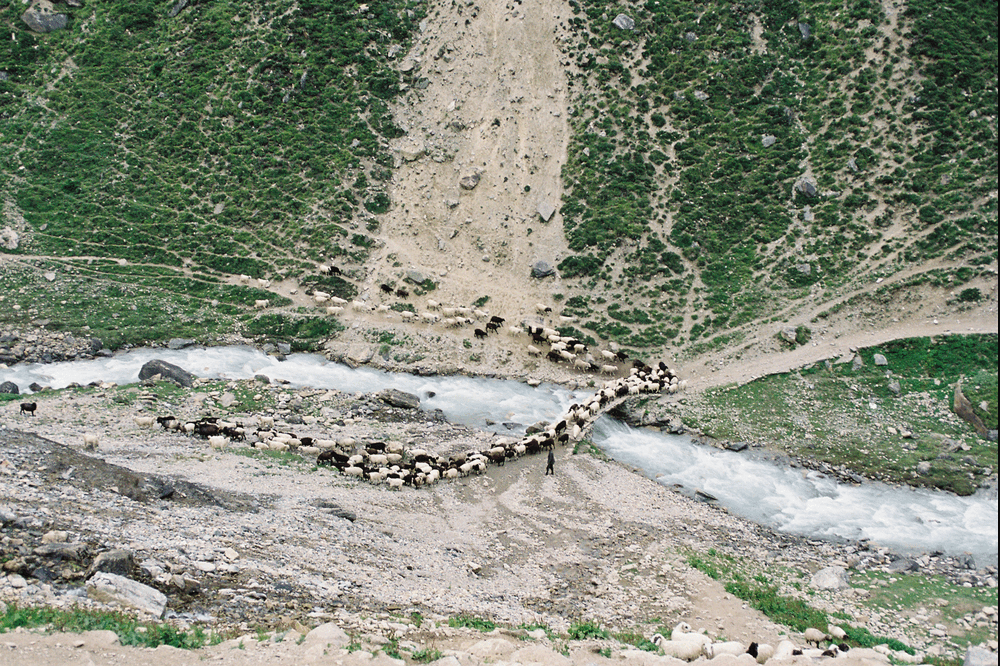
Tinker tumbles down as if he is tired of seeing the high mountains stretching east-west. Leaving the flock of sheep in the pasture, he has to dig his way blocked by landslides.
As Tinker descends, the sky he sees narrows and the landslide-damaged wings grow. Water is added to the Tinker river . And Tinker sees a village with his own name far above the path he walked. For the first time it gets to associate with a permanent human settlement . Previously, he had only seen temporary sheepfolds and sheep.
No meat on nails, no village on tinker .
After a short walk through an open space and a narrow passage, Tinker arrives at a wide area . By the time you meet a large leafy tree like Bhojapatra, its edge has widened. And after cutting Changru, a village on the banks of the Kali River, it flows into the Kali River flowing from the west.
Kali's journey should start from that source, but it is only under the control of Nepali on the map. That is why this journey had to be started with tinkering on how to describe Kali who walked in a place where he could not plow and roam.
In this border dispute of Kali-Udgam, the Indians say, "The place claimed by Nepal has already been taken by the White Sabs". The Saabs also had their eyes on Changru village.'
As we Nepalis say, the world has gone on in the way of keeping an eye on the territory of another country. There are some ways to make such land 'own' - to defeat the owner of that land by fighting, by some means to please, deceive, threaten or create such a situation to make the land surrender to him.
These areas of Kaliwari and Parika were taken by Nepal after defeating the rich people of those areas in a battle. The British did the same to Nepal. Jung Bahadur deceived the British and took Madhesh of Rapti-Kali. Before the British and later India took the land east of the Mahakali of Tanakpur and made Nepal well. However, when occupying a place with these measures, either the owner of that place was killed or a resignation letter was made saying "I gave the land to you with my pleasure" even if he did not agree. Sugauli Treaty, Sharada Treaty, Tanakpur Treaty are such documents .
If you like Kali's head, show the same paper or .
By letting people stop doing such disputes, or by pretending not to know that there is a dispute, or by thinking that such disputes are children's futile quarrels, Kali keeps coming down .
Leaving these two villages of the Shauka tribe, Changru and Tinker, and moving forward on the slopes, it walks with black and white foam. Motorway to India arrived via
. The road is creeping towards Nepal. How powerful is the landslide here, 27 years ago, a landslide in Malpa village buried 200 people in one grave. When you see the landslides on both sides of Kali, it seems that people have made a wish to build a road in such places in vain.
The road here does not get damaged in the rains, it flows without stopping.
Black water of Kali Ganga, Black water of Kali Ganga
Kalo Kalo Chailo Chailo, Kalo Kalo Chailo Chailo .
Yo Junyali night, Hi Junyali night
Nakhme ki phuli sua panchhi bun udayolo, night yo Junyali ..
(Meaning: How black-black, blurry-blurry it looks when the water of the Kali Ganga falls down on this June night. How beautiful the flower in your nose looks.)
This Kumauni song shows that even to describe the appearance of his beloved, the people here should not be without the Kali river.
Sometimes Kali expresses her anger by cutting Dharchula and Dharchula sitting on her right and left.
A little further down at Jauljivi, the Gori river coming from the west meets the Kali river coming from the north . Gori leaves the name . The Dhauli (Seti) river, which jumped into Kali a little higher up, did the same .
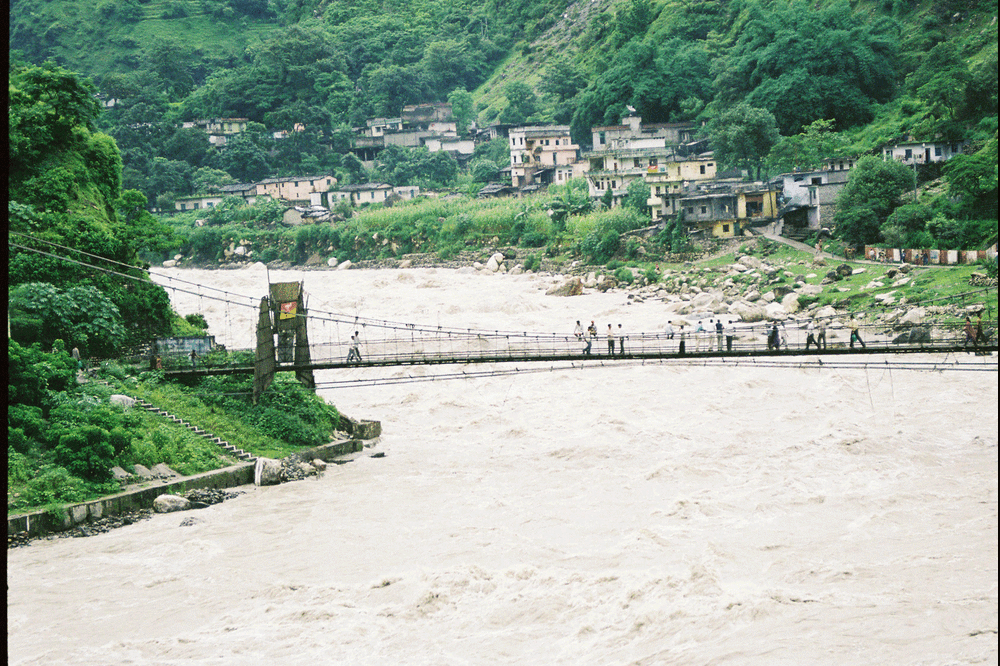
For others, Kali separates (the two countries) but in the opinion of the people here, it is a river that unites them. Jauljeevi means a place to meet, i.e. a place of union. It is not only a river crossing, it is also a place to meet the language, culture and people of the two countries . In the annual fair held here, the Kumaoni of Kali Wariparika Pakha and the Nepalese dance together and rejoice in the songs of both these languages.
Jouljeeviner lives in a forest surrounded by Kali . They make wooden vessels, collect honey and fish. However, in the census of Nepal, foresters are not seen in that place .
Chamelia or Chaulani (like white) river from the east enters Kali. Its head is Satlek, the watershed of Bajhang and Darchula. The water of the west side of that lake falls and splashes some part of Baitadi and merges into Chaulani river coming through Api Himal and Khandeshwari Lake. It has brought with it the juice of herbs, the hum of bees making honey and the irresistible excitement of a steep river.
Khandeshwari Patan comes to West Darchula from its source Satlek. Valuable herbs like yarchagumbu, jatamsi, forest garlic, kutki are found in the lake above 3,500 meters. A little taltir gucci mushroom, satuwa, setakchini, dalechuk etc .
The Lekalis leave their homes and go to the lake from the end of Baisakh to June to look for Yarchagumbu. It is said that this one herb sustains the inhabitants of the Himalayas for half a year.
The nearest village from Khandeshwari is Chheti . There is a saying - there is no meat on the nail, no village on the seti .
Going down the bank from Latinath along the banks of Chaulani, you will find the sugarcane village . Sugarcane is abundant here. Eating one sugarcane and walking with another sugarcane, some people get relief from hunger and thirst. This place is very fertile for ritha and chiuri . Honey will be made after it has been plucked . It has been some time since Rittha reached the international market via Kathmandu.
is a good way to bring money from the city to the village - trade in herbs, rittha, chiuri and honey. But, in turn, the government took revenue from the lottery. In this way, the opportunity to work abroad opened up when the people here were frustrated about who to fight with and how often. After that many went abroad . Farmers are decreasing due to difficult policies and regulations.
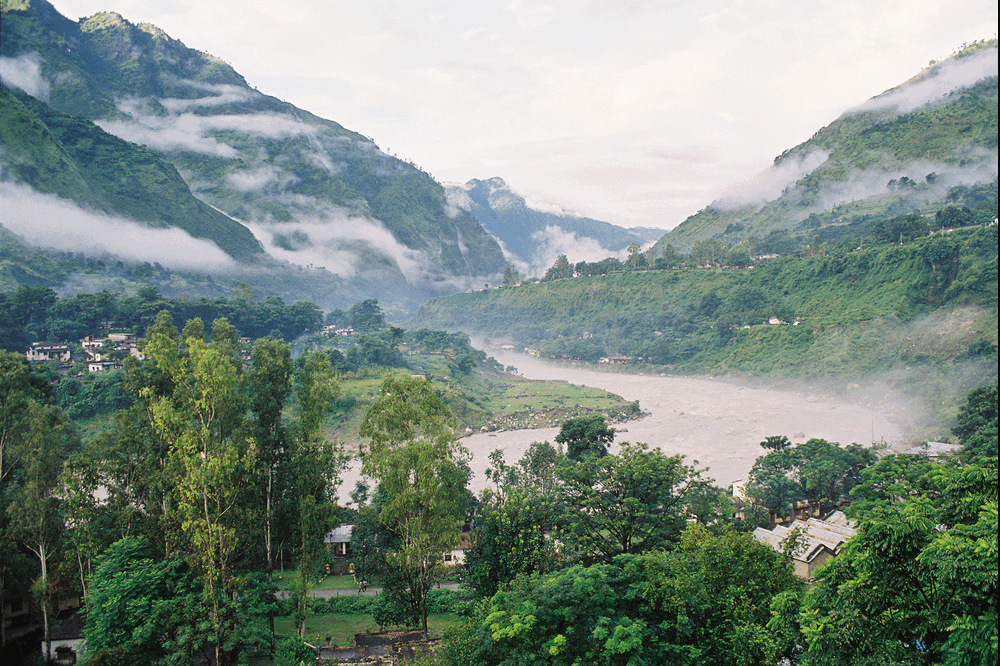
The grief of Mahakalipari is the same. That is why the people of the other side made such a statement - the water of the mountains and the youth of the mountains are never useful for the mountains. Modi, the Prime Minister of India mixed this statement in his speech and received the applause of Nepalese people a few years ago.
When reaching Chamelia, three sets have joined together and added the power of Kali . Here or wherever, if you pick up the Kali water in Anjuli, you will find two types of water in Kali - the water that comes from the Arabian Sea in the winter as snow or rain and the water that falls from the Bay of Bengal in the winter. However, these two types of water are mixed in such a way that our eyes do not know that they are of two types. Humans are the only ones with low moods.
Ironically, after going through many twists and turns and arriving at Taltir, it seems that Nepal and India agreed to use water and electricity to lock up Kali in Pancheswar. However, their meeting is not for work but for talking. To be a
er, it has been good not to have such a job - I don't have to be tied up with black, locked up and put in an electric machine .
But, as soon as Madhesh fell from the mountain, Kali was tied up 100 years ago. The British took the water to the west by returning its plates. At that time, they thought that Nepal has no right to this river. It was not at all difficult for Saab, the Chief Engineer of Nepal, to claim a small amount of water. Nepal gave four thousand acres of land to India and here Nepal's border moved east from Kali river.
Chandrashamsher lost the land brought by Jung Bahadur.
About 60 years after the English imprisoned Kali, his successor dammed the river in the same way, a little higher than the place where Kali was imprisoned by the British, just before Brahmadev Mandi. Even at that time, they continued the work quietly by insisting that the Nepalese do not have the right to this river. Later, Nepal had to suffer a lot to claim its rights. Even now, Nepal has lost some land .
The Nepalese moved four steps ahead of the Indians to conclude the Mahakali Treaty, which benefited India more than that.
After going down from Gaddachouki, the border posts moved to Kalipari . When the border of Nepal reached Kali from the Rapti River after getting a new country, there were two streams of Kali below the present Gaddachouki. A small stream flowed from the east. A large current from the west . Therefore, Nepal and British India considered the western edge as the Kali river.
It may be due to the pain of having to flow in the mountains, after falling in Madhesh, the Kali river flows with excitement . Sometimes right and sometimes left . When Kali reached the border of Nepal in Madhesh, in the following 165 years, a large stream of Kali moved eastward. Nepali villages like Dodhara and Chandni reached across Kali's water. The rest of the people had reason to say – Kalipari is also Nepal.
After crossing the Dodhara and completing the western border of Nepal, the Kali flows back to the east. Since we had been walking along the border till now, we could understand and speak a little Hindi. So we answered the question from a popular line in Hindi/Urdu literature:
Yeh lautenge kab tak, kahan ja rahe hain ? (Where are you going and when will you return?)
A voice came from the river:
Here is the punishment of life/Jahan se chale then wahi raha hoon . (i.e. cutting here the sentence of life/walked where I was there before .)
understood, it is going to where it came from i.e. to the Bay of Bengal and the Arabian Sea . What he did not tell us, but what we know, is that Kali, walking on foot during the Undhauli journey, rests for a while and, clothed in clouds in winter, parachutes from the Arabian Sea and from the Bay of Bengal in winter, parachutes around Lipulek, Tinker, and Satlek, and disperses in the hills . And slowly it gathers again and goes towards the sea. Because if he does not do this, the creation will be sterile .

