In our river system, the dignity and glory of Kaligandaki is unique. The Kaligandaki flowing from the Tibetan border does not just touch the sea. By flowing, it prevents the mid-terai from drying up, it makes it easier for the millions of lives in the coastal region that depend on it to live.
We use Google Cloud Translation Services. Google requires we provide the following disclaimer relating to use of this service:
This service may contain translations powered by Google. Google disclaims all warranties related to the translations, expressed or implied, including any warranties of accuracy, reliability, and any implied warranties of merchantability, fitness for a particular purpose, and noninfringement.
One of the best river systems in the world's river civilization is the Gandaki. Known as Saptagandaki, Kaligandaki, Sri Krishna-Gandaki, this river has been flowing from the Tibetan plateau. Gandaki originates from the fusion of the Nupchu River on the west side of the Tibetan Plateau and the Sarchu River on the east side.
The 814 km long Kaligandaki river with mythological, historical and cultural significance is also a religious area of Vedic Sanatani . This river is of special importance due to its biological diversity and life-giving power . There are hundreds of settlements and dhams in the coastal area of this river. In mythological texts, Lord Vishnu is considered as Shaligram . This river area is considered sacred for daily bathing, worship, cremation, tarpan and shraddha.
It is believed to be one of the most sacred rivers mentioned in ancient scriptures and revered by Hindu and Buddhist communities alike. This river is not only the mother of civilization, but also life. Various cultures within the Gandak civilization, beliefs and lives of the people of Gandaki province are connected with the 'Kaligandaki River'.
However, some destructive projects have been carried out in such an important river, which has threatened 300 lakes, 30 species of insects, 110 species of birds and other biological life found in the Kaligandaki river basin. Can we silently tolerate this serious crime against nature and human civilization in the name of hydropower production and development? This is a serious question for future generations.
Kaligandaki River System
According to the geographical layout, this river flows from the Himalayas and descends through narrow gorges in the mountains and spreads to the plains. In the river system of Nepal, the dignity and glory of Kaligandaki river is special and magnificent. Kaligandaki flowing from the border of Tibet does not just touch the sea . It is the responsibility of Kaligandaki to balance the environment of the lower coastal area while it is flowing, to save the middle-terai from drying up, and to facilitate the living of millions of lives in the coastal area who have been living in Kaligandaki for thousands of years .
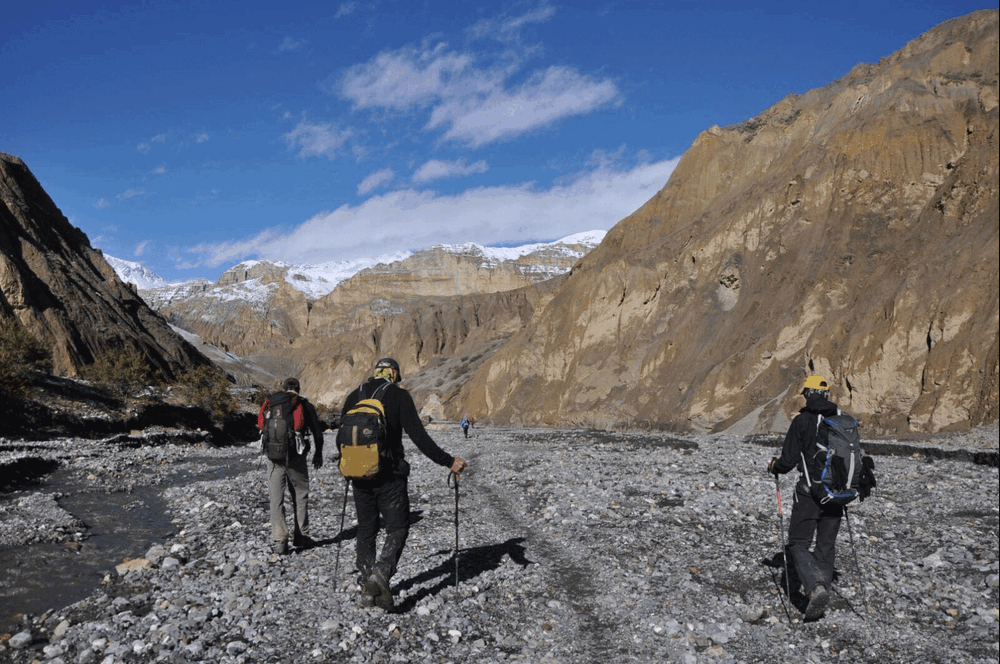
'Kaligandaki Trade Route' has been established as a commercial center since ancient times. This route is also popular for going to Muktinath and Jomsom. It is also a famous trade corridor for the Thakkhola 'Salt Route'. This route is also known as the main route to vote. After the construction of the Kaligand corridor road, a 9434 km road connecting Sunauli to China will also be constructed.
The development of human civilization in the world started from the banks of big rivers. Be it Trigis and Euphrates around Iran or Huang-Ho in China or Indus Valley in Pakistan, the civilization started from the river. In the same way, 'Kaligandki Civilization' is an old civilization of Nepal, which is connected with Aryan culture and Vedic civilization.
In the catchment area of Kaligandaki, there are three Himalayan mountain ranges above 8,000 meters, Dhawalagiri, Annapurna and Manaslu, and there are more than two dozen snow peaks from 8,000 to 6,000 meters . There are 10 districts in the catchment area of Kaligandaki namely Mustang, Myagdi, Parbat, Baglung, Syangja, Gulmi, Palpa, Tanahun, West Nawalparasi and East Nawalparasi. The 6 main tributaries of Kaligandaki, also known as Saptagandaki river system, include Trishuli, Budhigandaki, Marsyangdi, Madi, Seti and Daraundi .
More than 1.5 million people live in the coastal area of this river. 814 km in length and about 500 km in Nepal and 300 km through India to reach the Ganges and reach the Bay of Bengal at Kaligand.
Kaligandaki River is considered to be the largest among the three main river systems of Nepal. The world's deepest (2520 meters) Rupse Andhgalchi is also located here. It has many fields of scientific and economic studies as it is also a very large mining area of big rocks, Gegran, sandy soil, concrete, sand. Many coastal areas have various dhams, ghats and shrines. The Kaligand civilization, which is connected with Arya culture and Vedic civilization, is a very old civilization of Nepal. Its intoxication is directly connected with the Vedic period and the ecological system .
The religious glory of Kaligandaki and Shaalgram Shila
All the stones found in the sanctum sanctorum of the Kaligandaki river are Shalagram Shila . Shalagram is the main rock that has unique characteristics and abilities than the rocks found in the world community. According to the Puranas, those who believe that meeting the current human being with the Shalagrama is also meaningful, consider it a remnant of the beginning of the marine life lineage .
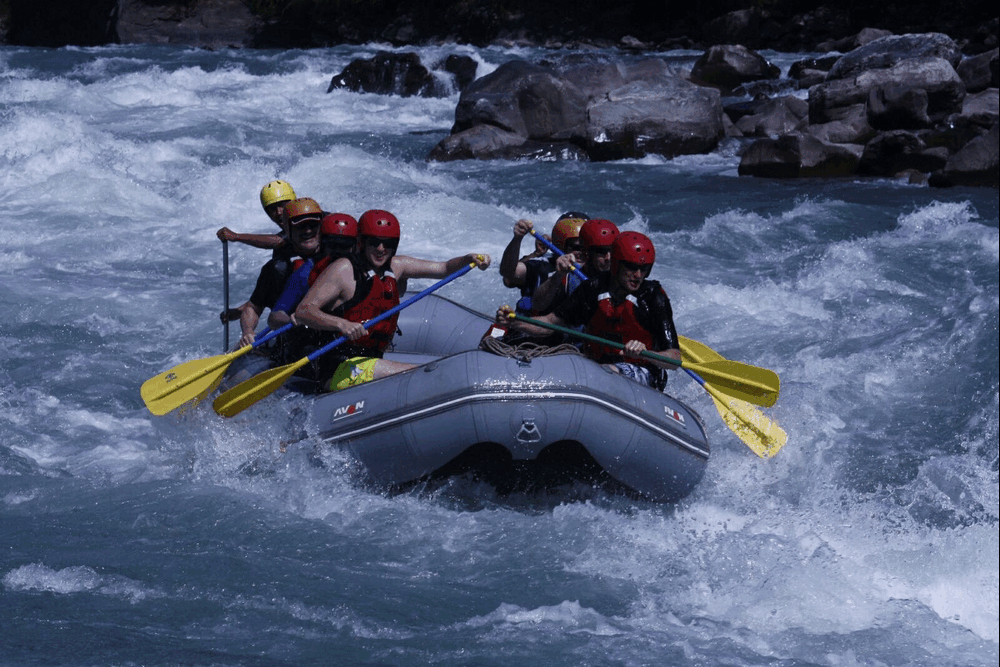
In the year 1988, Dollhouse University researched and published the report 'Gradstein et al - 1980' that the fossils found in Shaligram belong to dinosaurs - those animals that have disappeared in the past. It is estimated that the practice of worshiping Shaligram as an archavatar has been going on for about 2000 years. Jagdishchandra Regmi is . Sufficient grounds have been prepared to prove that the Himalayas are older than the written Vedas, the Puranas, Kaligandaki is older than the Himalayas, and Shaalgram is older than Kaligandaki. These Shalagram rocks have been converted into gravel and bran at the price of Kaudi.
Illegal Exploitation and Diversion of Kaligandaki
Interest groups are running the crusher industry in Kaligandaki. This heritage is a crime against civilisation. They have not set any criteria for environmental impact assessment. The entire river has been occupied by one person's selfishness and bullying. The local level is also doing vertical interference by making contracts and doing arbitrary things. What kind of development and prosperity will we give to tomorrow's generation by massaging nature, tradition, wealth, and civilization?
The watershed of Gandaki, the supreme river worshiped by Vedic orthodoxy, has faced many global crises. The life, water and land life here is at the threshold of crisis. They have been grossly exploited. Infrastructure is needed for development, there is no dispute about that. But, how to structure ? How to manage environmental, climate, soil and human resources security measures? How to find the source of construction materials? That is important . We have a lack of clarity and a crisis of confidence about the river system. There is a lack of environmental thinking .
According to the geographical layout of Kaligandaki, this river descends from a narrow gorge in the mountains and spreads in the plains . Rivers tend to find their way. Dams damage the traditional economy based on biology, society, environment, water culture and all. Why is the river encroached without leaving its natural form? Who benefits from this? The world-famous week-day 'Kaligandaki Jalayatra' has been completely replaced.
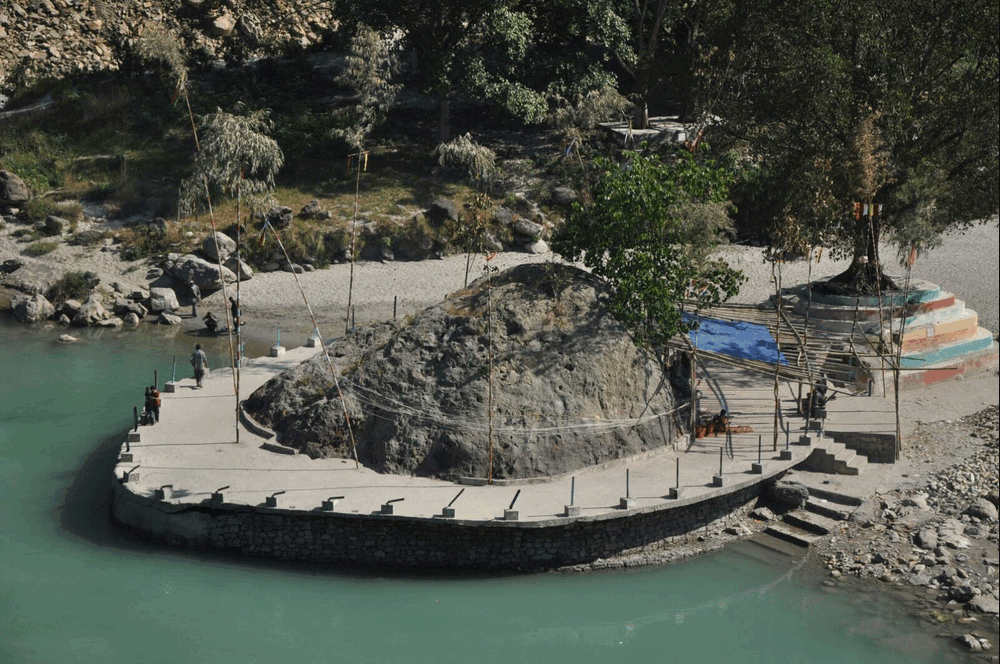
We have not been able to pay enough attention in the areas of development, conservation, environmental crisis, loss of biological diversity, extinction of aquatic species, appropriate use and sustainability . The river system is disturbed by twofold . Talking about the watershed area, we are in the process of clearing the watershed area of Gandaki river system which has 1002 glaciers. Art-culture, civilization, dignity, sacred places in Gounda Gounda are disappearing . Rivers are resources, which local rulers have no idea how to use.
Recently, the decision of the Supreme Court regarding the cancellation of the writ against the government's decision to divert the water of the Kaligandaki river under the Kaligandaki-Tinau Diversion multi-purpose project is very regrettable . Construction permission and environmental impact assessment report for Kaligandaki diversion are not available yet . In this way, the government's intervention in the project without preparation and assessment has raised serious questions about the long-term rights and future existence of the life of the Kaligandaki River and its surrounding areas.
In a large section of the Kaligand civilization, activities are being done that are causing a crisis in biological diversity, severely affecting the livelihood and culture of various communities . This will eventually lead to water crisis over large areas and destruction of heritage areas, which will cause a serious crisis in the lives of the entire river system and the communities that depend on it .
Neglecting such a serious issue and advancing various projects to divert the entire river to the other side is a game against the faith and culture of the people of Gandaki. Not only this, but we have forgotten the fact that it is an attack on the livelihood of millions of people from dozens of communities including Athar Magarat, Majhi, Bote, Tharu, Dhimal and others dependent on this river .
Kaligandaki culture, civilization and conservation debate
The river's natural resources are basically stones, rocks, gravel, sand, and the Kaligandaki river is becoming degraded due to over-exploitation. Indiscriminate mining on the river, dumping of excreta, garbage, direct mixing of sewage, encroachment of public land, deforestation and illegal smuggling of sand smugglers are increasing year by year . The river is dying day by day due to hundreds of open crusher industries. No one has paid attention to this .
Along with the exploitation of Kaligandaki, the nearby Kholsakholsi, Forest, Chaur, Dhiskadhiski, heritage areas and public school areas etc. have also been exploited under the Kaligandaki corridor. Everywhere the hills and mountains have become deformed . A policy for the environment and protection of Kaligandaki could not be made on behalf of the general citizen level and political parties, the principle of politics could not be formed, there was no one to listen to the screams of Kali . Kaligandaki never became a national core issue .
Don't run the watershed of Kaligandaki
Environment doesn't mean only human life . Since water, land, air, fire, sky are directly connected to these five elements, the environment, i.e. the all-round cover, is more important for the ecological balance of the earth than for us. Therefore, it is an urgent need to choose environment before choosing development.
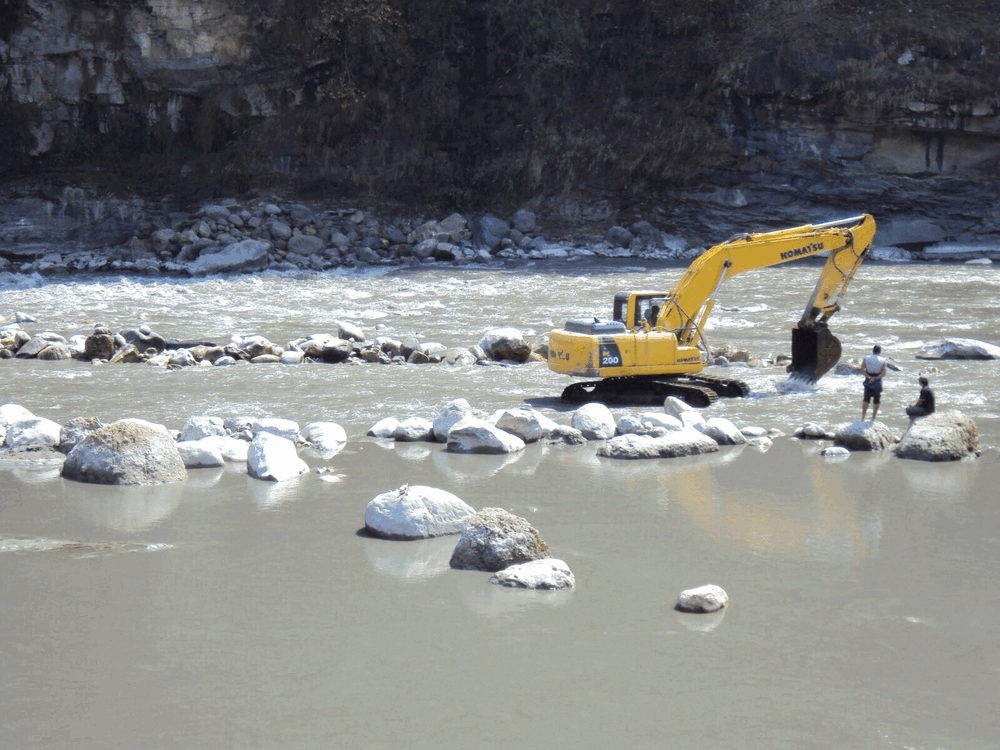
Kaligandaki's legendary glory and the glorious history associated with human civilization are being destroyed and the state should strictly control activities like indiscriminate exploitation and diversion of its natural course, construction of dams .
Today, more than a hundred crushers are running legally and illegally in the flow area of Kaligand. There are more than three hundred rotating industries. The unregistered crusher industry has been mining, processing and crushing river materials. These crusher industries are not even in the records of the Internal Revenue Office . This shows - how tight is the net of exploitation of Kaligand ?
Kaligand's river exploitation, diversion, the special reality inside the dam and the civilization of Kaligand and the local people's life have been spread. There is a lack of clarity and a crisis of confidence in the public about this river system. Therefore, the people of the coastal region are living in a false psychology .
If there is still no conscious and honest initiative in the conservation of Kaligand, we will be too late . The campaign we have started to save Kaligandaki from the existential crisis is to be shared by all. Kaligandaki river is the source of our life . Let the people understand the eternal importance of the river. And, let's all raise our voice for its protection . Let's save the civilization of Kaligand .

